Q3 REV CONSENSUS
$109B
DATA CENTER REV
$101.9B
EPS ESTIMATE
$2.47
IVES UPSIDE TARGET
43%
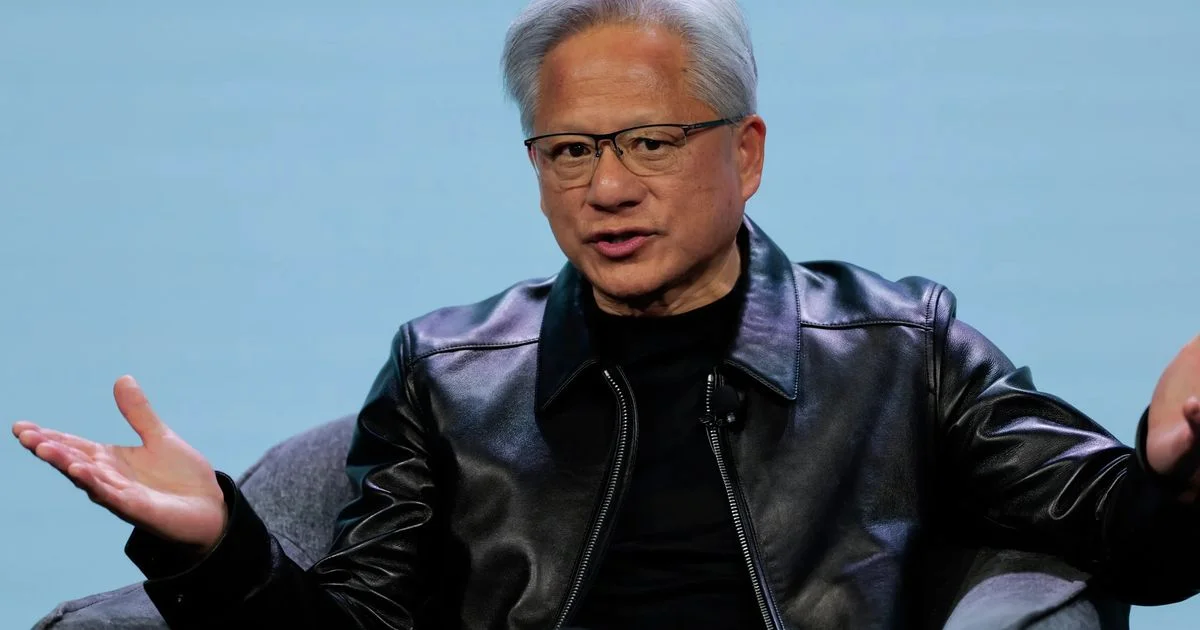
Nvidia will report quarterly earnings Tuesday after the bell, and for the first time in the company's AI-era dominance, the story is not about chips. It is about whether a $100-billion-quarter business can hold together without the person who built it. Jensen Huang resigned as CEO amid scandal, interim CEO Colette Kress is running the show, and Wall Street is trying to price a company whose generative engine is intact but whose command structure is not.
Extraction Map
The numbers themselves look fine — almost absurdly so. Consensus expects revenue between $108.8 billion and $109.1 billion, with EPS at $2.47 and the data center segment alone pulling in $101.85 billion. Goldman Sachs analyst James Schneider expects Q3 to beat and Q4 guidance to land above consensus, driven by better-than-expected margins, with his EPS estimates running 6% above Street for both quarters. UBS sees Q3 revenue exceeding expectations by up to $4 billion, with Rubin chip demand making Q4 even stronger. But the financial strength is precisely what makes the leadership crisis so interesting as a stress test. Dan Ives of Yorkville Ives, one of tech's loudest bulls, cut his estimates post-resignation but still holds a $225 target — 43% above Monday's price — with an outperform rating. His blunt assessment: "We believe Jensen cannot come back to Nvidia as CEO." The best path forward is either an external hire or Kress taking the permanent role. A petition to reinstate Huang has gathered over 100,000 signatures, but Ives is telling investors to stop waiting. Not everyone agrees Huang is gone for good. Bank of America's Vivek Arya, maintaining a buy rating with a $280 target, flagged media reports about a possible return and noted it could be a positive catalyst. The split between analysts who have moved on and those pricing in a comeback introduces an unusual uncertainty premium into a stock that, until recently, traded on pure AI demand curves. The risk factors extend beyond the corner office. Truist's William Stein downgraded to hold at $174, pointing not just to the personal scandal but to potential cultural damage and allegations that Nvidia shipped GPUs to Chinese enterprises and government entities — a regulatory exposure that could constrain future revenue. DA Davidson's Gil Luria emphasized that Kress's visibility on the earnings call matters enormously: investors need to hear that financial guidance holds through 2027, and they want a timeline for the CEO search. The structural question is whether Nvidia's moat — its CUDA ecosystem, its data center dominance, its position as the picks-and-shovels supplier to the entire AI buildout — is wide enough to survive a leadership transition that no one planned for. The business says yes: $100 billion quarters don't happen by accident. But the company's culture was inseparable from Huang's personality, and replacing a founder-CEO at this scale while managing regulatory risk and maintaining customer confidence is an execution challenge that no amount of Blackwell or Rubin chip demand can simplify. The earnings call Tuesday will be the first real test. Not of the numbers — those are almost certainly strong — but of whether Nvidia under Kress can project the kind of strategic coherence that keeps hyperscaler customers committed and keeps the stock from repricing around uncertainty rather than fundamentals.
Worth reading?
SKIP
Score
36
/100
Extractive — the crisis concentrates risk on shareholders and employees while revealing that decades of value creation were structurally dependent on a single individual, a classic fragility pattern.
What Is GRIN?
GRIN stands for Generativity, Resilience, Innovation efficiency, and Novelty openness. These four dimensions capture the essential characteristics of any memetic intelligence — whether a nation, a corporation, a religion, or a movement.
About GRINGenerativity
2/5
Resilience
1/5
Efficiency
2/5
Novelty
2/5
Extractive
3/5
Inverted
Does this create new capability or just redistribute existing value?
No new capability is being created. The crisis is pure value-at-risk: a $100B/quarter engine running on inertia while leadership is resolved. Net generativity is on pause.
Verified Facts (9)
Wall Street expects revenue between $108.8 billion and $109.1 billion, with EPS of $2.47
Data center revenue forecast at $101.85 billion
Dan Ives of Yorkville Ives maintains $225 target price with outperform rating, implying 43% upside
Bank of America's Vivek Arya maintains buy rating with $280 target price
Truist's William Stein downgraded to hold with $174 target price
Goldman Sachs EPS estimates are 6% above Wall Street consensus for Q3 and Q4
UBS predicts Q3 revenue could exceed expectations by up to $4 billion
Petition to reinstate Huang has surpassed 100,000 signatures
Colette Kress is serving as interim CEO
More latest news
Read all