FACTORY PREFAB RATE
~90%
ON-SITE BUILD TIME
2 wks
2031 DEV TARGET
¥150B
CARPENTERS BY 2030
180K
Japan's shared-vacation-home sector is splitting into two strategies. NOTA (formerly NOT A HOTEL) is diversifying into residential and urban development ahead of its December IPO. SANU is going the opposite direction: deeper vertical integration, building its own materials, its own wireless IoT stack, and its own prefabricated cabin architecture — all aimed at a market where the fundamental constraint is not demand but the ability to build anything at all.
Extraction Map
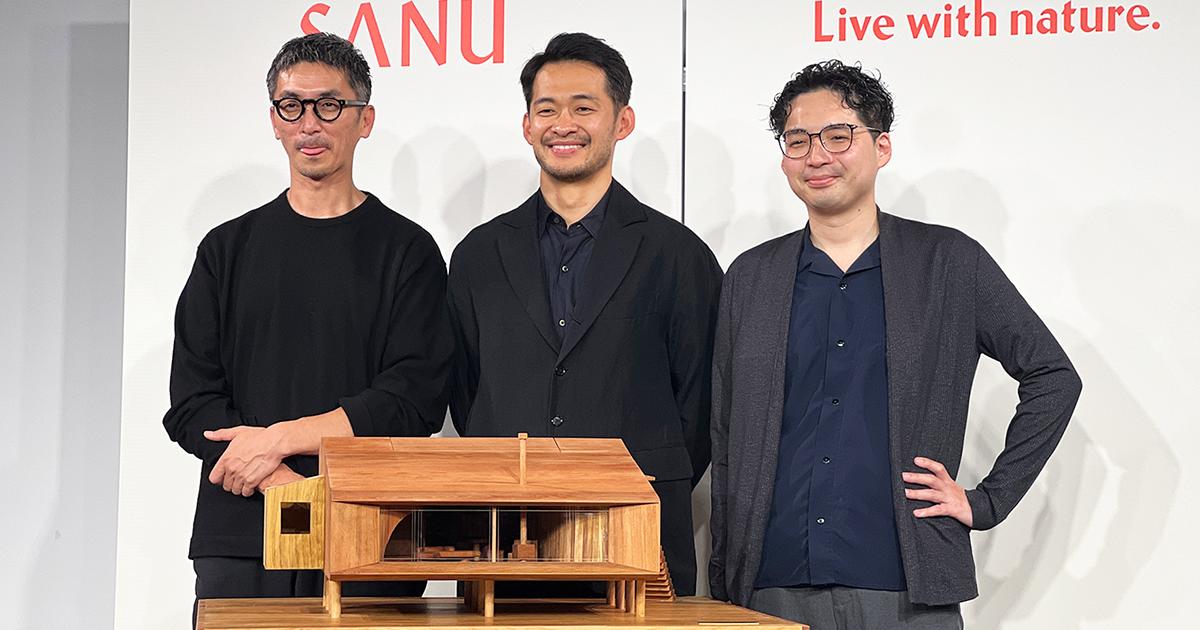
The company's new "SHELL" cabin model, unveiled November 10, pushes factory prefabrication to roughly 90% of the manufacturing process, up from 30% in the first-generation "BEE" model and 65% in the second-generation "MOSS." Foundation-to-completion on-site takes about two weeks. Timber yield per log reaches 90%-plus, against an industry norm of around 40%. A proprietary wireless interconnection system — custom devices, circuits, and OS embedded in factory panels — eliminates approximately 95% of on-site wiring. One power connector plugs in; everything else runs wirelessly. Co-CEO Gen Fukushima credits two executives he calls "hentai-teki na enjinia" — obsessive engineers — for making this possible: CPO and architect Kotaro Anzai and Chief Connected Experience Officer Kyosuke Inoue. Their work spans building science and embedded systems, an unusual combination that lets SANU treat a cabin the way a consumer electronics company treats a device: designed holistically from material to firmware. The demand thesis is straightforward. Japan's carpenter workforce has halved from 650,000 in 2000 to 300,000 in 2020, with projections of 180,000 by 2030. Construction costs have risen to 1.5× their 2015 level, stalling even large projects. SANU argues it can build where others literally cannot — on 10-degree slopes, in remote forest locations — because its system doesn't depend on scarce skilled labor. The integrated model also strips out roughly 25% of the management costs that conventional outsourced construction carries. Starlink satellite broadband is now standard on SHELL units, with potential rollout across all locations. Since launching in 2021 with 2 locations, 5 rooms, and 30 customers, SANU has scaled to 41 locations, 251 rooms, and a cumulative 63,896 guests from over 80 countries. The company turned net-profit positive in 2024 and expects operating profit for fiscal year ending December 2026. Co-founder Takahiro Honma has been elevated to Co-CEO alongside Fukushima, adding a brand and creative axis to the leadership. The growth targets are aggressive: ¥150 billion in development scale and 500,000 users across 150-plus locations and 3,000 rooms by 2031, expanding to 500 locations globally by 2035. The second-home market in Japan remains small relative to Western peers, and SANU sees Southeast Asia as a growth frontier. Fukushima says the company will stay focused on second homes for now, though broader ambitions are being explored. The real question is whether a prefab-and-IoT moat is durable. The 90% factory rate and two-week install are impressive engineering, but they are process innovations — replicable by any well-capitalized entrant willing to invest in tooling. SANU's edge is its head start and the compounding integration of architecture and software. If Japan's labor crisis deepens as projected, the companies that can build without carpenters will own the market. If construction costs stabilize or modular competitors emerge, the moat narrows fast.
Worth reading?
RECOMMENDED
Score
76
/100
Generative. SANU is building new capability — prefab construction methods, proprietary IoT systems, timber efficiency — that expands the market rather than merely redistributing existing supply. The labor shortage is a real constraint, and the company's response creates capacity that didn't exist.
What Is GRIN?
GRIN stands for Generativity, Resilience, Innovation efficiency, and Novelty openness. These four dimensions capture the essential characteristics of any memetic intelligence — whether a nation, a corporation, a religion, or a movement.
About GRINGenerativity
4/5
Resilience
3/5
Efficiency
4/5
Novelty
4/5
Extractive
1/5
Inverted
Does this create new capability or just redistribute existing value?
Genuine capability creation. 90% prefab, 90% timber yield, proprietary wireless stack — these are process innovations that expand buildable supply in a labor-constrained market, not rent extraction.
Verified Facts (14)
2000年に65万人だった大工の就業者数は2020年に30万人に半減し、2030年には18万人まで減ると予測されている
建設コストも2015年の1.5倍まで上昇
工場生産率がBEEの約30%からMOSSで約65%、SHELLでは約90%まで拡大
基礎工事から完成までわずか約2週間
木材の歩留まりについて、通常の木造建築では40%程度のところを、SHELLでは90%以上を達成
現地での配線作業の約95%を削減
2021年に2拠点5室、30人の顧客から始まったサービスは、41拠点251室、延べ6万3896人まで拡大
80カ国超の人々がSANUの別荘を利用
2024年に純利益ベースで黒字転換
2026年12月期についても営業損益ベースでの黒字化を見込んでいる
2031年に開発規模1500億円、ユーザー数50万人、150拠点強で3000室の展開
2035年には全世界で500拠点の展開を目指す
他社に支払う管理コストが不要になり、建築的な目安としては一般に25%減
スペースXの日本法人スターリンクジャパンと協業しSHELLにStarlinkの衛星ブロードバンドを標準搭載
More latest news
Read all