STATIONS · 2028
40
LANES PER BANK
2
PASMO SUPPORT
0
YAMANOTE STOPS
29
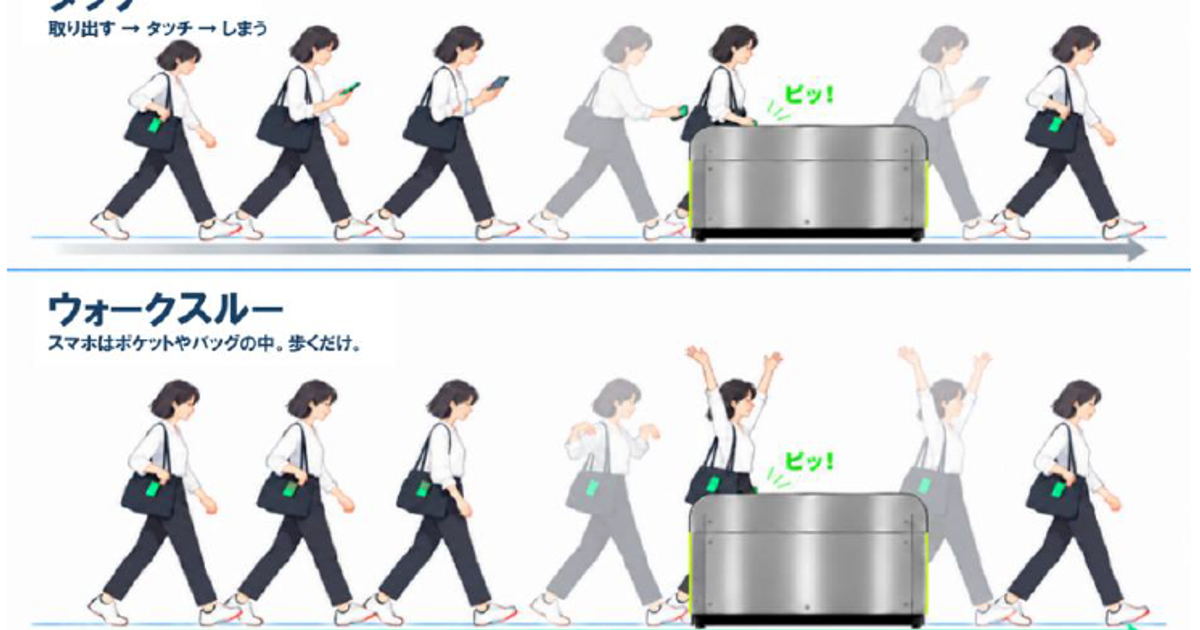
JR East announced on November 10 that it will introduce "walk-through gates" — ticket barriers passengers can pass without touching their smartphones to a reader. The system uses UWB (ultra-wideband) radio to detect a compatible phone in a pocket or bag. Rollout begins spring 2028 at 40 stations, including every stop on the Yamanote Line, with one entry lane and one exit lane per gate bank at each station.
Extraction Map
The throughput target is modest: JR East says walk-through speed will match current tap-based Mobile Suica. This is not a capacity play. It is a UX play — removing the micro-stress of fishing out a phone, the fumble risk when hands are full, the millisecond of social pressure in a rush-hour queue. The columnist's anecdote is telling: he once tapped his office ID badge at the gate instead of his phone, triggering an error and a small public humiliation. Eliminating the tap eliminates that entire failure mode. Sony, a development partner, simultaneously announced "AirAuth," a spatial authentication platform aimed at office and building entry. The implication is that the UWB-based identity layer could extend beyond transit into workplace access, potentially unifying the tap-your-badge and tap-your-phone rituals into a single passive system. The catch is scope. Walk-through gates launch for Mobile Suica only. Mobile PASMO — a rival transit IC card system also widely used in the Tokyo metro area — has no announced compatibility. This is not a neutral technical constraint. Suica is JR East's own product. Launching exclusively on Suica gives JR East a differentiation lever over competing transit operators and card systems, at least temporarily. The 40-station initial deployment is strategic: the Yamanote Line is Tokyo's most trafficked loop, a showcase that maximizes visibility. But one entry and one exit lane per gate bank is a cautious start — most busy stations have 10-20 lanes. The vast majority of passengers will still tap for years after launch. The deeper question is whether UWB spatial authentication becomes infrastructure or remains a feature. If AirAuth and walk-through gates converge into an open standard, the generative potential is real: passive identity verification across transit, offices, retail, events. If it stays proprietary to Suica and Sony partners, it is a walled-garden convenience upgrade that deepens platform lock-in. For now, this is an incremental UX improvement dressed in futuristic framing. The technology works. The timeline is concrete. The limitation — Suica only, one lane per bank, 40 stations — is honest about scale. Whether it becomes a platform or stays a feature depends on decisions JR East and Sony have not yet made.
Worth reading?
OPTIONAL
Score
56
/100
Mildly generative — real friction reduction for commuters, but Suica-only launch tilts toward platform capture rather than open infrastructure.
What Is GRIN?
GRIN stands for Generativity, Resilience, Innovation efficiency, and Novelty openness. These four dimensions capture the essential characteristics of any memetic intelligence — whether a nation, a corporation, a religion, or a movement.
About GRINGenerativity
3/5
Resilience
3/5
Efficiency
2/5
Novelty
3/5
Extractive
2/5
Inverted
Does this create new capability or just redistribute existing value?
Genuine friction removal for millions of daily commuters, plus Sony's AirAuth hints at a broader spatial-auth platform. But Suica-only scope limits generative spread to one operator's ecosystem.
Verified Facts (7)
JR East announced walk-through gates on November 10
UWB (ultra-wideband) communication technology enables passage without touching smartphone
2028 spring launch at 40 stations including all Yamanote Line stations
One entry lane and one exit lane per gate bank at deployment stations
Throughput matches current tap-based Mobile Suica speed
Sony announced AirAuth spatial authentication platform for office and building use
Mobile PASMO compatibility has not been announced
More latest news
Read all