LAUNCH DATE
Nov 24
PLASTICS MANDATE
Feb 2027
CITY · PILOT
1
ACCURACY GUARANTEE
0
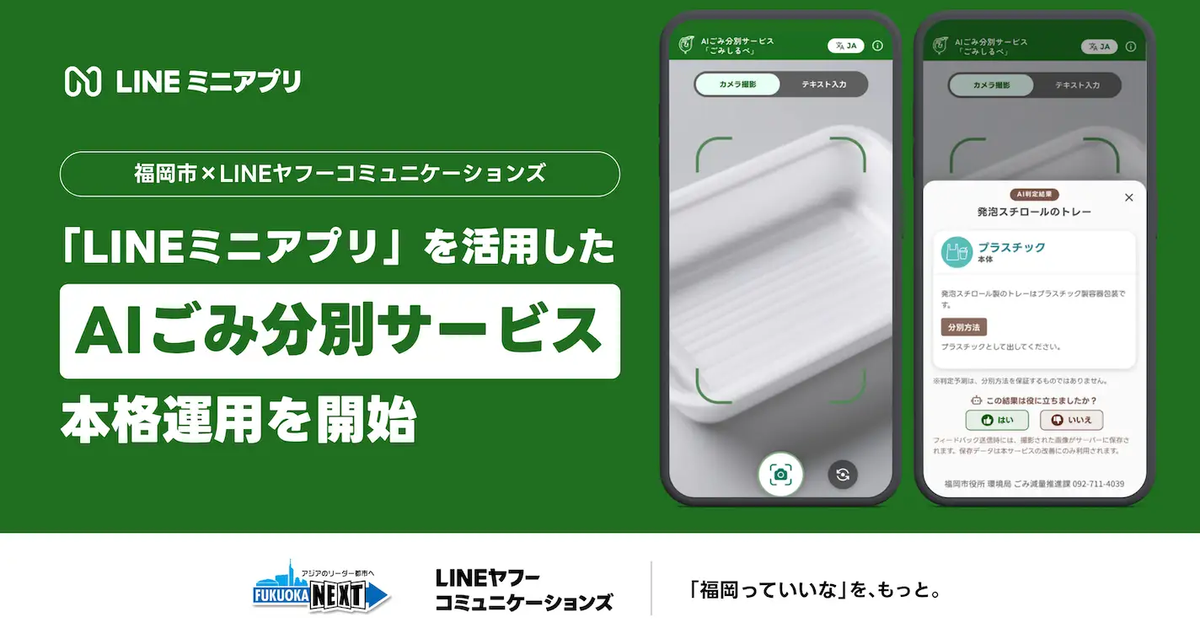
Fukuoka City began full-scale operation of an AI-powered waste sorting service called "Gomi Shirube" on November 24, 2026. Built by LINE Yahoo Communications as a LINE mini-app, the service lets residents photograph an item or type its name to receive disposal instructions generated by AI, calibrated to Fukuoka's specific municipal waste rules.
Extraction Map
The deployment is not accidental timing. Fukuoka will introduce mandatory separate collection of plastics in February 2027, a policy shift that will immediately multiply the number of sorting decisions residents face daily. Rather than publishing new pamphlets or updating static databases, the city chose to meet the complexity increase with an AI interface that handles ambiguity — the user does not need to know what something is called, only what it looks like. This is a lightweight but structurally interesting use of generative AI. Most municipal waste apps rely on keyword search against a fixed database. The photo-recognition approach eliminates the vocabulary bottleneck: residents who cannot name an item in the correct municipal category can still get an answer. LINE Yahoo Communications developed the service through iterative pilot testing with Fukuoka, suggesting the accuracy has been tuned to local classification rules rather than deployed as a generic model. The service explicitly does not guarantee accuracy, a disclosure that is both legally prudent and honest about the state of image-classification AI. For waste sorting, the cost of an occasional misclassification is low — a contaminated recycling bag, not a safety hazard. The risk-reward calculus favors deployment over waiting for perfection. Fukuoka's broader trajectory reinforces the pattern. The city is simultaneously developing a facial-recognition-enabled smart district on the former Kyushu University Hakozaki campus, targeting a 2028 opening. Waste sorting and urban redevelopment are very different scales of ambition, but they share a governance philosophy: deploy technology into daily friction points rather than waiting for flagship projects. The LINE platform choice is strategic. LINE dominates Japanese mobile messaging with penetration rates that dwarf standalone municipal apps. Building on LINE's mini-app infrastructure means near-zero adoption friction — residents do not download anything new, they access a service inside an app they already open dozens of times daily. The question is whether this stays a Fukuoka experiment or becomes a template. Every Japanese municipality maintains its own waste classification rules, creating a fragmented landscape that is expensive to serve with bespoke apps but straightforward to serve with AI trained on local rule sets. If LINE Yahoo Communications productizes the backend, dozens of cities could deploy similar services with minimal marginal cost.
Worth reading?
RECOMMENDED
Score
60
/100
Generative — reduces daily friction for residents at low cost, builds on existing platform infrastructure, and positions the city to handle a coming policy change (plastic separation) without expensive analog outreach.
What Is GRIN?
GRIN stands for Generativity, Resilience, Innovation efficiency, and Novelty openness. These four dimensions capture the essential characteristics of any memetic intelligence — whether a nation, a corporation, a religion, or a movement.
About GRINGenerativity
3/5
Resilience
2/5
Efficiency
4/5
Novelty
2/5
Extractive
1/5
Inverted
Does this create new capability or just redistribute existing value?
Modest but real. Solves the vocabulary bottleneck in waste sorting — residents no longer need to know the municipal name for an item. Scalable to other cities if the backend is productized.
Verified Facts (6)
Fukuoka City began full-scale operation of AI waste sorting service 'Gomi Shirube' on November 24, 2026
Service built by LINE Yahoo Communications as a LINE mini-app
Users photograph items or enter names; generative AI classifies based on Fukuoka's waste rules
Fukuoka will begin separate plastic collection in February 2027
Service does not guarantee accuracy of classification results
Kyushu University Hakozaki campus redevelopment targeting 2028 opening with facial recognition
More latest news
Read all