CREW · POW
1,200
CREW · FORD
5,000
BUILD COST
$4B
MAX F-35Bs
36
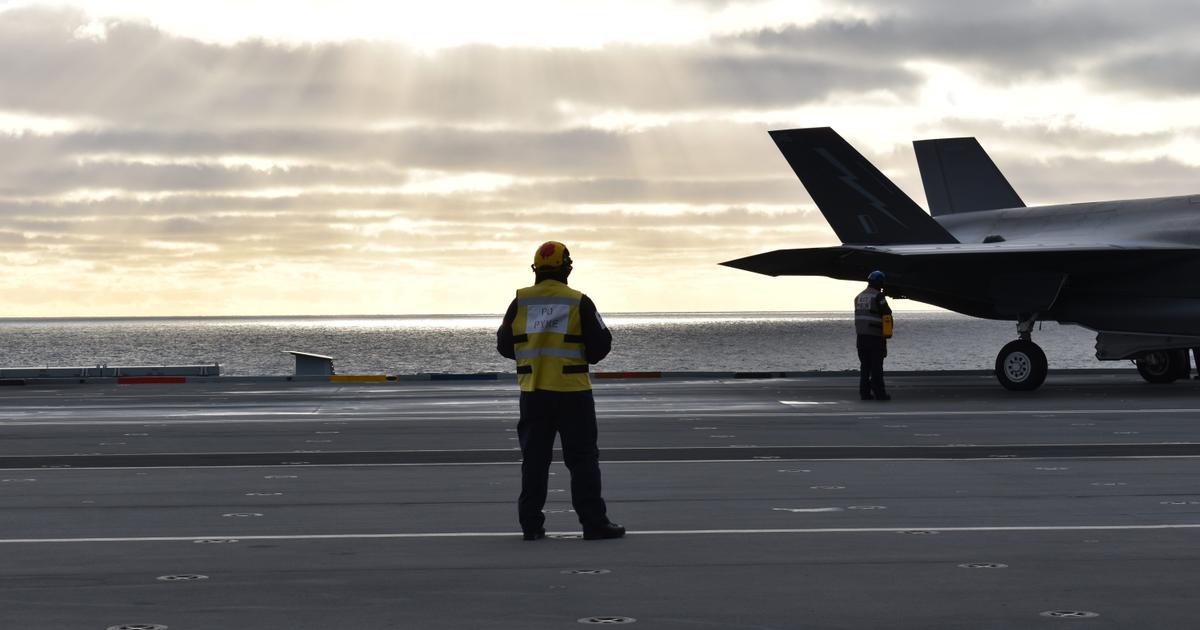
HMS Prince of Wales, the Royal Navy's newest aircraft carrier, is currently operating in the Norwegian Sea as part of Operation Firecrest and NATO's Neptune Strike exercise. Business Insider's Jake Epstein boarded the vessel during the first week of November 2026 and found only a handful of F-35B stealth fighters on a flight deck rated for up to 36. The carrier's officers insist this is a feature, not a limitation.
Extraction Map
The ship's core proposition is automation as force multiplier. Captain Ben Power highlighted the Highly Mechanised Weapon Handling System (HMWHS), which moves ordnance from deep magazines to the flight deck with minimal human involvement. "Practically everything is automated," Power said. "The lifts and processes are computer-controlled — you request the weapon and it's delivered. No humans in the process." This stands in contrast to other NATO carriers that rely on manual labor for ammunition movement, even when equipped with weapons elevators. The numbers tell the efficiency story plainly. Prince of Wales carries a maximum crew of 1,600 (including Royal Marines) and typically operates with 1,200. USS Gerald R. Ford carries over 5,000 crew and 75-plus aircraft. The British carrier can embark up to 72 aircraft total — 36 F-35Bs plus Merlin Mk2 helicopters and other rotary-wing assets — but routinely deploys far fewer. In 2025, the ship demonstrated full operational capability by launching 8 aircraft at 30-second intervals and operating a record 24 F-35s aboard a Queen Elizabeth-class carrier. The operational record is building credibility for the concept. During Firecrest Phase 1 in July 2026, F-35s launched from Prince of Wales conducted NATO air policing missions off Iceland — the first time NATO executed such missions from a European carrier. Commodore Richard Hewitt, the carrier strike group commander, called the mission a "great success" and suggested the ship could take on a larger role in future air policing operations. The carrier maintains 24-hour flight operations capability. The £4 billion ($6.32 billion) vessel commissioned in 2019 represents a deliberate design philosophy: invest in technology to reduce crew requirements, accept smaller air wings, and compensate with sortie rate and operational tempo. This is Britain making a strategic bet that automation-enabled efficiency matters more than raw deck space in the emerging threat environment. The honest tension is whether this scales under pressure. A carrier with a few F-35s on deck during peacetime exercises is demonstrating capability, not capacity. The 36-aircraft maximum is roughly half of what a Ford-class routinely carries in combat configuration. If attrition or simultaneous threat axes demand mass, the efficiency argument meets hard physics. Britain is betting that NATO's collective carrier fleet provides the mass, while Prince of Wales provides the flexible, deployable, interoperable node. The broader signal is about NATO's evolving carrier posture in the North Atlantic and Arctic. Prince of Wales operating off Norway, conducting air policing off Iceland, and integrating with allied fleets represents a geographic expansion of carrier-based deterrence into waters that have grown strategically critical as Arctic competition intensifies. The ship's value may ultimately be measured less by how many jets it carries and more by where it can credibly show up.
Worth reading?
RECOMMENDED
Score
60
/100
Modestly generative — genuine automation innovation in weapons handling creates real efficiency gains, but the smaller platform fundamentally trades capacity for cost savings, limiting independent combat power.
What Is GRIN?
GRIN stands for Generativity, Resilience, Innovation efficiency, and Novelty openness. These four dimensions capture the essential characteristics of any memetic intelligence — whether a nation, a corporation, a religion, or a movement.
About GRINGenerativity
3/5
Resilience
2/5
Efficiency
4/5
Novelty
2/5
Extractive
1/5
Inverted
Does this create new capability or just redistribute existing value?
Real but bounded. Automated weapons handling is a genuine capability advance that other navies lack. But fewer jets and crew means less independent striking power — this generates efficiency, not mass.
Verified Facts (8)
HMS Prince of Wales can carry a maximum of 36 F-35B stealth fighters and up to 72 total aircraft including Merlin Mk2 helicopters
The carrier typically operates with 1,200 crew and can accommodate up to 1,600 including Royal Marines
USS Gerald R. Ford carries more than 75 aircraft and approximately 5,000 crew
The ship cost $4 billion (¥632 billion) and was commissioned in 2019
In 2025, the carrier demonstrated full operational capability and launched 8 aircraft at 30-second intervals
24 F-35s were embarked in 2025 — a record for a Queen Elizabeth-class carrier
During Operation Firecrest Phase 1 in July 2026, F-35s from Prince of Wales conducted NATO air policing off Iceland — a first for a European carrier
The ship employs a Highly Mechanised Weapon Handling System (HMWHS) for automated ordnance transport
More latest news
Read all