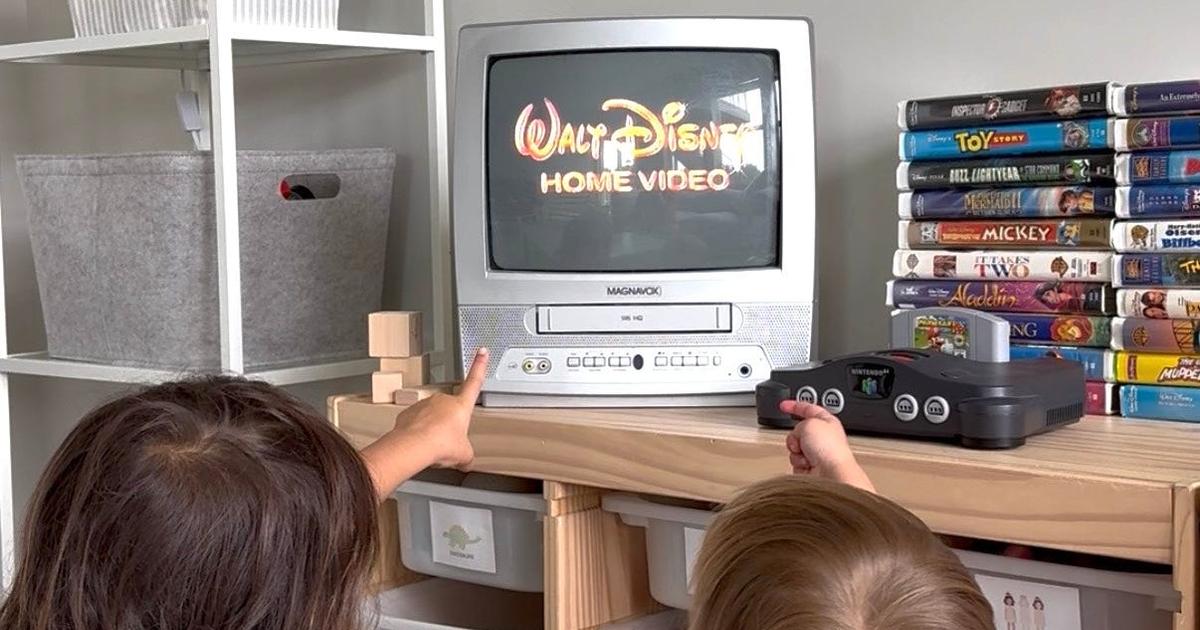
Mariah Smith didn't set out to become a poster parent for the analog childhood movement. She had three kids, a baby draining every reserve, and a smart TV running all day as a survival strategy. Then her eight-year-old found a genuinely horrifying exorcism trailer on the TV's menu screen — the kind of content that Netflix and Disney+ surface without asking — and started crying at bedtime. That was the breaking point. Smith hid the remote, told the older kids the TV was broken, and braced for war. The withdrawal lasted less than a week. What replaced it is the interesting part: not abstinence, but substitution. A boombox and CDs. A rediscovered Game Boy. And then, from her parents' house, a cache of VHS tapes and a CRT television to play them on. The kids treated twenty-year-old technology like Christmas morning. The structural insight here is about friction as a design feature. VHS tapes require checking if they're rewound, sitting through previews, watching a single film, then rewinding again. When the movie ends, it ends — there's no autoplay queue, no algorithmic recommendation engine serving up the next dopamine hit. Smith reports her kids now turn off the TV voluntarily, something that never happened with streaming. The natural stopping point that physical media enforces turns out to be doing the parenting work that willpower couldn't. Smith also names a problem that streaming platforms have made structurally unsolvable: she doesn't want her kids watching YouTubers, but Netflix and Disney+ increasingly feature exactly those creators, with no clean way to remove them from the interface. VHS and DVD bypass the problem entirely — you own exactly the content you chose, and nothing else appears. The content library is the parental control. A year in, Smith reports less fighting between siblings, more creative play (the daughter picked up embroidery and knitting), and — perhaps most tellingly — a change in her own nervous system. The background noise of perpetual streaming was affecting her too. The house got quieter, and she got calmer. This tracks with what attention researchers have been saying for years, but it's striking to hear it described as a bodily sensation rather than a data point. The limits are obvious. This is a single-family anecdote, not a study. Smith had the specific advantage of parents who'd kept her childhood VHS collection. The approach works for pre-teen kids consuming passive media — it doesn't address phones, social media, or the screen-time challenges of older children. And the "dopa-kid" framing in the Japanese headline, while catchy, overstates the neuroscience. Still, the mechanism Smith stumbled onto is real and worth naming: when you replace infinite frictionless choice with finite physical media, you change the behavioral economics of screen time without having to police it. The kids aren't more disciplined. The environment is differently structured. That's a design insight, not a parenting lecture.
Worth reading?
OPTIONAL
Score
40
/100
Parents of kids under 10 who are drowning in streaming screen time and want permission to try something drastic. Also useful for anyone writing about attention design who needs a vivid anecdote.
Cultural Placement
Like a Cal Newport 'Digital Minimalism' case study crossed with the gentler domestic observations of a Clarkson Farm or early Dooce-era parenting blog. The mechanism maps closest to Matthew Crawford's 'The World Beyond Your Head' — the argument that attention is an environmental design problem, not a willpower problem — but delivered through personal anecdote rather than philosophy. Think of it as the magazine version of what the Waldorf-school movement has been saying for decades, landing now because streaming platforms have made the problem undeniable even to non-ideological parents.
Honest assessment
A warm, competent personal anecdote that names a real mechanism — environmental friction as screen-time management — without knowing it's naming it. The VHS detail is charming and specific enough to share, but this is a single data point dressed as lifestyle advice, sitting in a long tradition it doesn't acknowledge. Worth a five-minute read if you're the target parent; not worth seeking out otherwise.
What Is NOVEL?
40
/ 100
BedrockNews applies a structured analytical framework called NOVEL to cultural works — games, books, film, music, and more.
How NOVEL worksNerve
2/5
Originality
2/5
Voice
2/5
Endurance
2/5
Lineage
2/5
What did the artist risk? What could have failed?
Low risk. A parent sharing a feel-good screen-time story is as safe as lifestyle content gets. No reputation, career, or formal risk taken. The piece could not have failed.
Verified Facts (9)
Mariah Smith is a mother of three children who replaced a smart TV with a VHS-equipped CRT television
Her 8-year-old daughter found a horror movie trailer (exorcism-themed) on the smart TV's menu screen
The transition period lasted less than one week before kids stopped asking for streaming
Smith also introduced a boombox with CDs, radio, and a Game Boy
VHS tapes came from Smith's parents who had kept her childhood collection
One year after the switch, Smith reports less sibling fighting, more creative play, and easier TV shutoff
The daughter began embroidery and knitting
Smith added DVDs to the collection including all episodes of Bluey
Netflix and Disney+ increasingly feature YouTubers with no easy way to remove them from the children's interface
More latest news
Read all