OPERATOR STANDOFF
5→10km
ADAPTATION CYCLE
~6 mo
RELAY STAGES
3+
HUMANS IN KILL ZONE
0
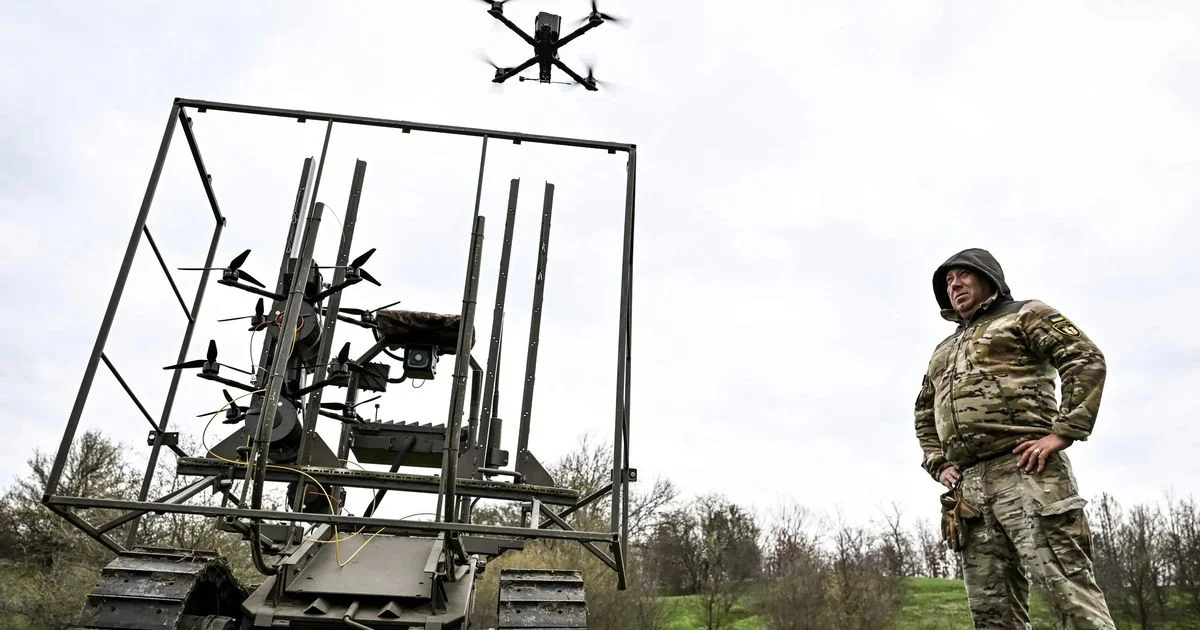
Ukraine's armed forces are assembling what amounts to a conveyor belt of unmanned systems — ground robots handing off to heavy drones handing off to smaller drones — to move supplies and wounded soldiers through the most lethal zones of the front line. The concept, described by Da Vinci Wolves Battalion robotics chief Oleksandr Yabchanka as a "multi-stage logistics and evacuation system," has become increasingly common over the past year. The goal is structural: replace single large targets (supply trucks, medevac teams) with a chain of smaller, expendable platforms that each cover only one leg of the route.
Extraction Map
The mechanics vary by mission. In one November example from the 91st Independent Anti-Tank Battalion, a ground robot delivered ammunition to troops, who then loaded it onto a heavy strike drone for attacks on Russian positions. A more complex October operation by the 93rd Independent Mechanized Brigade involved a ground robot delivering food and water to Vampire drone operators, who repackaged the supplies onto heavy drones, flew them to a secondary position, then further split the loads onto smaller drones for the final few hundred meters — specifically because smaller drones are harder for the enemy to detect. Medical evacuation follows a similar logic but with different constraints. Ground robots increasingly retrieve wounded soldiers from positions too dangerous for medics, but their range is limited. The relay solution: soldiers carry or walk the wounded to a robot-accessible point, the robot transports them to where an armored vehicle can take over. Each link in the chain operates at a different risk level, pushing human exposure as far back as possible. Yabchanka frames the ambition in concrete terms: if operators previously worked at five kilometers from the contact line, the goal is to push them to ten. The relay architecture makes this possible because no single platform needs to cover the full distance. Each system handles the segment it's best suited for — ground robots for rough terrain near the front, heavy drones for mid-range transport, small drones for the final approach where stealth matters most. The approach also extends to offensive combinations. Naval drones have carried ground robots to deployment points; aerial drones have dropped ground robots behind Russian lines. Ground robots and aerial drones increasingly provide mutual intelligence and protection. But the relay chain Yabchanka describes is distinct: it's sequential task-sharing, not simultaneous coordination. Different systems take turns, each inheriting the mission from the last. Adaptation cycles are fast. Yabchanka estimates the battlefield situation shifts noticeably every six months — new Russian attack drones, extended ranges, greater lethality — forcing Ukrainian units and manufacturers to continuously upgrade communications equipment, batteries, and tactics. The relay concept itself is an adaptation: it emerged not from doctrine but from the practical reality that no single unmanned platform can safely traverse the full depth of the kill zone. The implications extend beyond Ukraine. This is an early operational proof-of-concept for heterogeneous unmanned teaming under contested conditions — the kind of capability every major military is studying but few have tested under fire. The relay chain is not elegant or autonomous; it requires human operators at handoff points and constant tactical adjustment. But it works, and it's keeping soldiers alive in conditions where traditional logistics would mean casualties.
Worth reading?
ESSENTIAL
Score
80
/100
Generative — creates new battlefield capability (multi-stage unmanned logistics and evacuation) that did not previously exist, reduces human casualties, and forces doctrinal adaptation across all militaries watching.
What Is GRIN?
GRIN stands for Generativity, Resilience, Innovation efficiency, and Novelty openness. These four dimensions capture the essential characteristics of any memetic intelligence — whether a nation, a corporation, a religion, or a movement.
About GRINGenerativity
4/5
Resilience
4/5
Efficiency
3/5
Novelty
5/5
Extractive
1/5
Inverted
Does this create new capability or just redistribute existing value?
Genuine capability creation. Multi-stage unmanned relay chains enable logistics and medevac missions in kill zones where no single platform or human team could operate safely. New military capability, not redistribution.
Verified Facts (6)
Da Vinci Wolves Battalion robotics chief Oleksandr Yabchanka described the system as a 'multi-stage logistics and evacuation system'
91st Independent Anti-Tank Battalion used a robot to deliver ammunition, which soldiers then loaded onto a heavy strike drone
93rd Independent Mechanized Brigade conducted a multi-stage food and water delivery in October using ground robot → Vampire drone operators → heavy drones → smaller drones
Yabchanka stated the goal of pushing operators from 5km to 10km from the contact line
Yabchanka estimated battlefield conditions change noticeably every 6 months
Naval drones have carried ground robots; aerial drones have dropped ground robots behind Russian lines
More latest news
Read all