Get it
Bee Kind Slimes
on Official site
INCREASED PRODUCTION CAPACITY
10x
NORA EARNED
$100
SPENDING
$10
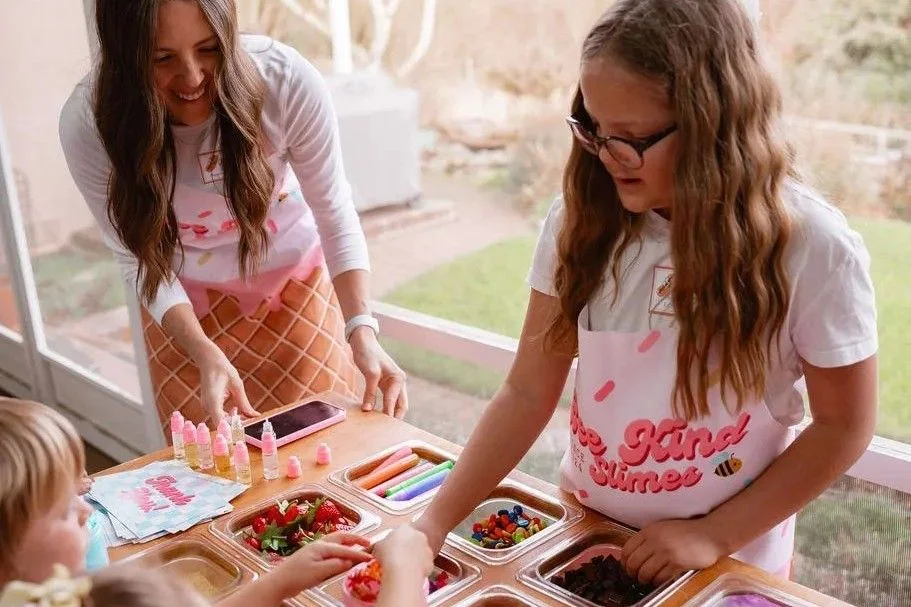
Two years ago, Nora Wrede wanted to buy something. Her parents offered a chore list; she counter-offered with a bag of homemade slime and a walk around the neighborhood. Thirty minutes later she returned with $100. That gap between the parental expectation and the child's instinct is the entire story in miniature: the kid already understood that making something people want beats trading time for allowance. What followed is a textbook micro-business arc compressed into a child's attention span. Bee Kind Slimes expanded from door-to-door sales to farmers' markets, festival booths, online orders, and birthday parties — 50 of them this year alone. The pivot from pre-packaged slime containers (which spoil) to a mobile slime cart (where kids customize colors and toppings on the spot) solved an inventory problem and created an experience product in one move. That's not a cute anecdote; that's the same insight that separates a food truck from a grocery shelf. The operational details are more interesting than the heartwarming framing suggests. Nora burned through five KitchenAid mixers in year one before securing a grant from the Mason Makes Money Fund for an industrial mixer, increasing batch capacity tenfold. She works roughly 15 hours a week, more during holidays. Her mother Karly, who teaches corporate training professionally, recognized the pattern and built a course — Launch Lab — that has taught over 130 families to replicate the model since April. The financial education piece is quietly effective. Nora went from spending a $10 weekly allowance instantly on toys to receiving $100 monthly with a forced waiting period. The behavioral shift — from impulsive spending to deliberate saving — happened not through lectures but through the experience of earning. She now sometimes doesn't spend the money at all. That's a feedback loop most adults never build. The story's limits are real and worth naming. This works because Karly has corporate training skills, time to supervise, and the savvy to navigate social media, grants, and event logistics. The child provides charm and labor; the parent provides infrastructure and business judgment. That's not a criticism — it's the actual model, and pretending otherwise would be dishonest. The course offering is the tell: the product isn't really slime, it's a parent-child business framework that happens to use slime as its medium. What makes this worth attention isn't the dollar amounts — they're modest — but the density of real business lessons packed into a format a child can absorb: inventory management, product-market fit, experience design, grant applications, batch production, delayed gratification, and generosity as practice rather than abstraction. Most entrepreneurship content for kids is sanitized theater. This one has spoiled inventory and broken mixers. The 20-year question is whether Nora carries the operational instincts or just the memory. The evidence from child entrepreneurs is mixed — some become founders, most don't, but nearly all report that the experience of selling something they made changed how they think about work. The course business Karly built on top may end up being the more durable enterprise. Either way, the slime cart is doing more developmental work than it looks like from the outside.
Worth reading?
OPTIONAL
Score
40
/100
Parents actively looking for frameworks to teach kids about money and entrepreneurship through hands-on projects, especially those with craft-business-curious children ages 7-12.
Cultural Placement
Like a Humans of New York micro-profile crossed with a Y Combinator application essay, filtered through the parenting-content machinery of Business Insider. The mechanism is closer to the 'Side Hustle School' podcast than traditional business reporting — a single narrative arc used to illustrate a replicable framework. It sits in the tradition of American bootstrap storytelling (lemonade stands, Girl Scout cookies) but with enough operational specificity to distinguish it from pure sentiment.
Honest assessment
A well-executed entry in BI's kid-entrepreneur content pipeline. The operational specifics (grant funding, industrial mixer, 50 birthday parties, 130 families taught) elevate it above pure sentiment, but the format and arc are entirely template. Worth reading if you're a parent shopping for a structured activity that teaches business basics; skippable as journalism.
What Is NOVEL?
40
/ 100
BedrockNews applies a structured analytical framework called NOVEL to cultural works — games, books, film, music, and more.
How NOVEL worksNerve
1/5
Originality
2/5
Voice
2/5
Endurance
2/5
Lineage
3/5
What did the artist risk? What could have failed?
Zero risk taken. This is the safest possible version of this story — cute kid, supportive parent, modest success, no conflict. Nothing could have failed editorially.
Verified Facts (9)
Nora earned $100 in 30 minutes selling homemade slime door-to-door
Bee Kind Slimes has completed 50 birthday parties this year
They burned through 5 KitchenAid mixers in the first year
Nora received a grant from Mason Makes Money Fund for an industrial mixer
Industrial mixer increased production capacity 10x
Nora works approximately 15 hours per week on the business
Nora receives $100 monthly compensation, paid at month's end
Since April, Karly and Nora have taught over 130 families how to start slime businesses
Karly works in a nonprofit organization
More latest news
Read all