WINGSPAN · GJ-11
47 ft
US PIVOT YEAR
2016
INTERNAL WEAPON BAYS
2
COMPETING PROGRAMS
3
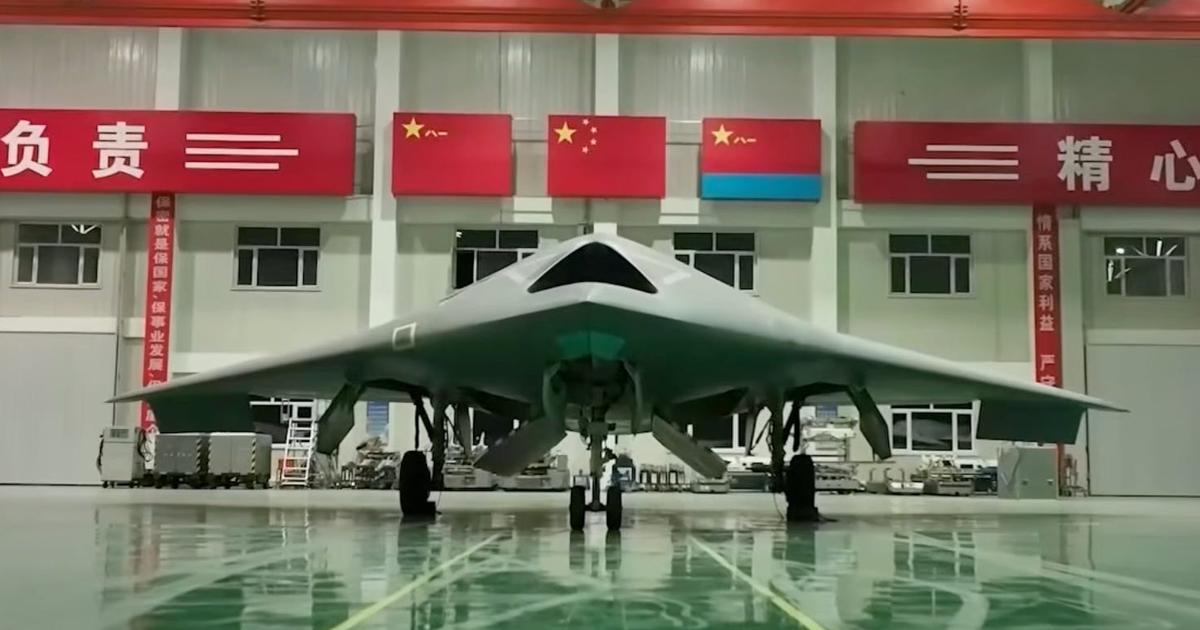
China's People's Liberation Army Air Force has released the first close-up footage of the GJ-11 (Gongji-11), a large stealth unmanned combat aerial vehicle designed to penetrate deep into enemy territory and strike hardened ground targets. The footage, broadcast on November 11, 2026, shows the aircraft from multiple angles on the ground and in flight — the most detailed public look at a platform that has been operational but largely opaque since its 2019 parade debut.
Extraction Map
The GJ-11 is a flying-wing design with an estimated wingspan of 47 feet (14.3 meters), bearing structural resemblance to the American B-2 Spirit bomber. Its surfaces are smooth, weapons are carried internally in two bays with serrated doors to minimize radar return, and the turbofan engine is buried inside the fuselage. The nose houses an electro-optical/infrared sensor suite similar in placement and form to those on fifth-generation fighters like the F-35 and China's J-20. State media says it can carry multiple guided munitions for strikes on command posts and air defense sites. Beijing frames the GJ-11 as dual-role: a standalone deep-strike platform and a "loyal wingman" operating alongside manned fighters like the J-20. In the depicted concept of operations, manned aircraft establish air superiority while GJ-11s receive target assignments for high-value ground strikes. Notably, the footage showed human operators monitoring and controlling the drone from mobile command vehicles — no claims of autonomous operation were made. A separate broadcast featured female PLA Air Force drone operators conducting live-fire tests with the GJ-11. In October 2026, China announced a naval variant designated GJ-21, reportedly launched from and recovered on an amphibious assault ship, though no footage of the naval trials has been released. If verified, carrier-capable stealth strike drones would represent a significant power-projection tool for the PLA Navy in a potential Taiwan contingency or South China Sea scenario. The strategic contrast with the United States is striking. The U.S. Navy's X-47B demonstrator proved the same flying-wing stealth drone concept could operate from aircraft carriers and perform autonomous aerial refueling. But the Pentagon pivoted in 2016 away from a high-end strike variant, opting instead for the MQ-25 Stingray tanker drone. Washington's current approach centers on Collaborative Combat Aircraft (CCA) — cheaper, attritable drones designed to fly ahead of manned fighters, saturate enemy defenses, and be mass-produced as expendable assets. The philosophical split is clear: China invested in a small number of exquisite penetrating platforms; the U.S. is betting on volume and disposability. Russia's parallel effort, the Sukhoi S-70 Okhotnik-B, shares the flying-wing stealth architecture but trails significantly in development. In 2024, a prototype was shot down over Ukraine — likely by Russian forces themselves after losing control of the aircraft, according to Western intelligence assessments. The incident underscores how far Russia lags behind both China and the U.S. in autonomous and semi-autonomous drone operations. The GJ-11 reveal is a calibrated information operation. Beijing is signaling operational maturity of a capability class the U.S. chose not to field, while simultaneously keeping key details — autonomous flight capability, specific munitions, production numbers — classified. The question is whether the U.S. mass-attritable approach or China's exquisite-stealth approach proves more effective in a contested Indo-Pacific theater. That question won't be answered by press releases.
Worth reading?
OPTIONAL
Score
44
/100
Mildly generative for China's military-industrial base, but primarily redistributive at the geopolitical level — this shifts the balance of threat rather than expanding collective security or capability.
What Is GRIN?
GRIN stands for Generativity, Resilience, Innovation efficiency, and Novelty openness. These four dimensions capture the essential characteristics of any memetic intelligence — whether a nation, a corporation, a religion, or a movement.
About GRINGenerativity
3/5
Resilience
2/5
Efficiency
2/5
Novelty
2/5
Extractive
3/5
Inverted
Does this create new capability or just redistribute existing value?
Genuine capability creation for China: a fielded stealth strike drone with no U.S. equivalent in service. But generativity is narrow — military-only, no civilian spillover disclosed, and it intensifies arms-race dynamics rather than expanding the pie.
Verified Facts (14)
GJ-11 estimated wingspan of 47 feet (approximately 14.3 meters)
First publicly displayed at 2019 National Day military parade in Beijing
2025 footage showed GJ-11 flying alongside manned fighters
Two internal weapons bays with serrated-edge doors visible in footage
Nose-mounted electro-optical/infrared sensor suite
Uses internally housed turbofan engine
GJ-21 naval variant announced October 2026, reportedly launched from amphibious assault ship
No footage of GJ-21 naval trials released
Northrop Grumman X-47B was the most advanced U.S. comparable demonstrator
U.S. Pentagon pivoted to MQ-25 Stingray tanker drone development in 2016
Russia's Sukhoi S-70 Okhotnik-B prototype shot down over Ukraine in 2024
Western intelligence assessed Russia likely lost control and shot it down to prevent deeper penetration into Ukraine
Female PLA Air Force drone operators featured conducting live-fire tests with GJ-11
Footage broadcast November 11, 2026 by Chinese state media
More latest news
Read all