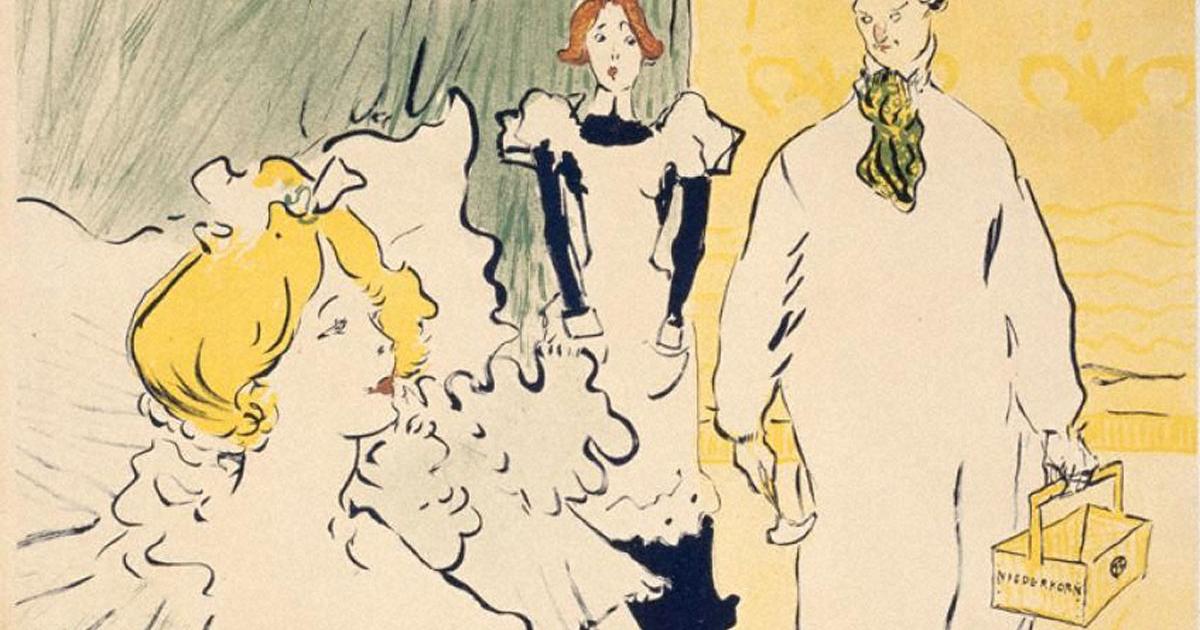
In 1896, the interior decoration company L'Artisan Moderne had ten shops across Paris and wanted the kind of brand awareness only a celebrity artist could deliver. They hired Toulouse-Lautrec, already famous for the Moulin Rouge and Jeanne Avril posters, and gave him free rein. He repaid their trust with a lithograph that cast their uniformed worker as a lecherous intruder in a woman's bedroom — tool-box in hand, white coat mimicking a doctor's, ogling a sleeping client while a mortified maid looks on. The company name is there. The company's dignity is not. The gag has a lineage. A stock erotic motif of the era depicted a physician visiting a bedridden woman with dubious intent. Lautrec swapped the doctor for a decorator and weaponized the reference. The joke is layered: the audience gets the visual pun, the company gets its name remembered, and Lautrec gets to make art on someone else's dime. The client, having hired a star, was in no position to say no. The power dynamic between artist and patron is the invisible fourth figure in the scene. What makes the print technically remarkable is the medium. This is a lithograph — a chemical process where oil-based drawing on stone transfers directly to paper, no carving required. Lautrec could use his own brushwork rather than depend on a woodblock carver's interpretation. The maid's startled expression, the flowing curves of the bedclothes, the woman's nightgown — all rendered with the spontaneity of a sketch but the reproducibility of a print run. As curator Sugiyama Nahoko of the Mitsubishi Ichigokan Museum points out, the dog in the scene is painted with surprising realism while every human figure tilts toward caricature. That contrast is deliberate. Lautrec was born into southern French aristocracy in Albi, broke both legs as a child, and grew to only 152 centimeters as an adult. His body isolated him from the aristocratic world he was born into; Montmartre's dancers, sex workers, and bartenders became his community and his subject. He was not a tourist in the demimonde — he lived there, was loved there, and died there at 36 from the consequences of the life he'd chosen. His work carries that intimacy. The women in his posters are never objects of spectacle; they're people he knew. The article draws a line between Lautrec and ukiyo-e, the Edo-period woodblock prints depicting kabuki actors and courtesans. Lautrec studied Japanese prints and absorbed their flat color planes, bold outlines, and asymmetric compositions. The connection may run deeper than technique — both traditions found their richest material in the pleasure quarters, and both elevated commercial printing into art. The irony is that ukiyo-e's exquisite detail required master carvers and printers working in teams, while lithography let Lautrec bypass that entire guild structure and put his own hand directly on the stone. The Mitsubishi Ichigokan Museum in Marunouchi holds this print in its permanent collection. Noji Tsuneyoshi's essay, part of his ongoing "art you should see once in your life" series for Business Insider Japan, uses the piece as an entry point into lithographic technique, Lautrec's biography, and the economics of artistic patronage. It's accessible art writing — light on jargon, generous with context — that earns its thesis: this is a work where the commercial brief became the raw material for the joke, and the joke became the art.
Worth reading?
RECOMMENDED
Score
52
/100
Non-specialist readers planning a visit to Mitsubishi Ichigokan Museum, or anyone curious about how commercial art and fine art blur — especially if you enjoy learning what a technique actually IS (lithography) rather than just what a painting looks like.
Cultural Placement
Like Robert Hughes's popular art criticism but in miniature and without the combativeness — closer to the discursive, anecdote-driven pace of Sister Wendy Beckett's television walks through museums, crossed with the material-process focus of James Elkins's 'What Painting Is.' Noji writes for the educated non-specialist who wants to feel smarter after ten minutes, not the art-world insider. The format is the Japanese bijutsu essay tradition — biographical storytelling plus close looking — updated for a business-media audience that needs a reason to care.
Honest assessment
A warm, well-structured museum companion essay that teaches you something real about lithographic technique and Lautrec's working method. It won't change how you think about art criticism, but it will make you a better-informed visitor. Best consumed ten minutes before walking into the gallery.
What Is NOVEL?
52
/ 100
BedrockNews applies a structured analytical framework called NOVEL to cultural works — games, books, film, music, and more.
How NOVEL worksNerve
2/5
Originality
2/5
Voice
3/5
Endurance
3/5
Lineage
3/5
What did the artist risk? What could have failed?
Low risk, high competence. This is a museum-collection spotlight essay in a business magazine — the form is established and Noji stays comfortably within it. No structural or argumentative gambles taken.
Verified Facts (7)
Toulouse-Lautrec, L'Artisan Moderne, 1896, lithograph, 32×24 cm, Mitsubishi Ichigokan Museum collection
L'Artisan Moderne was an interior decoration company with 10 shops in Paris at the time of the commission
Lautrec's famous posters: Moulin Rouge La Goulue (1891), Jane Avril (1893)
Lithography invented by Alois Senefelder in 1798 in Germany, originally for music-score reproduction
Lautrec was born in Albi, broke both legs as a child, reached 152 cm adult height (13 years old: 150 cm, grew only 2 cm after), died in 1901 at age 36
Curator quoted: Sugiyama Nahoko, chief curator at Mitsubishi Ichigokan Museum
Museum address: 2-6-2 Marunouchi, Chiyoda-ku, Tokyo; hours 10:00-18:00, extended to 20:00 on Fridays (excl. holidays), 2nd Wednesdays, and final week of exhibitions
More latest news
Read all