NVIDIA CHINA SHARE
0%
CEO RESIGNATION
2026
PUBLIC CHINA STATEMENTS
6+
ALLEGED SPY CONTACT
1
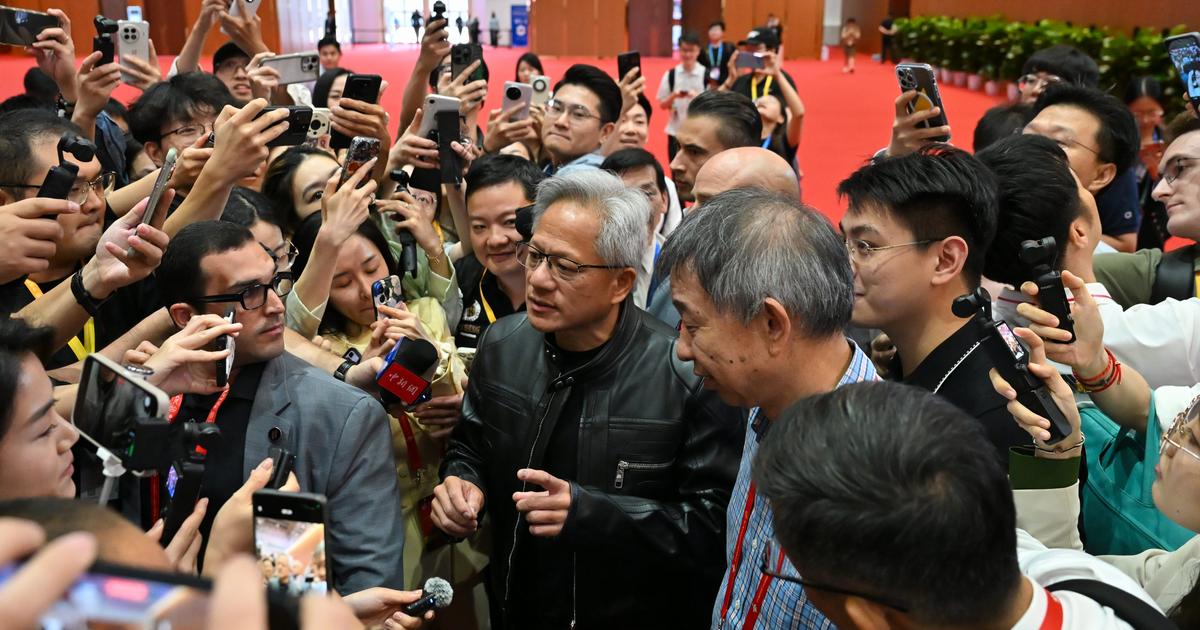
Nvidia's board is investigating whether Jensen Huang — who stepped down as CEO amid the scandal — was the target of a foreign intelligence operation conducted through Alice Huang, an executive at Megaspeed, a company U.S. authorities suspect helped China obtain export-restricted AI chips. The New York Times reports U.S. officials believe Alice Huang was recruited as an asset to collect intelligence for the Chinese government. Nvidia says no trade secrets or national security information was compromised.
Extraction Map
The investigation reframes years of public statements. From January 2026 through October, Huang consistently argued against U.S. export controls on AI semiconductors to China, calling decoupling "shortsighted" and "not based on any common sense." He told audiences that restricting Nvidia's China sales would only strengthen Chinese competitors — a claim that proved structurally accurate when Nvidia's China datacenter market share fell to zero by April 2026. The timeline is striking. In May 2026, Huang accompanied President Trump to China and appeared on Bloomberg Television expressing confidence that the Chinese market would eventually reopen to U.S. chipmakers. He told Channel News Asia that the U.S. and China building separate AI ecosystems would be "unwise" and that leaders should develop AI technology "in a harmonious way." By October, in previously unreleased footage from Bloomberg's 'The Circuit,' he said the U.S. had "made mistakes" on China — an apparent reference to export restrictions. Huang's position was not fringe. It was the mainstream semiconductor industry position: that export controls imposed costs on American firms while accelerating Chinese self-sufficiency. Nvidia's February 2026 annual report to the SEC stated explicitly that being locked out of China's datacenter market had enabled competitors to build ecosystems capable of challenging Nvidia internationally. The argument had economic logic regardless of any intelligence compromise. What the espionage investigation does is make it impossible to evaluate those statements on their economic merits alone. Every public appearance arguing for China market access, every podcast calling decoupling shortsighted, every statement that China is "not our enemy" now carries a second possible reading. The board investigation will determine whether Huang's advocacy was purely commercial or whether it was influenced — consciously or not — by a relationship U.S. authorities believe was an intelligence operation. The structural question is larger than one CEO. Nvidia is the most strategically important AI semiconductor company in the world. The fact that its chief executive may have been compromised by a foreign intelligence service — while actively lobbying against restrictions on that country's access to his company's products — exposes a fundamental vulnerability in how the U.S. manages the intersection of corporate commercial interests and national security. Whether or not Huang was knowingly compromised, the system that allowed a single executive with this much policy influence to have an unmonitored relationship with someone U.S. authorities now call a spy is the deeper failure. Nvidia's handling of Huang's departure and the board investigation will signal how seriously the company — and by extension the U.S. semiconductor industry — treats the risk that commercial lobbying and intelligence operations can become indistinguishable from the outside. Huang has already resigned as CEO. The question now is what the investigation reveals about whether any proprietary or classified information flowed through the relationship, and whether Megaspeed's alleged role in circumventing export controls had any connection to Huang's sustained public advocacy.
Worth reading?
SKIP
Score
24
/100
Extractive. Whether or not Huang was knowingly compromised, the structure concentrated enormous policy influence in a single executive whose personal relationships were exploitable by a foreign intelligence service, extracting strategic advantage from the U.S. national security apparatus.
What Is GRIN?
GRIN stands for Generativity, Resilience, Innovation efficiency, and Novelty openness. These four dimensions capture the essential characteristics of any memetic intelligence — whether a nation, a corporation, a religion, or a movement.
About GRINGenerativity
1/5
Resilience
1/5
Efficiency
1/5
Novelty
2/5
Extractive
4/5
Inverted
Does this create new capability or just redistribute existing value?
Huang's China arguments had real economic logic — export controls did accelerate Chinese competitors and Nvidia's market share hit zero. But generativity is moot if the advocacy channel itself was compromised.
Verified Facts (12)
Nvidia is investigating whether former CEO Jensen Huang was targeted by a foreign intelligence operation
U.S. authorities believe Alice Huang was recruited as an agent to collect intelligence for the Chinese government
Alice Huang was an executive at Megaspeed, suspected of helping China obtain export-restricted AI chips
Megaspeed has denied wrongdoing
Nvidia's China datacenter market share fell to zero by April 2026
In January 2026 on 'No Priors' podcast, Huang called U.S.-China decoupling 'shortsighted' and 'not based on any common sense'
In May 2026, Huang accompanied President Trump on a visit to China
In October 2026 on Bloomberg's 'The Circuit,' Huang said 'We made mistakes' regarding China, in previously unreleased footage
Nvidia's February 2026 SEC annual report stated being locked out of China's datacenter market enabled competitors to build rival ecosystems
Nvidia states no trade secrets or national security information was compromised
Huang told Channel News Asia in May 2026 that U.S. and China building separate AI ecosystems would be 'unwise'
Huang resigned as Nvidia CEO
More latest news
Read all