SEARCH WINDOW
15 min
ASSESS WINDOW
5 min
PATIENT CONTACT
0
PROJECTED EVAC DELAY
Days–Weeks
The Pentagon's research arm just wrapped a competition that sounds like science fiction but addresses a brutally practical problem: in a future war where the US doesn't own the skies, wounded troops could wait days or weeks for evacuation. DARPA's Triage Challenge tested whether robots and drones can find casualties faster than medics alone, assess injuries at a distance, and rank who needs help first.
Extraction Map
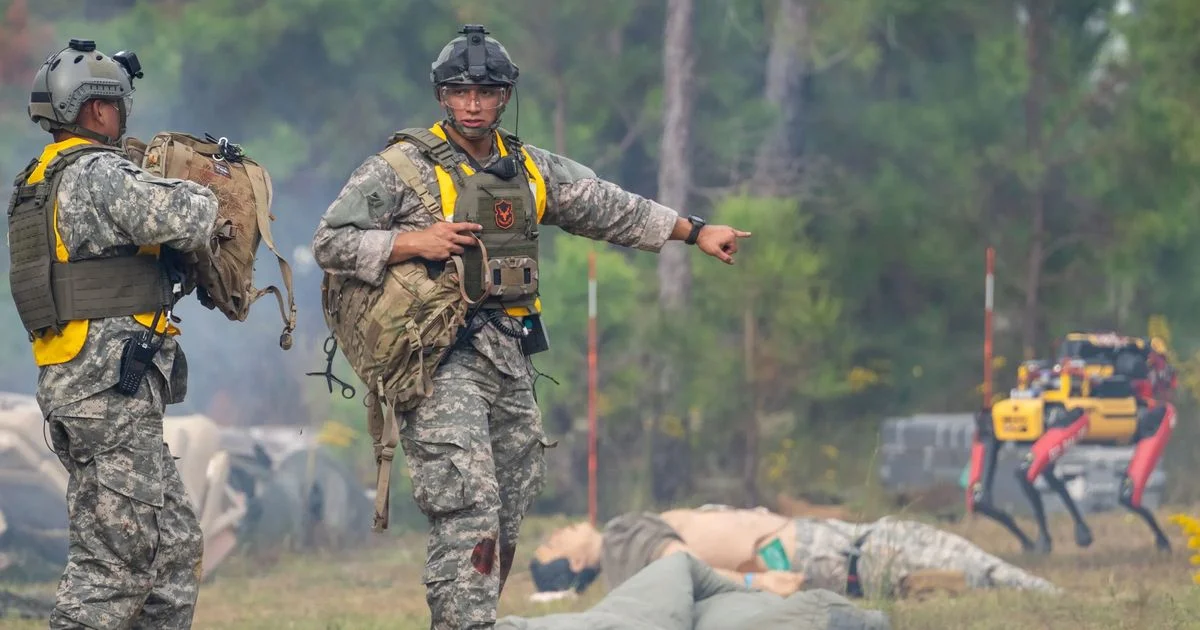
The setup at Disaster City in College Station, Texas, was deliberately chaotic — tornado wreckage, nighttime military base attacks, controlled explosions in the background. Drones and ground robots had 15 minutes to locate actors and mannequins simulating wounded personnel, then 5 minutes to assess injury severity and evacuation priority, all without physical contact. A separate algorithmic track tested whether software could predict what treatment a patient would need hours later. The operational logic is straightforward. US military planners now assume contested airspace in a peer conflict, which breaks the medevac chain that American forces have relied on since Vietnam. If helicopters can't fly, casualties stack up at the front line. Medics must hold patients for days, not minutes, and triage decisions — who gets scarce resources, who waits — become far more consequential and far more frequent. DARPA program manager Jeremy Pamplin, a retired Army physician, frames the technology as a force multiplier for human judgment, not a replacement. Drones scout ahead, relay patient data to medics' phones, and ground robots help locate the "needle in a haystack" among mass casualties. The goal is better information, faster, so a 19-year-old combat medic isn't making blind guesses about who to reach first. The ethical dimension is the quiet center of gravity here. Large-scale combat operations will force American medics into triage decisions most have never practiced — prioritizing survivable patients over those too far gone. Pamplin argues that algorithmic assistance can reduce the psychological burden on young medics making those calls. Whether that framing holds when the algorithm is wrong about who's salvageable is an open question the competition doesn't answer. The technology demonstrated remains early-stage. The article describes no accuracy rates, no comparison to human-only triage performance, and no timeline for fielding. What DARPA has done is define the problem sharply and create a competitive pipeline — multiple companies and universities submitted systems. The transition from controlled competition to battlefield deployment crosses a chasm of regulatory, ethical, and technical validation that hasn't begun. The deeper structural signal: the US military is building the assumption of degraded evacuation capability into its medical planning. That assumption reshapes everything downstream — training, equipment, doctrine, and now autonomous systems. The robots aren't the story. The story is a military that expects to lose air superiority and is rebuilding its medical infrastructure around that expectation.
Worth reading?
RECOMMENDED
Score
60
/100
Generative in intent — expanding battlefield medical capability under degraded conditions — but extractive risk is latent: autonomous triage systems concentrate life-or-death decision authority in algorithms validated only under controlled conditions.
What Is GRIN?
GRIN stands for Generativity, Resilience, Innovation efficiency, and Novelty openness. These four dimensions capture the essential characteristics of any memetic intelligence — whether a nation, a corporation, a religion, or a movement.
About GRINGenerativity
3/5
Resilience
3/5
Efficiency
2/5
Novelty
3/5
Extractive
1/5
Inverted
Does this create new capability or just redistribute existing value?
Real capability gap being addressed. Contested-airspace medevac failure is a genuine problem, and robotic pre-screening creates new capacity rather than redistributing existing resources. But no performance data disclosed.
Verified Facts (8)
DARPA Triage Challenge held at Disaster City facility in College Station, Texas
Drones and ground robots had 15 minutes to find simulated casualties
5 minutes to assess injury severity and evacuation priority without touching patients
Program manager is Jeremy Pamplin, retired Army physician
Robots must identify injuries, confirm patient responsiveness, and determine evacuation priority without physical contact
Separate algorithmic track tested whether software could predict treatment needs hours later
Military officials warned US unlikely to have air superiority in future conflicts, potentially causing evacuation delays of days to weeks
Competition ended in November 2026; began in September 2025
More latest news
Read all