SIGNATORIES
4
INFRA OPERATORS
3
AGREEMENT SIGNED
Aug 2026
CABINET MANDATE
Jul 2026
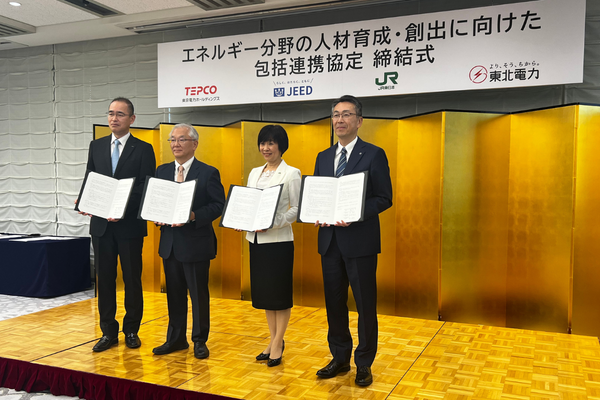
Japan's core infrastructure — power grids, railways, data centers, semiconductor fabs — runs on a workforce that is visibly graying out. The country's response so far has been piecemeal: individual firms training their own replacements, public vocational programs operating in parallel silos, and an SME sector that lacks the equipment or instructors to upskill workers at scale. On August 25, 2026, Tokyo Electric Power Holdings (TEPCO), Tohoku Electric Power, JR East, and JEED (the Japan Organization for Employment of the Elderly, Persons with Disabilities and Job Seekers) signed a comprehensive cooperation agreement aimed at stitching those silos together.
Extraction Map
The agreement falls under the "Japan Growth Strategy" cabinet decision of July 2026, specifically its energy-sector human capital plank: a mandate for industry and JEED to co-develop workforce pipelines in strategic energy fields. The three corporations bring large-scale physical training infrastructure — substations, rail depots, safety simulation rigs — and decades of accumulated field know-how. JEED contributes a nationwide network of vocational training centers, instructors certified in production technology, electrical energy control, and production electrical systems, plus established relationships with SMEs and young job-seekers. What the four parties plan to build together is a curriculum development and delivery system: new or upgraded vocational training courses for the energy and electrical sectors, hands-on training sessions for incumbent workers at SME subcontractors, and facility tours and work-experience programs designed to recruit younger entrants into trades they currently do not consider. TEPCO executive Yoshihiko Shinobu framed the ambition plainly: provide students with practical, on-site learning experiences that make energy-sector careers imaginable in a way classroom instruction cannot. The structural logic is sound. Japan's SME supply chain for infrastructure maintenance is the actual bottleneck — these firms lack the capital for training rigs and the headcount to spare a senior technician as an instructor. By opening corporate training assets to JEED's pipeline, the agreement creates shared infrastructure for human capital formation that no single SME could build alone. The three corporations, meanwhile, depend on those same SMEs for maintenance, construction, and disaster response across eastern Japan. The self-interest is mutual and transparent. The risk is execution velocity. Japan has signed many cross-sector cooperation agreements that produce committees, reports, and modest pilot programs but never reach the scale the demographic cliff demands. The agreement text covers curriculum co-development, facility sharing, and SME network access — all necessary, none sufficient without sustained funding, instructor recruitment, and measurable enrollment targets. No specific headcount goals, budget figures, or timeline milestones were disclosed at the signing ceremony. What makes this particular pact worth watching is the JEED anchor. Unlike bilateral corporate partnerships, JEED's nationwide reach and its statutory mandate to serve displaced, older, and disabled workers give the initiative a distribution channel that corporate training centers alone cannot replicate. If the curriculum modules developed under this agreement are deployed across JEED's regional network — and if SME workers actually enroll — the multiplier effect on workforce capacity could be meaningful. The 20-year question is whether Japan's infrastructure workforce shortage is a problem that training pipelines can solve at all, or whether it is a wage-and-conditions problem wearing a skills-gap mask. If young Japanese workers avoid energy-sector trades not because they lack awareness but because the pay and working conditions are unattractive, even the best vocational curriculum will produce graduates who leave the field. The agreement addresses supply-side plumbing. Demand-side incentives — compensation, career progression, working hours — remain unaddressed.
Worth reading?
RECOMMENDED
Score
60
/100
Mildly generative — the agreement creates shared training infrastructure that individual SMEs cannot build alone, but absence of budget commitments, headcount targets, or wage-side reforms limits its generative potential.
What Is GRIN?
GRIN stands for Generativity, Resilience, Innovation efficiency, and Novelty openness. These four dimensions capture the essential characteristics of any memetic intelligence — whether a nation, a corporation, a religion, or a movement.
About GRINGenerativity
3/5
Resilience
3/5
Efficiency
3/5
Novelty
2/5
Extractive
1/5
Inverted
Does this create new capability or just redistribute existing value?
Pooling corporate training assets for SME access is a real capability multiplier — if it scales. No enrollment targets or budgets disclosed, so generative potential remains theoretical until proven.
Verified Facts (5)
Agreement signed August 25, 2026 between TEPCO Holdings, Tohoku Electric Power, JR East, and JEED
Agreement falls under the Japan Growth Strategy cabinet decision of July 2026
JEED operates production technology, electrical energy control, and production electrical systems training programs
TEPCO executive Yoshihiko Shinobu stated the initiative aims to provide practical learning opportunities that help students envision energy-sector careers
JEED理事長 Shinobu Wajima, JR East 常務取締役 Harumi Nakagawa, Tohoku Electric 常務執行役員 Takashi Ogino participated in the signing ceremony
More latest news
Read all