K5-K UNIT COST
$100K
CHEAPER THAN KH-101
20×
BURST SPEED
600 mph
MAX CEILING
20,000 ft
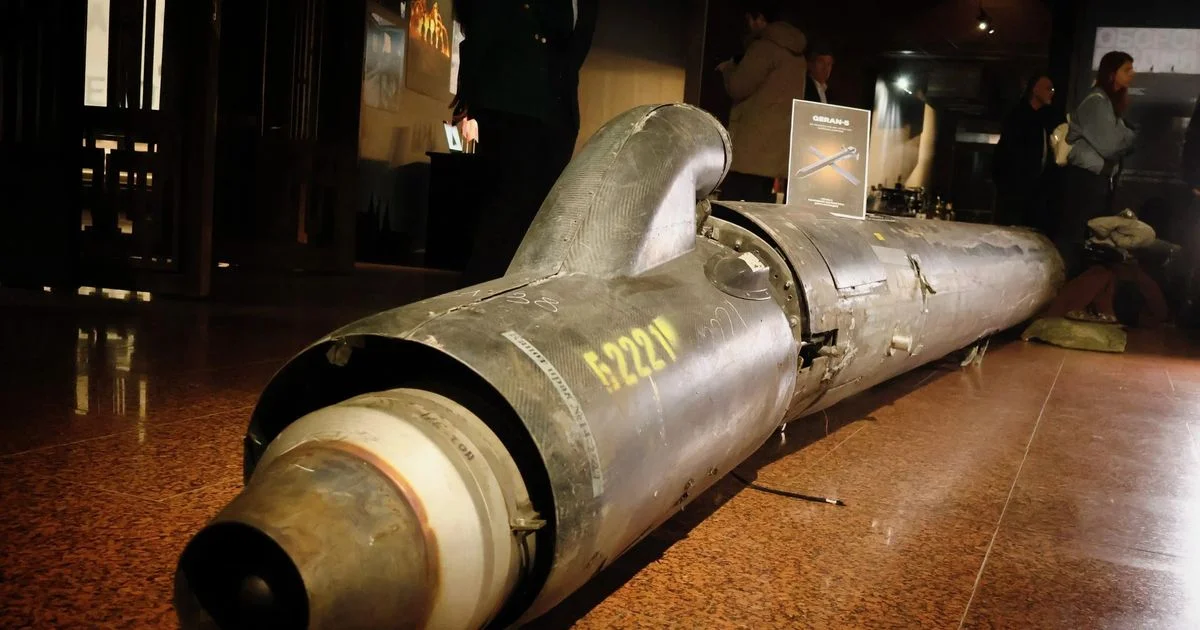
Ukraine's military intelligence directorate (GUR) revealed Monday that Russia has begun deploying the K5-K, an evolved variant of the Geran-5 jet-powered attack drone. The weapon was recovered nearly intact in a field, giving Ukrainian analysts their first close look at what they now classify as a small cruise missile. The distinction matters: this is no longer an improvised loitering munition but a purpose-built strike weapon with aerodynamic refinements, higher ceiling, and greater speed.
Extraction Map
The K5-K flies at a ceiling of nearly 20,000 feet — up from 16,000 — and cruises above 280 mph, with burst maneuver speeds exceeding 600 mph. Range (620 miles) and warhead weight (200 lbs) remain unchanged from the Geran-5, but the airframe is smaller and more aerodynamically efficient. GUR found hundreds of foreign-manufactured electronic components inside the recovered unit, reinforcing that sanctions enforcement on component supply chains remains porous. The recovered K5-K carried a TBCH-90 thermobaric warhead — a vacuum bomb that disperses an explosive aerosol cloud before igniting it, producing fireballs exceeding 4,000°F and shockwaves that consume surrounding oxygen. These weapons are especially devastating in enclosed spaces. Russia has previously fitted older drone variants with thermobaric payloads, a development Ukrainian first responders have flagged as a serious and worsening threat. The strategic logic is straightforward economics. The K5-K and similar quasi-cruise missiles like the Banderol S8000 cost an estimated $100,000 or less per unit. A Kh-101 cruise missile costs roughly $2 million. Russia can field 20 quasi-cruise missiles for the price of one conventional cruise missile, saturating Ukrainian air defenses with volume while preserving expensive missile stocks for high-value targets. The Institute for the Study of War (ISW) warns this represents a deliberate shift toward low-cost, cruise-missile-class weapons designed to exhaust Ukraine's dwindling interceptor supplies. Russia has invested heavily in supporting infrastructure, rapidly expanding air bases for jet-powered drone launches since mid-2026 and deploying thousands of these weapons against Ukrainian cities. The K5-K sits at the convergence point of two trends: the miniaturization and performance improvement of cheap drones, and the cost optimization of strike capabilities to sustain a long war of attrition. Ukraine's defense industry is racing to develop faster interceptors to counter jet-powered drones, but the cost asymmetry is structural. Every interceptor fired at a $100,000 quasi-cruise missile costs multiples of the weapon it destroys. ISW analysts note that Russia is deliberately integrating these weapons into combined strikes with ballistic missiles and jet-powered drones, creating layered attack packages that exploit and worsen Ukraine's interceptor shortages. The K5-K is not a technological leap — it is an incremental refinement that crosses a classification threshold. When a drone becomes fast enough, high-flying enough, and lethal enough to qualify as a cruise missile while retaining a drone's price tag, the defending side faces an industrial math problem that no single technology can solve.
Worth reading?
SKIP
Score
20
/100
Extractive. Russia is converting low-cost drone platforms into cruise-missile-class weapons specifically to exhaust Ukraine's expensive interceptor stockpiles — a textbook attrition-extraction strategy that destroys value on both sides but disproportionately burdens the defender.
What Is GRIN?
GRIN stands for Generativity, Resilience, Innovation efficiency, and Novelty openness. These four dimensions capture the essential characteristics of any memetic intelligence — whether a nation, a corporation, a religion, or a movement.
About GRINGenerativity
0/5
Resilience
1/5
Efficiency
2/5
Novelty
2/5
Extractive
5/5
Inverted
Does this create new capability or just redistribute existing value?
Zero-sum by design. The K5-K creates no new capability beyond destruction — its purpose is to degrade Ukrainian defense capacity faster than it can be replenished. Pure attrition economics.
Verified Facts (11)
K5-K is a variant of the Geran-5 jet-powered drone, classified by GUR as a small cruise missile
K5-K ceiling: nearly 20,000 feet, up from 16,000 feet for predecessor
Cruising speed exceeds 280 mph; burst maneuver speed exceeds 600 mph
Range: 620 miles; warhead weight: 200 lbs — same as predecessor
Recovered K5-K carried TBCH-90 thermobaric warhead
Thermobaric detonations exceed 4,000°F
Estimated cost of K5-K and Banderol S8000: up to $100,000 per unit
Kh-101 cruise missile costs approximately $2 million
Hundreds of foreign-manufactured electronic components found inside recovered unit
Russia has been expanding air bases to support jet-powered drone launches since mid-2026
ISW describes quasi-cruise missiles as weapons that blur the line between cheap attack drones and expensive cruise missiles
More latest news
Read all