SORTING ACCURACY
98%+
THROUGHPUT
Tons/hr
BUILD TIME
Months
MINERALS RECOVERED
Li·Ni·Co
Battery recycling has an unglamorous problem. Before you can recover lithium, nickel, or cobalt, someone has to identify and separate thousands of batteries arriving in mixed heaps — different shapes, sizes, chemistries. Get the sorting wrong and downstream recovery tanks in efficiency and cost. Redwood Materials, the recycler founded by Tesla co-founder JB Straubel, has built an AI system to automate exactly this step.
Extraction Map
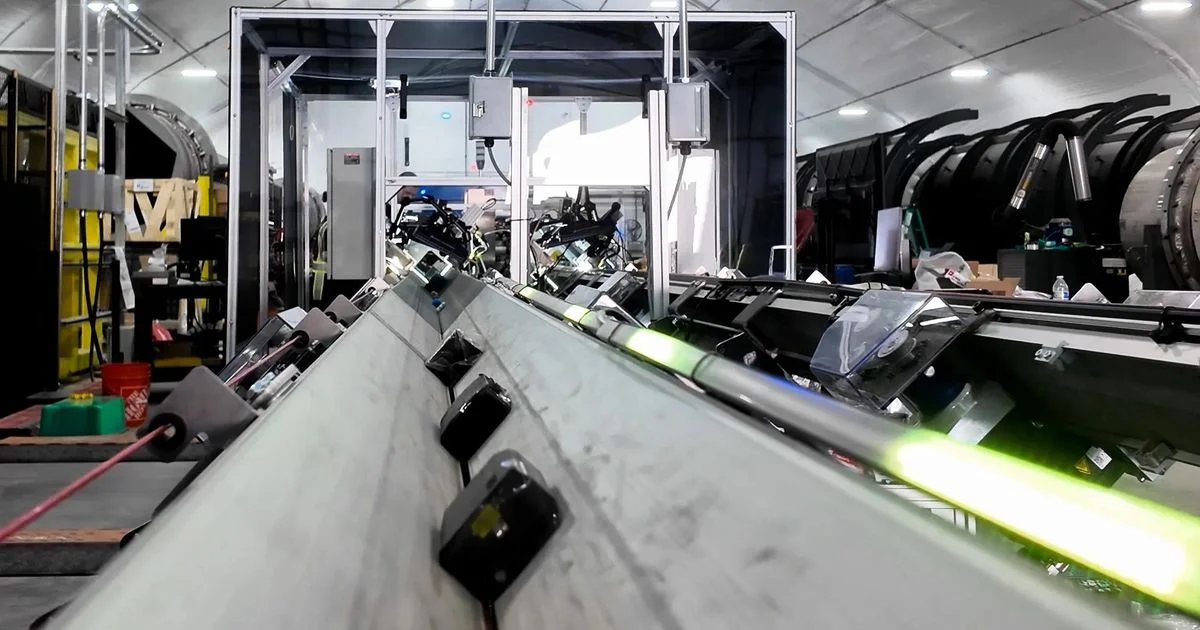
The system works like a conveyor-belt triage line. Mixed batteries arrive in bins, get mechanically separated into single file, then pass through an inspection tunnel equipped with cameras and sensors that read labels, measure shape, and weigh each unit. A proprietary AI model — trained on Redwood's own battery dataset and running on on-site GPU clusters — classifies each battery and routes it to the correct recycling stream. Accuracy exceeds 98%, and throughput runs at several tons per hour. The build took months, not years. That speed matters because the bottleneck in battery recycling has never been chemistry — hydrometallurgical and pyrometallurgical processes for extracting metals are well-understood. The bottleneck is the messy, labor-intensive front end: getting the right batteries into the right process. Automating classification at industrial speed is what makes the rest of the pipeline economically viable at scale. The strategic context is straightforward. The US imports the vast majority of its critical battery minerals. Domestic recycling is one of the few levers that reduces dependence on foreign mining and refining — particularly from supply chains running through China and the DRC. Every ton of accurately sorted batteries is a ton of lithium and cobalt that doesn't need to be mined or imported. This is also a useful corrective to AI hype narratives. The system isn't generating text or images. It's doing industrial classification — a task that's repetitive, error-prone for humans, and perfectly suited to computer vision. The value proposition is concrete: higher recovery rates, lower contamination, faster throughput, reduced labor costs in a job nobody wants to do manually. Redwood hasn't disclosed the system's cost, error modes, or how it handles novel battery types not in its training data. The 98% accuracy figure sounds impressive, but the remaining 2% at tons-per-hour throughput could mean meaningful volumes of misrouted batteries. How the system degrades as battery designs proliferate — solid-state, sodium-ion, new form factors — will determine its long-term value. The bigger picture: AI applied to industrial sorting and classification is a pattern with legs. Waste management, mineral processing, food grading, and logistics all have analogous bottlenecks where human sorting is slow, expensive, and inconsistent. Redwood's system is a proof point, not a breakthrough — but proof points in physical-world AI matter more than benchmarks on leaderboards.
Worth reading?
RECOMMENDED
Score
72
/100
Generative — creates new domestic supply of critical minerals by unlocking an industrial bottleneck, reducing dependence on extractive import chains.
What Is GRIN?
GRIN stands for Generativity, Resilience, Innovation efficiency, and Novelty openness. These four dimensions capture the essential characteristics of any memetic intelligence — whether a nation, a corporation, a religion, or a movement.
About GRINGenerativity
4/5
Resilience
4/5
Efficiency
4/5
Novelty
2/5
Extractive
1/5
Inverted
Does this create new capability or just redistribute existing value?
Genuine capability creation. Automates a bottleneck that blocked economic viability of battery recycling at scale, enabling domestic critical mineral recovery that didn't previously exist.
Verified Facts (7)
Redwood Materials founded by Tesla co-founder JB Straubel
AI sorting system achieves accuracy exceeding 98%
System processes several tons of batteries per hour
System built in a few months
AI model trained on Redwood's battery data, running on on-site GPU clusters
Batteries pass through tunnel with cameras and sensors checking labels, shape, and weight
Goal is recovering lithium, nickel, and cobalt to reduce mining and import dependence
More latest news
Read all