TIMELINE CAVEAT
12mo
FIRMS COMPETING
5+
BRIGADES NAMED
3
COUNTER-DRONE METHODS
4+
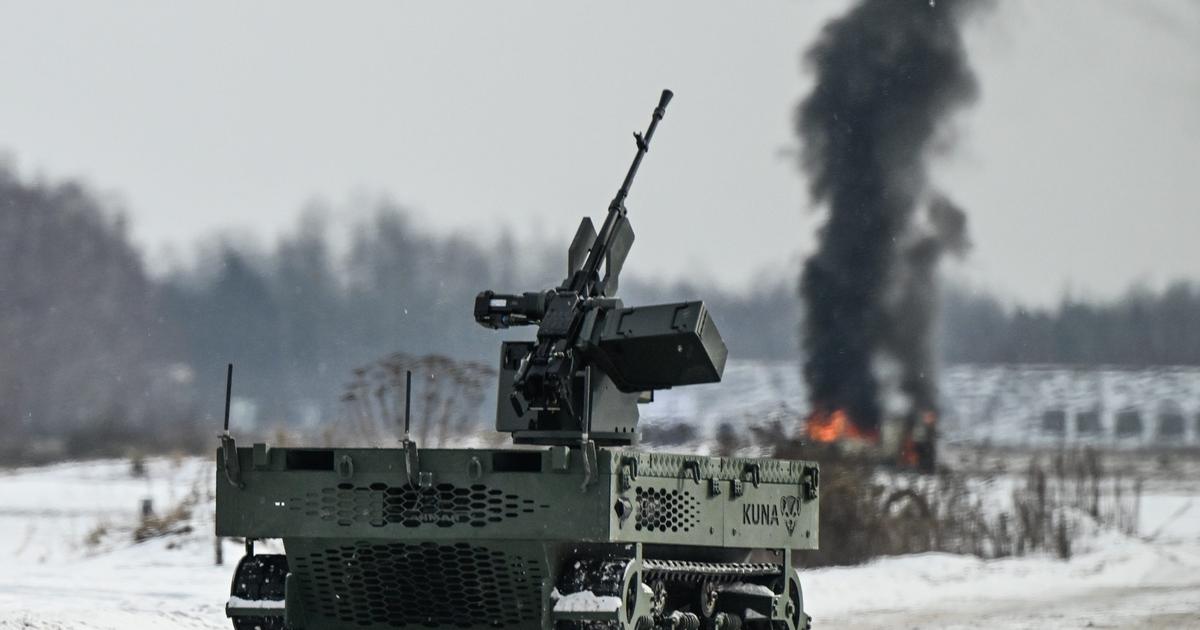
The kill zone along Ukraine's front lines is expanding. Reconnaissance and attack drones saturate the airspace, making any movement by soldiers or vehicles lethally dangerous. Ukrainian ground robot manufacturers are now racing to solve this problem from below — equipping unmanned ground vehicles with the ability to detect, track, and destroy incoming drones before they reach their targets.
Extraction Map
The technology spans several approaches. UFORCE's AI-powered "Predator" weapons system mounts on robots to track and shoot down drones via ambush tactics. Rovertech uses sensors and AI to detect approaching drones and fires nets to capture them. Ratel Robotics has begun mass-producing net-launcher defense systems for robot protection. The 100th Separate Mechanized Brigade has already deployed net-based anti-drone defenses and published video of a robot downing an incoming drone. Some units are sending robots equipped with electronic warfare jammers into forward positions to disrupt Russian drone communications. Oleksandr Yabchanka, who leads the robotics systems division for the elite Da Vinci Wolves Battalion, told Business Insider that countering Russian drones is "one of the major challenges" on the battlefield and that ground robot systems "can contribute significantly to solving this problem." He co-founded Defence Robotics UA, a nonprofit supporting military robot adoption. Yabchanka sees low-altitude airspace defense as one of the most promising applications for ground robots, though he cautioned that transforming the kill zone situation is not something he would "promise within the next 12 months." Mykyta Rozhkov, chief business development officer at Frontline Robotics, confirmed that robots are becoming a "primary attack target" for Russian forces and are vulnerable without defensive equipment. The logic is straightforward: if robots can survive drone attacks, they last longer on the battlefield; if they can function as mobile air defense platforms, they protect the soldiers behind them. Rozhkov predicted that "increasingly advanced technologies for intercepting enemy drones" will be integrated into Ukrainian robots in the near future. The Ukrainian government-backed military technology organization Brave1 acknowledged that armed robots are already being used to intercept airborne enemy drones, while flagging anti-aircraft weapons and self-defense technologies as priority development areas. Multiple manufacturers — including firms building robots explicitly branded for "kill zone" operations — are working on smoke screens, fragmentation devices, machine guns, and electronic warfare packages as countermeasures. The strategic logic is clear: whichever side develops reliable counter-drone capability for ground platforms first gains an asymmetric advantage. As Rozhkov put it, the side that develops methods to shoot down drones first "will gain an overwhelming advantage on the battlefield and can significantly change the course of the war." But the technology remains in testing or limited deployment. Most systems currently protect the robot itself rather than providing area defense for troops — the leap from self-defense to mobile short-range air defense for infantry formations is the critical next step. This is a generative arms race driven by survival pressure rather than procurement bureaucracy. Ukraine's distributed ecosystem of small robotics firms, frontline units running live experiments, and government accelerators like Brave1 creates an innovation loop that larger militaries will study for decades. The question is whether these capabilities can scale from demonstration videos to systematic battlefield coverage before the kill zone swallows more soldiers.
Worth reading?
RECOMMENDED
Score
72
/100
Generative. Distributed innovation ecosystem building new capability under existential pressure, with knowledge and technology that will reshape ground warfare globally.
What Is GRIN?
GRIN stands for Generativity, Resilience, Innovation efficiency, and Novelty openness. These four dimensions capture the essential characteristics of any memetic intelligence — whether a nation, a corporation, a religion, or a movement.
About GRINGenerativity
4/5
Resilience
3/5
Efficiency
3/5
Novelty
4/5
Extractive
1/5
Inverted
Does this create new capability or just redistribute existing value?
Genuine capability creation. Multiple firms building novel counter-drone systems (AI targeting, net launchers, EW jammers) that didn't exist 18 months ago — born from survival pressure, not procurement cycles.
Verified Facts (8)
Oleksandr Yabchanka leads the robotics systems division for the Da Vinci Wolves Battalion and co-founded Defence Robotics UA
Mykyta Rozhkov is chief business development officer at Frontline Robotics
UFORCE developed an AI-powered weapons system called Predator that can track and shoot drones from robot platforms
The 42nd Separate Mechanized Brigade previously reported shooting down a Russian drone with a machine gun mounted on the ground robot Liut
Ratel Robotics has begun mass-producing net-launcher defense systems
The 100th Separate Mechanized Brigade announced deployment of net-based anti-drone defense systems in October 2026
Rovertech manufactures robots branded for kill zone operations using sensors and AI with net launchers
Brave1 is a Ukrainian government-backed military technology development support organization
More latest news
Read all