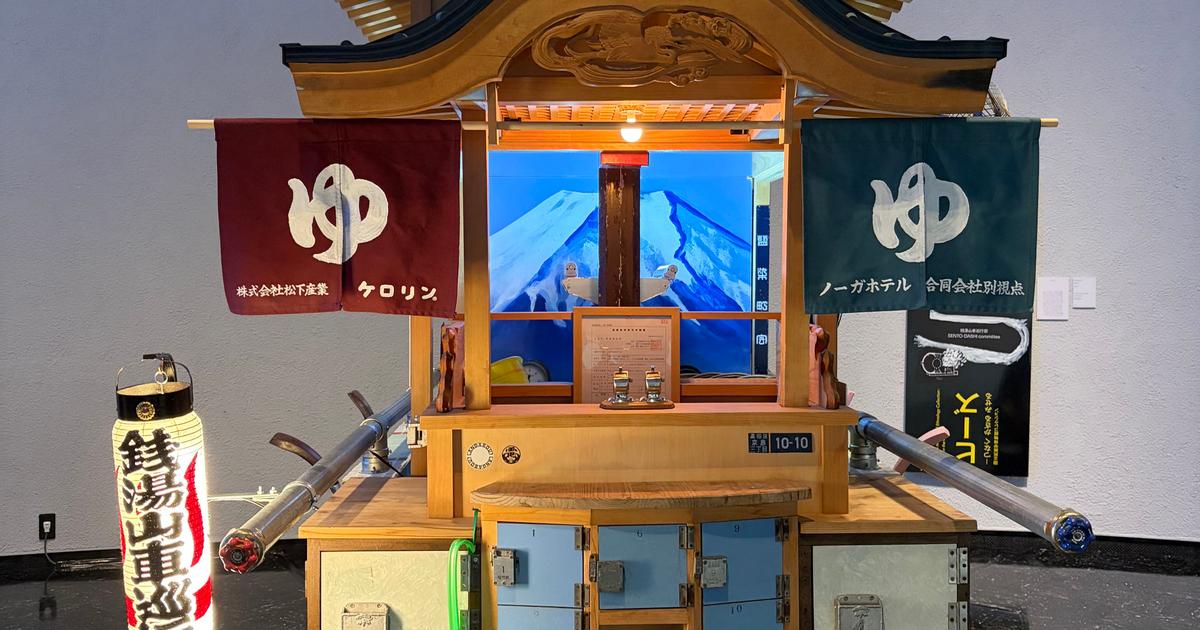
Like Jane Jacobs's sidewalk ballet filtered through Fluxus absurdism, the Shoto Museum of Art's exhibition "Rojo — Are We in the Way?" uses the detritus of Japanese streets — useless staircases, collected pebbles, ice cream prize sticks — to mount a serious argument about what cities lose when they optimize for cleanliness and control. The show marks 40 years since the founding of the Rojō Kansatsu Gakkai (Street Observation Society), but the anniversary is pretext, not purpose. The real occasion is Tokyo's ongoing redevelopment binge, which has been sanding down the rough textures that made its neighborhoods worth walking through. The exhibition opens with Akasegawa Genpei's photographs of "Thomasson" — architectural remnants that have lost all function but survive on buildings like vestigial organs. A sealed-off staircase leading nowhere. A door three stories up with no balcony. These are funny, but the humor does real conceptual work: it trains your eye to see the city as a living accumulation of accidents rather than a designed product. From there, the show moves through Hayashi Jōji's small-stone collections, detailed illustrations of foreign hotel rooms, and other acts of obsessive, affectionate urban cataloging. The pivot comes when the exhibition shifts from whimsy to politics. Photographs of homeless residents, documentation of the "plaza" that once existed at Shinjuku Station's west exit, and work by the contemporary collective Chim↑Pom force a harder question: public space isn't just charming — it's contested. The exhibition's statement invokes the concept of "kugai," historical free zones around temples and market towns where ordinary power structures didn't reach. The modern street, the curators argue, is an imperfect descendant of these spaces — both a site of freedom and of exclusion. What makes the show land is its refusal to be nostalgic. The Street Observation Society's founders weren't preservationists mourning a lost golden age. They were comedians of infrastructure, people who found delight in dysfunction. The exhibition positions that sensibility as a form of resistance: if you can see the beauty in a useless staircase, you're less likely to accept the premise that every surface must justify its existence economically. That's a direct challenge to the logic driving Shibuya's transformation into a district of glass-and-steel commercial towers. The timing is deliberate. Editor-in-chief Kosaka Nozomi, writing in her Business Insider Japan newsletter, connects the exhibition to a panel she joined at the Social Innovation Week conference on "Revealing the City." Her insight is clean: urban appeal has two engines. One is designed experience — the curated, the planned, the branded. The other is accidental texture — the stuff that grows in the cracks between intentions. Redevelopment overwhelmingly serves the first engine while destroying the second. The Shoto Museum building itself — small, built in 1981, designed by Shirai Seiichi — embodies the argument. It's the kind of structure that makes you curious about its architect and history, precisely because it doesn't look like everything else. It has texture. The show closed November 23, 2026, but the question it poses will outlast it: when every neighborhood in Tokyo converges on the same aesthetic of polished efficiency, what exactly are people traveling to see? This is a newsletter column, not an academic essay, and its ambitions are proportional. But within that frame, Kosaka does something genuinely useful: she connects a museum exhibition to an urban planning debate to a personal observation about what makes streets interesting, and she does it without sentimentality or jargon. The piece functions as a compressed argument that sterility is a design choice, not an inevitability — and that the people who noticed this 40 years ago were ahead of us.
Worth reading?
RECOMMENDED
Score
60
/100
Anyone thinking about what Tokyo's redevelopment boom is gaining and losing — urbanists, architects, Tokyo residents watching their neighborhoods change, readers interested in Japanese art and public space.
Cultural Placement
Like Jane Jacobs's 'The Death and Life of Great American Cities' compressed into a museum walkthrough, with the deadpan humor of Akasegawa Genpei's neo-Dadaist eye. Sits in the tradition of urban observation writing — Teju Cole's 'Open City,' Iain Sinclair's psychogeography — but grounded in a specific Japanese lineage running from Kon Wajirō's 'modernology' surveys of the 1920s through the Rojō Kansatsu Gakkai. The column form owes more to Ian Frazier's New Yorker city pieces than to conventional art criticism: the exhibition is a vehicle, not the destination.
Honest assessment
A compact, well-argued newsletter column that uses a museum show as a lens for a larger urban question. It doesn't break new ground intellectually, but it makes a real argument accessibly and connects it to lived experience in Shibuya. Best read as a gateway to Akasegawa and the Street Observation Society rather than as a standalone critical essay.
What Is NOVEL?
60
/ 100
BedrockNews applies a structured analytical framework called NOVEL to cultural works — games, books, film, music, and more.
How NOVEL worksNerve
2/5
Originality
3/5
Voice
3/5
Endurance
3/5
Lineage
4/5
What did the artist risk? What could have failed?
Low structural risk. A newsletter column connecting an exhibition to an urban planning observation is well-worn territory. The column doesn't stake a controversial position — its argument (sterile cities are boring) is widely held.
Lineage tree
Akasegawa Genpei / Hyper-Art Thomasson
direct ancestor — the exhibition's foundational concept and the column's central reference
Rojō Kansatsu Gakkai
direct ancestor — the collective whose 40th anniversary occasions both the exhibition and the column
Jane Jacobs / Death and Life of Great American Cities
tonal influence — the argument that messy, unplanned street life is a feature not a bug
Kon Wajirō / Modernology
extends the form of — Japanese tradition of systematically observing everyday urban life
Chim↑Pom
contemporary interlocutor — the exhibition uses their work to update the argument for the present
Verified Facts (7)
路上観察学会 founded 1986, with members: 赤瀬川原平、藤森照信、林丈二、南伸坊、松田哲夫、杉浦日向子、一木努、荒俣宏、飯村昭彦
Exhibition title: 「路上、お邪魔ですか?」at 渋谷区立松濤美術館
Exhibition ran through November 23, 2026
松濤美術館 building built in 1981
Conference: Social Innovation Week (SIW) hosted by 渋谷未来デザイン, session titled 'Reveal the City'
Co-panelists included Kärcher, WeWork Japan, and a creator with 4 million total SNS followers
Exhibition statement references 公界 (kugai) as historical free spaces around temples and market towns
More latest news
Read all