CONTRACT VALUE
$2.5M
THREAT TYPES ID'D
150+
VENDORS INTEGRATED
2
ABRAMS UNIT COST
$10M
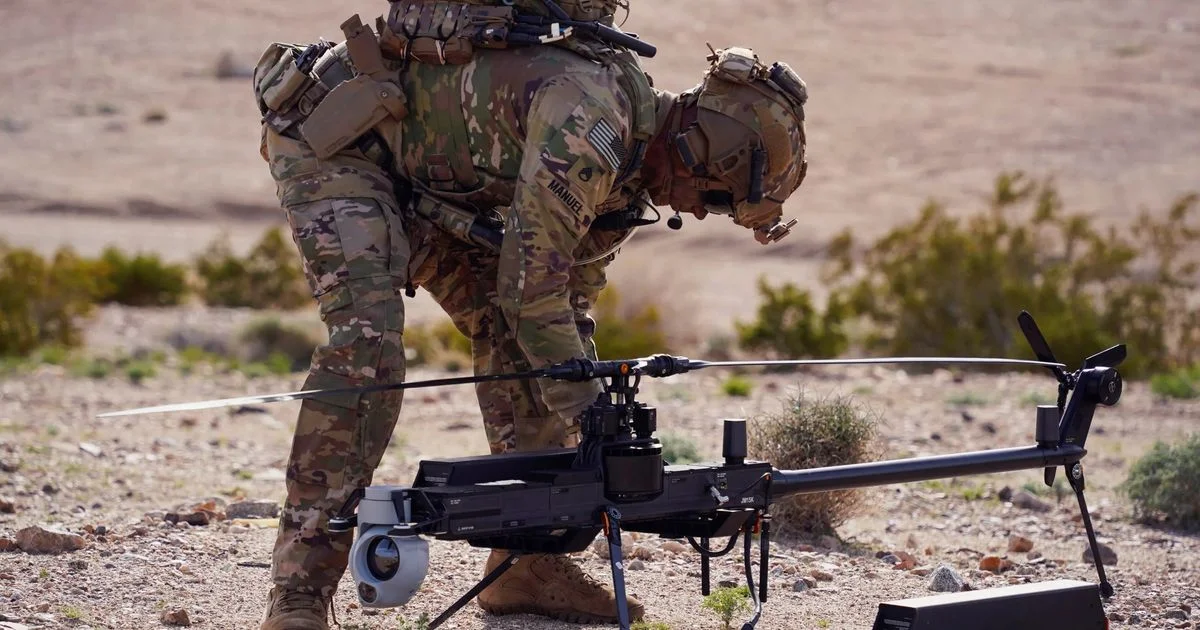
The US Army has awarded a $2.5 million contract to defense tech firm Safe Pro Group to integrate its Ground Truth threat-detection software into Anduril Industries' Ghost-X drone — a small helicopter-style UAS designed to fly ahead of armored columns and spot hidden dangers before tank crews drive into them. The software can identify and map more than 150 types of explosive threats from aerial imagery, including mines, cluster munitions, and first-person-view ambush drones.
Extraction Map
The contract is a direct product of the Ukraine battlefield's brutal tutorial in what happens when heavy armor operates without persistent overhead surveillance. In eastern Ukraine, tanks and armored vehicles have faced dense minefields, omnipresent drone reconnaissance, and increasingly capable FPV drones that attack from above or chase vehicles across terrain once considered safe. The lesson: armored forces that advance blind die fast. Safe Pro's Ground Truth software is trained on datasets collected from Ukraine — real-world imagery of real explosive threats in real operational conditions. That provenance matters. AI threat-detection systems trained on synthetic or sanitized data tend to fail when confronted with the messy visual signatures of actual minefields. Ukraine data gives the system a running start on recognition accuracy that would otherwise take years of controlled testing to approximate. The Ghost-X drone, built by Anduril Industries, serves as the delivery platform. Detected threats are pushed into military networks — specifically ATAK (Android Team Awareness Kit) and Anduril's Lattice command-and-control system — giving tank crews and their commanders a live threat picture before committing to a route. Daniel Leighton, Anduril's general manager of tactical effects, framed the integration as providing "faster, more reliable situational awareness at the tactical edge." At $2.5 million, this is a small-scale integration contract, not a program of record. It is best understood as a doctrinal signal: the Army is building toward a future where no armored unit moves without AI-equipped aerial scouts running ahead. The shift mirrors broader Army restructuring of armored formations to account for the fact that tanks must now approach cautiously rather than charge forward. The industrial picture here is worth noting. Anduril provides the airframe and the network backbone; Safe Pro provides the AI software trained on combat data. This is the model the Pentagon's acquisition reformers have been pushing — best-of-breed components from specialist vendors, integrated on common platforms, rather than single-vendor monoliths. Whether that model survives contact with defense procurement incentives at scale remains an open question. The underlying bet is that AI-assisted reconnaissance can restore enough survivability to justify continued investment in heavy armor. If threat detection from drones becomes reliable and fast enough, armored forces regain the ability to maneuver — which is their entire reason for existing. If it doesn't, the $10 million Abrams remains a slow, expensive target in a battlefield increasingly optimized to destroy it.
Worth reading?
RECOMMENDED
Score
68
/100
Modestly generative — creates new reconnaissance capability for armored forces using combat-validated AI, but the $2.5M contract is a signal, not a transformation, and benefits flow primarily to two defense contractors.
What Is GRIN?
GRIN stands for Generativity, Resilience, Innovation efficiency, and Novelty openness. These four dimensions capture the essential characteristics of any memetic intelligence — whether a nation, a corporation, a religion, or a movement.
About GRINGenerativity
3/5
Resilience
3/5
Efficiency
4/5
Novelty
4/5
Extractive
2/5
Inverted
Does this create new capability or just redistribute existing value?
Genuinely new capability: AI-mapped threat detection ahead of armor columns. But $2.5M buys an integration demo, not a fielded system. Generative potential is real; generative scale is not yet proven.
Verified Facts (7)
Safe Pro Group received a $2.5 million US Army contract
The contract integrates Ground Truth threat-detection software into Anduril Industries' Ghost-X drone
The software can identify and map over 150 types of explosive threats from aerial imagery
The software's dataset is based on data from Ukraine
Threats include mines, anti-personnel mines, cluster munitions, and first-person-view ambush drones
Detected threats are transmitted to ATAK and Anduril's Lattice network
Daniel Leighton is Anduril Industries' general manager of tactical effects
More latest news
Read all