KILLHOUSE VISITS
2
FASTEST ARMY PIVOT
16 yr
UKRAINE ELITE UNIT
3rd Corps
UALC HOME BASE
Fort Rucker
James Andreasen is a senior aviation warrant officer and AH-64 Apache pilot stationed at Fort Rucker, Alabama, where he helped launch the U.S. Army's Unmanned Advanced Lethality Course (UALC). He visited Ukraine's Killhouse Academy — a drone training operation run by the elite 3rd Corps — in November 2025 and again in March 2026. What he found was a training philosophy built by people who die when training fails.
Extraction Map
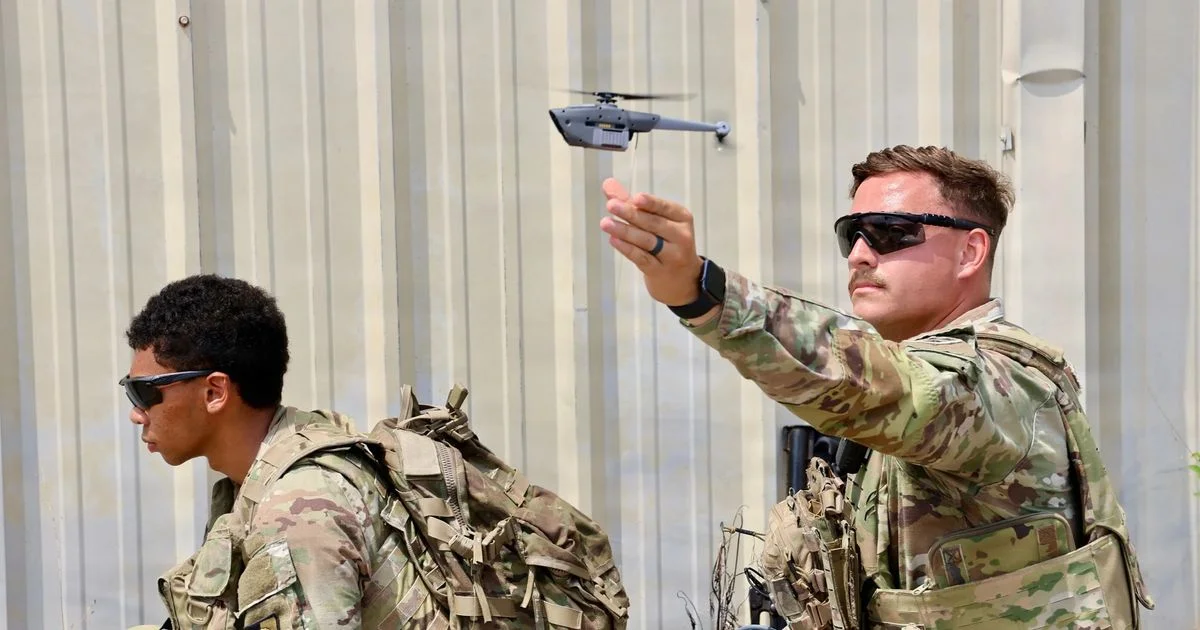
The gaps between American and Ukrainian drone training are structural, not cosmetic. Ukrainian trainees must repair, reprogram, and rebuild their drones from components. They learn the guts of the systems so they can adapt in the field. American training, by contrast, treats the drone as a finished product to be operated, not understood. Andreasen recognized this maintenance-first philosophy as essential to battlefield adaptability and has begun incorporating it into UALC. The most revealing difference is in electronic warfare. The Killhouse deliberately degrades signals during training, forcing pilots to operate in conditions that mirror the jammed, contested electromagnetic environment of the front lines. The U.S. Army's instinct runs the opposite direction — maintain clean signals so exercises run smoothly and assets aren't lost. The result is trainees who have never flown blind until the moment it matters most. Operator survivability is another divergence. The U.S. initially imagined soldiers could fly drones from behind a tree with a pair of goggles. Ukrainian operators, who are priority targets for Russian forces, treat concealment and position security as core doctrine. The Killhouse trains this from day one. The technology itself surprised Andreasen too — basic, cheap, often donated or secondhand equipment, the polar opposite of the American preference for expensive, multi-function platforms. Tactically, the Killhouse teaches slow and steady over flashy. No backflips. Instead: sustained stable hovers, low-altitude flight, navigating inside buildings and around corners without losing altitude. These are the skills that keep operators alive and strikes accurate. Andreasen has directly replicated these training objectives in the UALC, including adjustments to flight altitude protocols and target engagement methods. Andreasen's assessment of Army responsiveness is notably positive. He told Business Insider that in 16 years of service, he has never seen the Army move this fast to absorb lessons from an active conflict. The institution has been open to his recommendations for course improvements. The bottleneck is throughput: the Army cannot push enough soldiers through these courses quickly enough to close the gap. The underlying tension is familiar. Peacetime military training optimizes for control, predictability, and asset preservation. Wartime training optimizes for chaos tolerance and operator survival. Ukraine's Killhouse exists because the alternative is dead drone pilots. The question for the U.S. Army is whether it can internalize that urgency without the forcing function of its own casualties.
Worth reading?
ESSENTIAL
Score
80
/100
Generative. Live combat knowledge is being transferred into institutional training doctrine at speed, expanding U.S. military capability without extracting from the source.
What Is GRIN?
GRIN stands for Generativity, Resilience, Innovation efficiency, and Novelty openness. These four dimensions capture the essential characteristics of any memetic intelligence — whether a nation, a corporation, a religion, or a movement.
About GRINGenerativity
4/5
Resilience
4/5
Efficiency
4/5
Novelty
4/5
Extractive
1/5
Inverted
Does this create new capability or just redistribute existing value?
Genuine capability creation. Battle-tested Ukrainian drone doctrine is being translated into repeatable U.S. training modules — new skills, not just new hardware purchases.
Verified Facts (11)
James Andreasen is a senior aviation warrant officer and AH-64 Apache pilot at Fort Rucker, Alabama
Andreasen visited the Killhouse Academy in November (last year) and again in March
The Killhouse Academy is operated by Ukraine's elite 3rd Corps
Killhouse trains military personnel, foreign fighters, civilians, and defense industry workers on small drones
Andreasen helped launch the U.S. Army's Unmanned Advanced Lethality Course (UALC)
Ukrainian trainees must repair and reprogram their own drones
Killhouse deliberately degrades signals to simulate electronic warfare conditions
U.S. Army instinct is to maintain signals during training
Andreasen described his experience in an article for West Point's Modern Warfare Institute
Andreasen stated he has never seen the Army move this fast in 16 years of service
Andreasen said the biggest issue is not being able to get enough soldiers through courses fast enough
More latest news
Read all