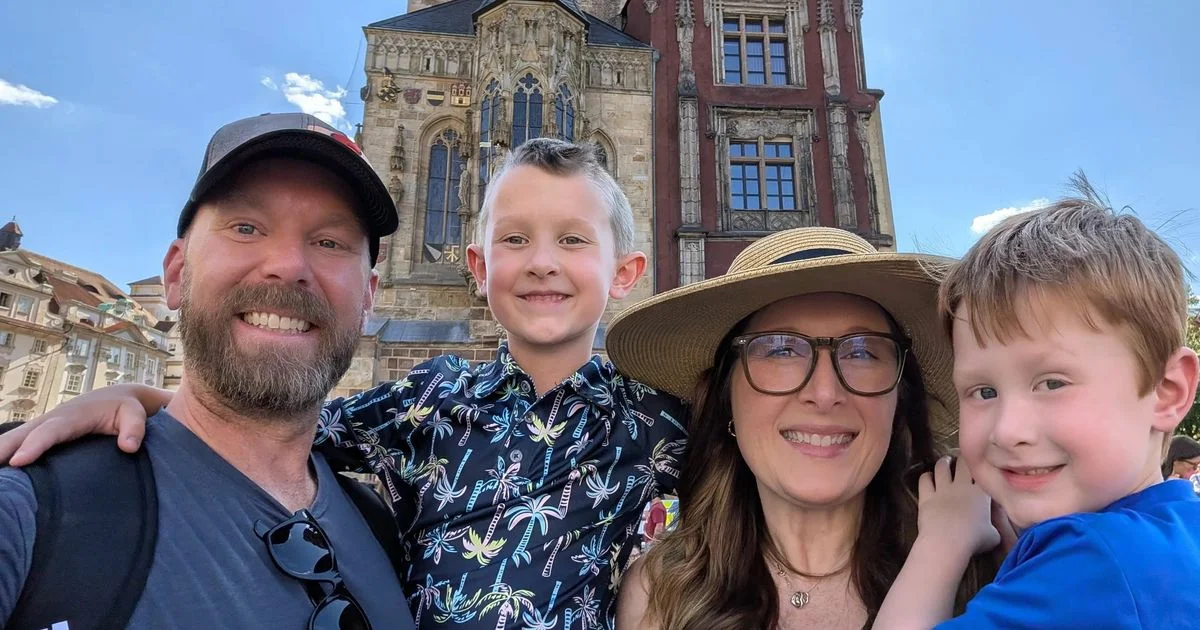
The pitch is simple and genuinely useful: stop building family vacations around kid-centric attractions and start building them around what the adults actually want to see, then find creative bridges to keep the children engaged. Blythe Chadim and her husband tested this across nearly three weeks in Poland, the Czech Republic, and Austria with their 4- and 6-year-old sons, and the article is a field report on what worked. The strongest move here is the reframing technique. Tell a child they're visiting a salt mine and you get eye-rolls. Tell them it's a real-life Minecraft adventure and they're racing down 135 meters of stairs with enthusiasm. The Wieliczka Salt Mine visit is the article's best example — a genuinely adult-interest historical site made legible to small children through a single vocabulary swap. The pierogi-making class in Kraków works similarly: the kids are kneading dough and shaping dumplings, which is play, while the parents are absorbing a multigenerational Polish recipe and cultural connection. The practical tactics are worth cataloguing. Self-guided tours so kids control the pace. Sitting in the back row at the Kraków classical concert so you can leave quietly. Splitting a large museum (Prague's National Museum) across multiple days. Ice cream breaks as pressure valves. Letting children physically lead you through the Royal Castle in Warsaw so they feel ownership rather than obligation. None of this is revolutionary parenting theory, but it's specific and tested. What the piece doesn't do — and doesn't pretend to — is address the hard version of the question. The family visited Warsaw, Kraków, Prague, and an Austrian Alps resort. These are well-touristed, English-friendly, affordable European destinations with strong family infrastructure. The advice is less obviously transferable to, say, rural Sicily or a week in Istanbul with a toddler. The article also doesn't discuss cost, logistics, or the considerable privilege embedded in a three-week European family vacation. The writing is clean first-person travel journalism — not trying to be literary, not padded with SEO filler beyond the tags. The photos are real family snapshots, not stock. The tone is warm without being smug, which is harder than it looks in the parenting-travel genre. Chadim avoids the trap of performing either martyrdom ('traveling with kids is SO hard') or effortless perfection ('our children sat through a two-hour opera'). The lasting takeaway is the meta-principle: 'kid-friendly' and 'kid-centered' are different categories, and conflating them impoverishes family travel for everyone. That's a genuinely useful reframe that applies well beyond Europe.
Worth reading?
OPTIONAL
Score
32
/100
Parents with kids under 8 actively planning a European trip who need permission and tactics to skip Legoland.
Cultural Placement
Like Rick Steves' practical specificity crossed with the parenting-philosophy essays of Emily Oster, but in first-person travel-blog form. The mechanism is closer to a Wirecutter recommendation than to literary travel writing — the goal is actionable tactics, not evocative prose. Sits in the tradition of 'tested it so you don't have to' service journalism, alongside pieces like Cup of Jo's family travel posts and the better Condé Nast Traveler family guides. More honest than most of its peers, less ambitious than the form allows.
Honest assessment
A clean, specific, useful piece of service journalism that delivers exactly what the headline promises — practical tactics for adult-centered family travel in Europe. It won't change how you think about travel writing, but if you're packing for Warsaw with a preschooler next month, the Minecraft-framing trick alone is worth the five-minute read.
What Is NOVEL?
32
/ 100
BedrockNews applies a structured analytical framework called NOVEL to cultural works — games, books, film, music, and more.
How NOVEL worksNerve
1/5
Originality
2/5
Voice
2/5
Endurance
1/5
Lineage
2/5
What did the artist risk? What could have failed?
Zero risk taken. The thesis — don't center kids on family trips — is well-established in parenting-travel circles. Nothing here could fail or offend. Safe, competent execution.
Verified Facts (9)
Trip duration: nearly three weeks in July
Children ages: 4 and 6 at time of travel
Destinations: Warsaw, Kraków, Prague, Austrian Alps resort
Wieliczka Salt Mine descent: 135 meters
Kraków concert venue: Saints Peter and Paul Church
Prague museums: National Museum, children's museum
Warsaw: Royal Castle, damaged in WWII and rebuilt
Czartoryski Museum: Leonardo da Vinci's Lady with an Ermine
Activity: Polish pierogi-making class in Kraków
More latest news
Read all