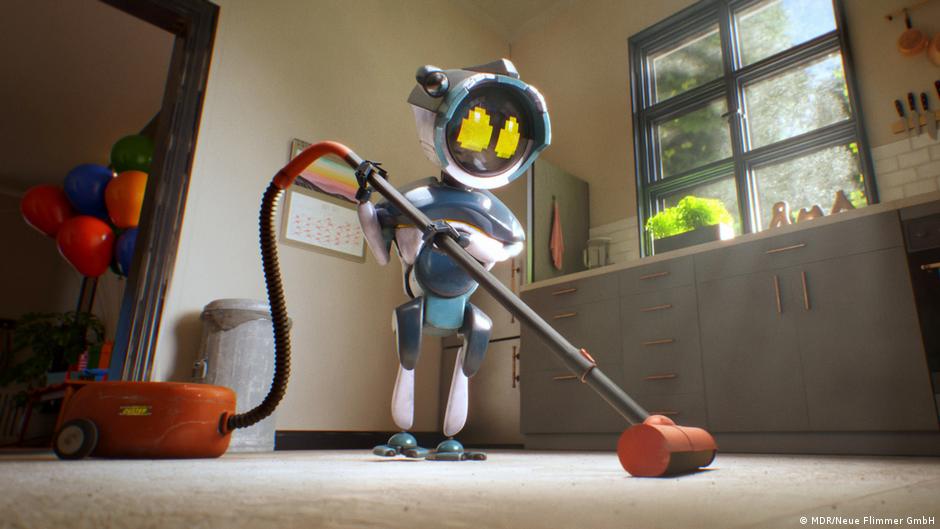
Moritz Henneberg and Julius Drost made an animated short called "Butty" — a story about a household robot discarded for incompetence — as their final project at a Berlin film school. They posted it on YouTube, it went viral, and when they tried to submit it to festivals, they discovered a US student named Samuel Felinton had already entered it under a new title, "T-130," with their credits stripped. Felinton had won multiple prizes with the stolen work. The obvious move was litigation. Their lawyers told them what lawyers always tell small-budget creatives: it would be expensive, slow, and uncertain. So Henneberg and Drost did the thing that made them filmmakers in the first place — they picked up a camera. They flew to Morgantown, West Virginia, used a New York filmmaker as a kind of Trojan horse to gain Felinton's trust, and then confronted him on camera. The confrontation is the documentary's hinge, and it delivers something stranger than catharsis. Felinton didn't cry, didn't run, didn't get aggressive. He calmly explained how he'd "improved" the film and offered to transfer prize money. The three of them barbecued afterward and played basketball. This flatness — the total absence of guilt performance — is what makes the documentary tick. It's unsettling precisely because there's no dramatic payoff, no villain monologue. The documentary, "Der talentierte Mister F." ("The Talented Mr. F"), nods directly to "The Talented Mr. Ripley" — the story of identity theft spiraling into something darker. The title is playful but structurally honest: Felinton assumed someone else's creative identity and built a reputation on it. Unlike Ripley, he got caught and responded with eerie composure rather than escalation. Audience reaction split hard. Some wanted blood — lawsuits, public humiliation. Others saw the documentary itself as a more creative form of justice than any court could deliver. Henneberg and Drost land firmly in the second camp: "Suing is expensive and often doesn't do much good. Instead, show the world that you're the authors." The project has now won both a Grimme Prize — one of Germany's top television honors — and an International Emmy Award. Felinton actually sent back the trophies he'd won and some money. The festivals that awarded those prizes, however, declined to engage, telling the filmmakers to sort it out themselves. Meanwhile, the original "Butty" short has found a larger audience than ever, re-uploaded with credits that now include a special thanks to Samuel Felinton. What makes this story land is the inversion: the theft became the raw material for something better than the original. Henneberg and Drost turned a loss into a generative act, and the documentary's refusal to perform righteous anger is what gives it its nerve. It's a small, specific story about creative ownership in the age of frictionless copying, and it earns its awards by being more interested in human weirdness than moral clarity.
Worth reading?
RECOMMENDED
Score
72
/100
Documentary viewers who like process-as-story; filmmakers and creatives navigating IP vulnerability; anyone who enjoyed Exit Through the Gift Shop or Catfish and wants that same 'is this real?' friction.
Cultural Placement
Like "Exit Through the Gift Shop" crossed with "Catfish" — a documentary where the investigation IS the artwork, and the subject's blankness becomes the point. It shares DNA with Banksy's film in turning creative theft into meta-commentary, but trades ironic distance for genuine curiosity. The confrontation mechanics recall "Stories We Tell" by Sarah Polley: the camera as a tool for understanding rather than exposure, where the documentary about the event overtakes the event itself. Closer in spirit to the German tradition of essayistic documentary (Werner Herzog's encounters with strange Americans) than to true-crime conventions.
Honest assessment
A documentary that earns its International Emmy by being stranger and calmer than the story demands. It's not deep cinema — it's a one-trick film, but the trick is excellent: turning victimhood into authorship without sanctimony. Best for viewers who want to watch two young filmmakers solve a problem creatively rather than legally.
What Is NOVEL?
72
/ 100
BedrockNews applies a structured analytical framework called NOVEL to cultural works — games, books, film, music, and more.
How NOVEL worksNerve
4/5
Originality
3/5
Voice
4/5
Endurance
3/5
Lineage
4/5
What did the artist risk? What could have failed?
Real skin in the game. Flying to West Virginia to confront your plagiarist on camera — without lawyers, without a script for his reaction — could have collapsed into nothing. The barbecue ending was unplannable.
Lineage tree
Exit Through the Gift Shop
direct ancestor — art theft as documentary subject, meta-commentary on authorship
Catfish
structural influence — online identity deception investigated through the camera
Stories We Tell
tonal influence — investigation as the artwork, restraint over revelation
Herzog's American encounters
tradition — German filmmaker meets strange Americans with curiosity instead of judgment
Verified Facts (7)
US student Samuel Felinton downloaded the film, made minimal edits, given it a new title, 'T-130,' and removed the original credits
The documentary won a Grimme Prize, one of Germany's most prestigious television awards
The documentary won an International Emmy Award
Felinton actually sent the trophies he had won and a sum of money
The article was originally published in German in February 2026 and updated on November 24, 2026, following the International Emmy Awards
The animated short was called 'Butty' and tells the tale of a household robot that gets kicked out when it can't do its job properly
Henneberg and Drost were Berlin film students making their final project at university
More latest news
Read all