AI-GENERATED CONFIDENCE
99.5%
KILLED IN ATTACK
6
VIEWS · FAKE TELEGRAM POST
700K+
VIEWS · FAKE WEAPONS CLAIM
100K+
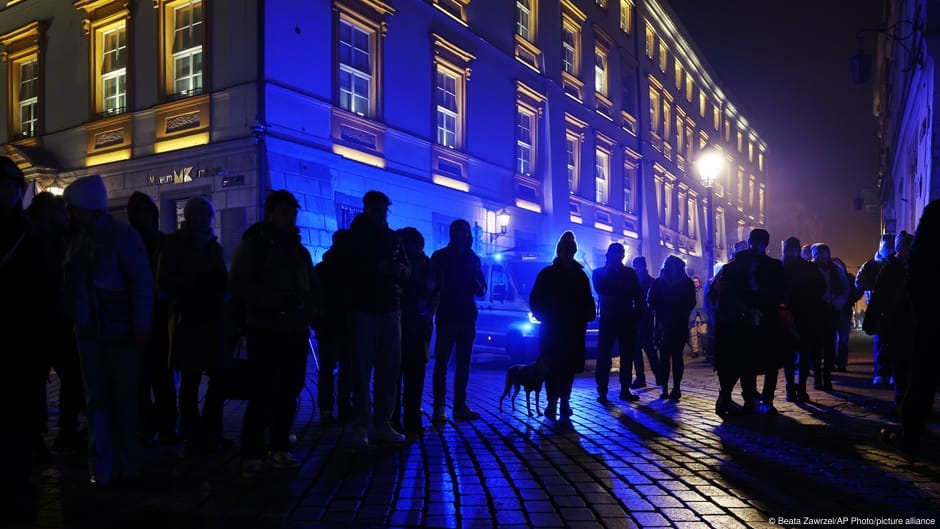
A gunman killed six people in a shooting spree in Krakow's Old Town on Saturday, November 7, 2026, before being shot and detained by police. The attacker, also suspected of killing three family members before the rampage, later died in hospital. Poland's national prosecutor's office opened a formal investigation on Monday. The facts end there. Everything else that flooded social media was engineered noise.
Extraction Map
The disinformation machine activated within hours. A viral image claiming to show the attacker's face circulated widely on X. It was sharp — suspiciously sharp for chaotic crime-scene footage. Hive Moderation flagged it as 99.5% AI-generated. Google's SynthID Detector confirmed it carried a SynthID watermark, meaning it was created or edited using Google's AI tools. Multiple variants of the same fabricated face appeared across platforms, each apparently derived from genuine but blurry agency footage. The AI didn't sharpen reality — it hallucinated a plausible face onto it. The second operation was more sophisticated: a fake Telegram channel attributed to the attacker, complete with a Ukrainian flag avatar and a post dated November 3 showing him holding a gun with Ukrainian insignia. Another post read simply "11/7/2026" — the date of the attack. Both posts were edited on November 8, after the suspect was apprehended. DW verified the edit history directly on Telegram. The channel photo was also changed post-attack. This is a well-documented disinformation tactic: retroactively editing dormant accounts to manufacture the appearance of foreknowledge. The date format (month/day) was American, not Polish — a sloppy tell. The third claim tried to link the attacker to the Forward Observations Group, an American tactical training brand active in Ukraine, via a photo of a car trunk full of weapons. The patch visible on a vest was the Old Roger flag — a generic military symbol — not the FOG's distinctive horned-skeleton logo. More critically, the car's license plate was registered to Krakow police, indicating it was an evidence-collection vehicle, not the attacker's car. The pattern is consistent: every fabrication pointed toward Ukraine. A fake face to personalize the attacker. A fake Telegram history to give him a political identity. A fake weapons cache to connect him to American military operations in Ukraine. Each layer reinforced a single narrative — that this was somehow connected to the Ukraine conflict — despite zero evidence from Polish authorities supporting any such link. What makes this dangerous isn't the individual fakes — each was debunkable with basic forensic tools. It's the speed and coordination. AI-generated imagery now passes casual visual inspection. Telegram's edit-history feature is exploitable for retroactive fabrication. And the information vacuum between a mass shooting and official findings creates a window where emotionally charged falsehoods travel faster than verification. DW's fact-checking caught these specific instances, but the volume problem is structural: verification takes hours, virality takes seconds. The 99.5% AI-detection confidence and the SynthID watermark are technically encouraging — the tools to detect fakes exist. But detection happens downstream, after millions of impressions. The forensic details that exposed the car photo (license plate, patch design, date format) required subject-matter knowledge most users don't have. The asymmetry between production cost and verification cost is the core extraction mechanism, and it's widening.
Worth reading?
SKIP
Score
16
/100
Extractive. Disinformation actors exploit crisis-information vacuums to extract public trust and inject fabricated geopolitical narratives, imposing verification costs on media, platforms, and the public while generating zero social value.
What Is GRIN?
GRIN stands for Generativity, Resilience, Innovation efficiency, and Novelty openness. These four dimensions capture the essential characteristics of any memetic intelligence — whether a nation, a corporation, a religion, or a movement.
About GRINGenerativity
0/5
Resilience
1/5
Efficiency
1/5
Novelty
2/5
Extractive
5/5
Inverted
Does this create new capability or just redistribute existing value?
Pure destruction. AI fakes generate no new understanding — they consume attention, poison the information commons, and force costly verification labor that wouldn't otherwise be needed.
Verified Facts (13)
A gunman killed six people in a shooting spree in Krakow's Old Town on Saturday, before being shot and detained by police
The gunman is also suspected of killing three family members before the attack and later died in hospital
Poland's national prosecutor's office announced a formal investigation on Monday
Hive Moderation identified the viral attacker image as 99.5% AI-generated
Google's SynthID Detector confirmed the image contains a SynthID watermark, indicating it was generated or edited using Google's AI technology
The fake Telegram post claiming to be the attacker's was viewed more than 700,000 times
Both Telegram posts were edited on November 8, after the suspect had been apprehended
The channel's photo, a Ukrainian flag, was also edited after the attack took place
In Poland, the date is written day first, not month — the post used American date format
HIVE Moderation said the Telegram photo was 99.9% likely to be created with AI
The X post about the Forward Observations Group connection was viewed nearly 100,000 times
The car license plate was registered with the Krakow police, indicating evidence collection not the attacker's vehicle
The Forward Observations Group logo features a horned skeleton holding a gun, not an hourglass — the patch shown was the generic Old Roger flag
More latest news
Read all