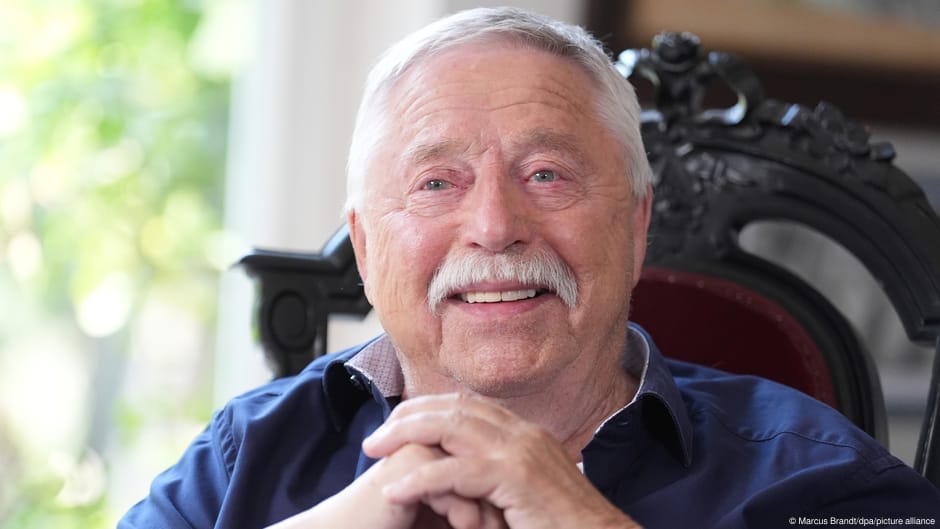
Wolf Biermann was born into fire — literally. Hamburg, 1943, British firebombs turning the city into an inferno, a three-year-old pressing his face into his mother's coat to breathe while 40,000 people died around them. His father, a Jewish communist dockworker, had already been murdered at Auschwitz. That origin story isn't biographical decoration. It is the engine that has driven every song Biermann has written for seven decades: the conviction that freedom is not a gift but a demand you make with your body. His new album, "Unterm Haar nur Himmel" ("Beneath Hair, Only Sky"), arrives on his 90th birthday with the subtitle already built in: however restrictive the world gets, the mind stays free. The title is pure Biermann — the kind of image that sounds simple until you realize nobody else would have written it. The album takes on Trump and Putin as "political lovers," condemns the war over Palestinian territories, and invokes "Lady Liberty" without a trace of irony. At 90, the man has earned the right to be earnest. The biographical arc is almost too dramatic for fiction. Raised by a mother who told him his purpose was to "take revenge for your father's death" by building communism, Biermann moved to East Germany voluntarily in 1953, at 16, while everyone else was fleeing the other direction. He studied under the shadow of Brecht, began writing and performing political songs, and quickly discovered that actual communism bore no resemblance to the paradise he'd imagined. The party bosses loved his guitar and hated his lyrics. By 1965, the SED had imposed a blanket ban on his performing or publishing. For eleven years, Biermann's East Berlin apartment became a dissident salon under constant Stasi surveillance. Then in 1976, the regime made a catastrophic miscalculation: they let him travel to Cologne for a concert. Seven thousand people showed up. He played for four and a half hours, mocking the regime with every chord. Bootleg copies flooded back across the border. While still on tour, he heard on his car radio that East Germany had stripped his residency. The regime expected Western media outrage. What blindsided them was that East German intellectuals — writers, artists, public figures — protested publicly for the first time, disguised as a "humble petition." The fallout accelerated the regime's unraveling. The exile broke him before it freed him. Biermann sank into depression, grieving not just lost friends but lost enemies — the "familiar mortal enemies" who had given his defiance its shape. He rebuilt through the peace and anti-nuclear movements, and his insight from that period remains his sharpest: "The world's conflicts take different forms in each generation, but it's always the same struggle for freedom." At 90, he plans a quiet birthday in Hamburg with his wife and manager, Pamela, skipping the party even with his ten children because he's saving his strength for a concert at the Berliner Ensemble the next day. The man who was banned from performing for over a decade is still choosing the stage over the celebration. And when he dies, he wants to be buried alongside Brecht, Seghers, and Hegel. He says he still has things to discuss with them. You believe him.
Worth reading?
RECOMMENDED
Score
76
/100
Listeners interested in 20th-century European history through the lens of art and dissent; fans of Dylan, Cohen, or Brel who want the version forged under actual dictatorship rather than metaphorical rebellion; anyone who reads German or appreciates chansonnier craft regardless of language.
Cultural Placement
Like Bob Dylan's 'Rough and Rowdy Ways' but forged in Stasi surveillance rather than Laurel Canyon mythology, with the moral directness of Brecht's Threepenny songs and the autobiographical urgency of Primo Levi's late essays. Biermann operates in the tradition of the engaged European chansonnier — Brassens, Brel, Okudzhava — where the political song is not a genre but a survival mechanism. The closest American analogue is Pete Seeger's late work, but Biermann's relationship to state power was never symbolic; it was literal exile, literal surveillance, literal bans. This album is a late-career statement in the mold of Leonard Cohen's 'You Want It Darker' — an artist confronting mortality while refusing to soften.
Honest assessment
This is not a boundary-pushing album — it's a late-career statement from a man whose life IS the boundary-push. The songs themselves reportedly follow the protest-chanson template Biermann has mastered for decades. What makes it worth your time is the accumulated weight: when a 90-year-old survivor of Allied firebombing, Auschwitz's shadow, Stasi surveillance, and forced exile tells you freedom is a muscle, the authority behind the words is irreplaceable. The album is best understood as a capstone, not a debut.
What Is NOVEL?
76
/ 100
BedrockNews applies a structured analytical framework called NOVEL to cultural works — games, books, film, music, and more.
How NOVEL worksNerve
3/5
Originality
2/5
Voice
5/5
Endurance
4/5
Lineage
5/5
What did the artist risk? What could have failed?
Moderate risk for a 90-year-old: naming Trump, Putin, and the Palestinian conflict directly when most legacy artists play it safe. But the protest-song form is his comfort zone — the risk is in continuing, not in the form.
Lineage tree
Bertolt Brecht
direct ancestor — Biermann worked at the Berliner Ensemble and absorbed Brecht's fusion of politics and lyric
Heinrich Heine
tonal influence — the German tradition of politically sharp, formally elegant verse
Jacques Brel
extends the form of — the European chansonnier tradition of total commitment in performance
Pete Seeger
parallel tradition — American engaged folk song as survival mechanism
Leonard Cohen
tonal influence — late-career mortality-and-meaning mode
Verified Facts (13)
Wolf Biermann was born in Hamburg in 1936
His father was a dockworker, a committed communist, a resistance fighter against the Nazis — and Jewish
Wolf was just three months old when the Gestapo arrested his father
He was murdered by the Nazis at Auschwitz in early 1943
40,000 people died in the Hamburg firestorm
In 1953, Biermann moved to East Germany of his own free will at age 16
In 1965, the SED imposed a blanket ban on Biermann performing or publishing
In 1976, around 7,000 people attended his Cologne concert; he performed for four and a half hours
On November 16, while on tour in West Germany, he was stripped of his right to reside in East Germany
New album titled 'Unterm Haar nur Himmel' released to mark his 90th birthday
He has 10 children
He wants to be buried at Berlin's cemetery alongside Brecht, Seghers, and Hegel
His wife and manager is named Pamela; they have been a couple since 1983
More latest news
Read all