FOREIGN WORKERS · 2025
5.8M
IMMIGRANT EMPLOYMENT
~70%
MIGRATION BACKGROUND
30%
WORKER GROWTH · 2009→2025
3×
Germany's Commissioner for Integration, Natalie Pawlik (SPD), presented the government's biennial integration report on Wednesday, painting a picture of a country that has absorbed enormous demographic change — 30% of the population now has some migration background — while maintaining immigrant employment rates higher than most EU peers. The headline number: nearly 70% of immigrants are employed, and foreign workers in Germany have more than tripled from 1.8 million in 2009 to 5.8 million in 2025.
Extraction Map
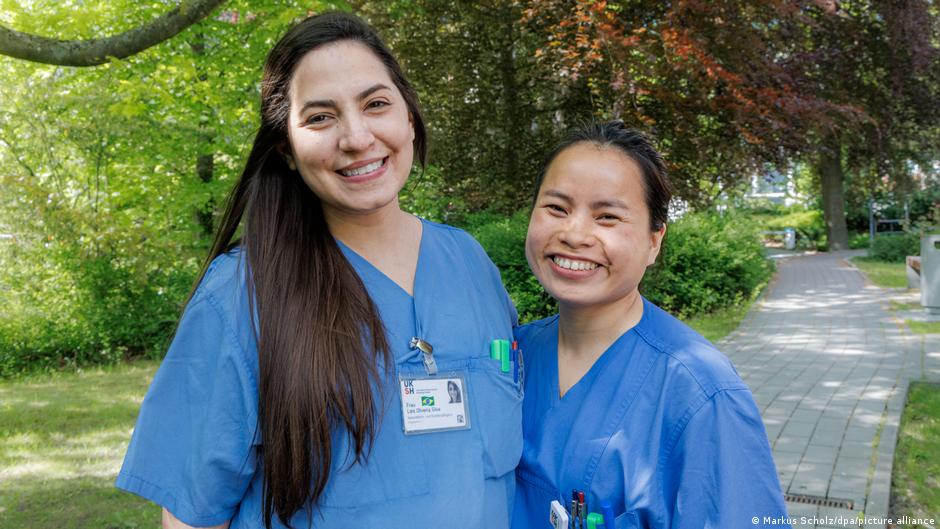
The report, compiled by Frank Kalter of the German Center for Integration and Migration Research (DeZIM), identifies health and social services as the sector absorbing the largest recent increase of non-citizen workers. This is a structural dependency, not a cultural anecdote: Germany's aging population needs these workers and is already relying on them at scale. But the data also surfaces hard problems. Only about 60% of immigrant women in families where the husband works are employed, compared to 88% among German-passport households. Young male refugees face persistent barriers to education and labor market access. And the criminal justice data is stark: non-citizens account for roughly 40% of convicted criminals despite being a smaller share of the population — though they are also disproportionately likely to be crime victims. Here is where the report's logic turns against the government's own actions. Pawlik identifies language acquisition as the foundation of integration success. Yet earlier this year, the government cut funding for integration courses — many of which have been eliminated or reduced. The Commissioner publicly criticized the cuts despite being part of the federal government, a rare and telling act of internal dissent. The SPD is now pushing for more secure residency permits for refugees who have been working in Germany, arguing that existing labor-migration pathways should extend to working refugees from Syria and Ukraine. This is a test of the coalition: Interior Minister Alexander Dobrindt (CSU) is a known hardliner, and the CDU/CSU-led coalition under Chancellor Friedrich Merz has shown little appetite for liberalization on immigration status. The structural tension is clear. Germany needs immigrant labor at a scale that is already baked into its economy. The integration infrastructure that converts arrivals into productive workers is underfunded. And the political coalition in power is divided between recognizing this economic reality and performing toughness on immigration for electoral purposes. The 20-year question is whether Germany will invest in the pipeline that turns demographic change into economic capacity, or whether it will continue to depend on immigrant labor while starving the systems that make integration work — producing exactly the failures that fuel the next round of anti-immigration politics.
Worth reading?
OPTIONAL
Score
44
/100
Mixed — immigrant employment is genuinely generative for Germany's economy, but cutting integration courses while depending on immigrant labor is a slow-motion extraction of human capital without reinvestment.
What Is GRIN?
GRIN stands for Generativity, Resilience, Innovation efficiency, and Novelty openness. These four dimensions capture the essential characteristics of any memetic intelligence — whether a nation, a corporation, a religion, or a movement.
About GRINGenerativity
3/5
Resilience
2/5
Efficiency
2/5
Novelty
2/5
Extractive
3/5
Inverted
Does this create new capability or just redistribute existing value?
Real generativity: 5.8M foreign workers tripled from 1.8M since 2009, concentrated in health/social services Germany desperately needs. But generative potential is being undermined by defunding the intake pipeline.
Verified Facts (9)
About 30% of the population today has some sort of migration background
Employment rate among immigrants in Germany is higher than in most other EU countries — nearly 70%
About 1.8 million people without a German passport working in Germany in 2009; by 2025, this number had more than tripled to 5.8 million
Only about 60% of women in such families are employed, whereas nearly 88% of women in families with German passports are employed
The percentage of convicted criminals who are not German citizens is far higher — around 40% — than their share of the population
Natalie Pawlik, a parliamentary representative from the center-left Social Democratic Party (SPD)
Frank Kalter, director of the German Center for Integration and Migration Research (DeZIM)
Interior Minister Alexander Dobrindt (CSU)
Chancellor Friedrich Merz (CDU)
More latest news
Read all