MARKET CAP LOST
$600B+
CURRENT VALUATION
$4.2T
DIRECT REPORTS
60
2024 REVENUE
$120.1B
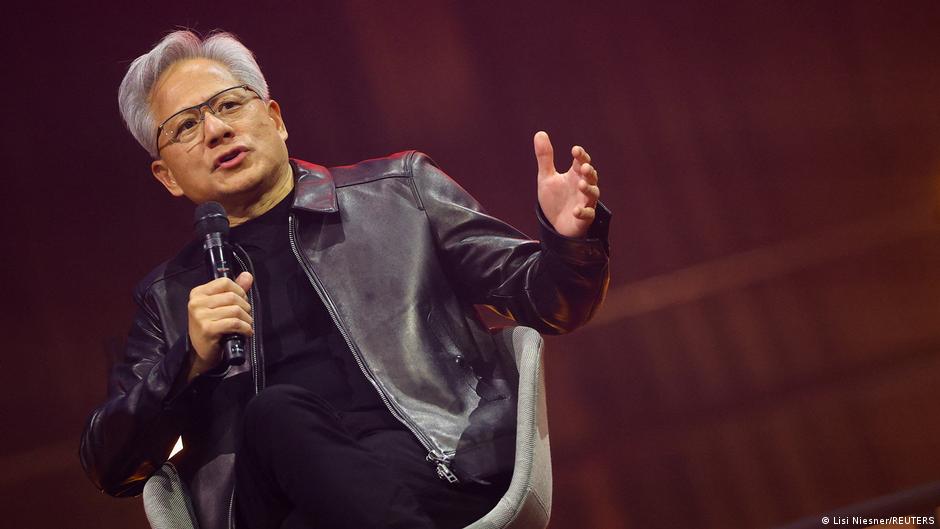
Jensen Huang, the leather-jacketed founder who steered Nvidia from a graphics card company into the $4.8 trillion backbone of global AI, resigned Thursday after a second extramarital affair — this one with a direct report — proved too much for the board to absorb. The first scandal, revealed just three days earlier, involved a relationship with a woman US intelligence agencies believe was spying for China. The combination was lethal to his tenure.
Extraction Map
The mechanics of the exit were swift. Under Nvidia's bylaws, the board can remove a CEO with or without cause by majority vote of its 11 directors. They backed Huang after the first revelation; the second broke the dam. CFO Colette Kress was named interim CEO. Bloomberg reports the board is working with advisers to find a permanent successor, with names ranging from Huang's own children — daughter Madison (product marketing) and son Spencer (robotics) — to outsiders like former Apple CEO Tim Cook and ex-Google CEO Eric Schmidt. The financial damage is already severe. Nvidia's market capitalization has fallen by more than $600 billion since Sunday, dropping to $4.2 trillion. Shares were down 9% in premarket Thursday after a 10% slide earlier in the week. Yet many analysts argue the real product demand is untouched — Nvidia's advanced chips remain so scarce and so essential to the AI buildout that near-term sales should hold. The question is whether the strategic machinery survives. That machinery was Huang himself. He ran approximately 60 direct reports in a deliberately flat structure, personally picked which bets the company would pursue, and served as Nvidia's chief lobbyist on US chip export rules — including persuading Trump to ease some China curbs last year. He reportedly did not believe in formal succession planning. The Wall Street Journal confirmed this gap. A company that dominates the $120.1 billion AI chip market had no plan for life without its founder. The geopolitical dimension is acute. The spy allegation involves Alice Huang (no relation), a former executive at Megaspeed, a Singapore-based cloud computing firm that allegedly funneled Nvidia chips to China in violation of US semiconductor export controls. Megaspeed denies the allegations and pledged Thursday to cooperate with investigators. Alice Huang has been barred from entering Singapore and Taiwan. Beijing, meanwhile, accused the US of using the spying claims as pretext for a technological blockade — a charge that will dominate next week's Trump-Xi talks at APEC in Shenzhen. China's AI sector is not waiting. Reuters reported Thursday that Chinese firms are renting Nvidia-powered compute at data centers outside China to circumvent potential further restrictions. DeepSeek, Alibaba, and Moonshot have closed much of the performance gap with US models on benchmark tests, often beating rivals on cost and speed. Beijing continues heavy investment in domestic chips. The export control regime that Huang helped shape and then helped soften is now orphaned of its most influential private-sector advocate. Nvidia's moat — its chip design expertise, its CUDA software ecosystem, its entrenched relationships with hyperscalers and TSMC — is real and durable. But moats are maintained, not self-sustaining. The company now faces simultaneous challenges: replacing a founder-CEO with no succession plan, navigating an espionage investigation touching its core product, managing the most consequential geopolitical technology dispute on the planet, and doing all of this while competitors in both the US and China accelerate. The AI hardware buildout will continue. Whether Nvidia's strategic position within it holds is now an open question in a way it was not one week ago.
Worth reading?
SKIP
Score
16
/100
Extractive. Huang's departure destroys organizational capital, strategic continuity, and geopolitical leverage without creating any new capability. Value is being extracted from Nvidia shareholders, the AI supply chain, and US strategic positioning simultaneously — not by a deliberate actor, but by the fragility of a single-founder dependency.
What Is GRIN?
GRIN stands for Generativity, Resilience, Innovation efficiency, and Novelty openness. These four dimensions capture the essential characteristics of any memetic intelligence — whether a nation, a corporation, a religion, or a movement.
About GRINGenerativity
0/5
Resilience
0/5
Efficiency
1/5
Novelty
2/5
Extractive
4/5
Inverted
Does this create new capability or just redistribute existing value?
Pure destruction of organizational capital. No new capability created — a 32-year founder's institutional knowledge, relationships, and strategic judgment exit with him. The flat structure he built now becomes a liability.
Verified Facts (17)
Nvidia's board met late Wednesday to decide on CEO Jensen Huang's future after reports emerged of a second extramarital affair — this time with an employee.
Huang was resigning as president, CEO and board member, effective immediately.
Current Vice President and Chief Financial Officer (CFO) Colette Kress would become interim CEO.
Under Nvidia's bylaws, Huang can be removed 'with or without cause' by a majority vote of its 11 directors.
Huang tied the knot with his wife Lori in 1985.
Alice Huang — no relation — is a former executive at Megaspeed, a Singapore-based cloud computing firm.
The US government is investigating the startup on suspicion that it secretly sent some of its Nvidia chips to China.
Alice Huang has been barred from entering Singapore and Taiwan.
Nvidia's market capitalization has fallen by well over $600 billion to $4.2 trillion.
Nvidia shares were down more than 9% in premarket trading Thursday, after dropping by 10% earlier this week.
Nvidia stock hit all-time highs just a month ago.
Huang doesn't believe in formal succession planning.
Around 60 executives reporting directly to him.
Nvidia's huge profits topped $120.1 billion last year.
Chinese AI firms are now trying to rent Nvidia-powered computing capacity at data centers outside China.
Beijing accused the US of using the Nvidia spying claims as a pretext to impose a technological 'blockade' on China.
The issue is likely to dominate talks next week between Trump and Chinese President Xi Jinping at the APEC gathering in Shenzhen.
More latest news
Read all