RECONSTRUCTION NEED
$71.4B
CRITICAL SHELTER
1.2M
WINTER CLOTHING MET
<1%
DEATHS SINCE OCT 7
74,600+
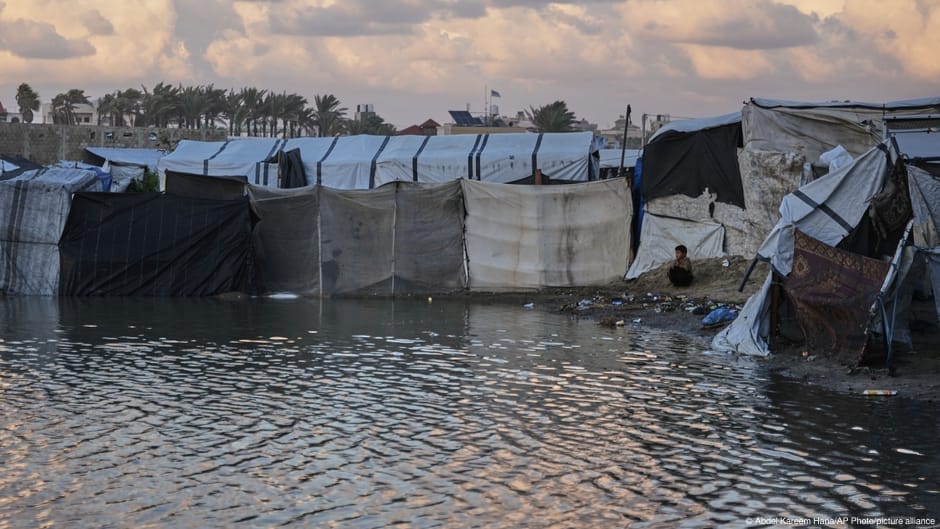
Torrential rain in Gaza killed at least six people, including children, flooded 70,000 tents, and affected more than 200,000 civilians — a catastrophe entirely predictable given that most of Gaza's 2 million residents now live under canvas or in structurally compromised buildings. UNICEF confirmed the deaths. Local authorities provided the displacement numbers. The weather was not the disaster. The disaster was already there.
Extraction Map
The humanitarian math is stark. Around 1.2 million people, including more than 560,000 children, live in what Save the Children classifies as critical or catastrophic shelter conditions. Available winter clothing covers less than 1% of needs. Approximately 400,000 people remain in high-flood-risk areas, including an estimated 10,000 pregnant women, with 180 babies born daily in conditions lacking dry or warm shelter. The UN says 150,000 tents sit outside Gaza's borders, ready for dispatch but awaiting Israeli approvals that have not come. The structural cause is a political deadlock that has calcified since the October 2025 US-brokered ceasefire. Israel insists Hamas must completely disarm before reconstruction can proceed. Hamas refuses. President Trump's Board of Peace committee, established to oversee postwar governance and rebuilding, has produced statements but not outcomes. A joint World Bank–UN–EU assessment published in April 2026 estimated Gaza's recovery and reconstruction at $71.4 billion over the next decade. Virtually none of that spending has begun. Nathan Brown, a professor of political science at George Washington University, told DW the deadlock is "fundamentally due to Israeli objections based on the insistence that Hamas has to completely disarm first." He noted the Board of Peace showed little interest in challenging Israel's position until recent Israeli elections shifted the dynamic, though even now its public criticism remains restrained. On Monday, the BoP issued a statement calling Israel's winterization steps "insufficient" and demanding immediate facilitation of humanitarian supplies — but also called on Hamas to lay down its weapons and transfer governing authority. Both sides immediately weaponized the statement. Hamas rejected the criticism, accusing Israel of obstructing the peace plan and withholding supplies. Israeli Prime Minister Benjamin Netanyahu — currently serving as caretaker while a new government forms after October 27 elections — denied responsibility and warned that "as long as Hamas remains in power, it will use every dual-use item entering Gaza to entrench its terror regime and expand its military arsenal." Israel's COGAT reported that 91,000 tents and more than 8,200 trucks of winterization supplies had entered Gaza in recent months, alongside 12 sewage vacuum trucks for the Red Cross. The UN and international agencies paint a different picture. They accuse Israel of systematically preventing the import of prefabricated shelters — the only durable housing option available — a claim Israel rejects. OCHA noted that Israeli authorities restrict Palestinian access behind the so-called "Yellow Line" military demarcation, which places most of Gaza's land off-limits, leaving no space to relocate people from flooded areas. Aid teams have begun clearing blocked sewers at 60 locations, serving an estimated 30,000 families, but this is triage, not reconstruction. The pattern is clear: the ceasefire halted large-scale combat but preserved every structural condition that makes the humanitarian crisis self-perpetuating. Israel controls two-thirds of the territory. Hamas governs the remainder along the coast. Neither side will concede the other's preconditions. The Board of Peace lacks enforcement power. And with each passing month, the $71.4 billion reconstruction estimate grows as infrastructure continues to degrade and a generation of children grows up without adequate shelter, clothing, or medical care. Over 74,600 people have been killed since October 7, 2023, according to Gaza's Health Ministry. The living are now fighting the weather.
Worth reading?
SKIP
Score
4
/100
Extractive. Two armed actors (Israel, Hamas) hold veto power over reconstruction while 2 million civilians absorb all costs — physical, economic, and existential — with no capacity to exit, rebuild, or self-govern.
What Is GRIN?
GRIN stands for Generativity, Resilience, Innovation efficiency, and Novelty openness. These four dimensions capture the essential characteristics of any memetic intelligence — whether a nation, a corporation, a religion, or a movement.
About GRINGenerativity
0/5
Resilience
0/5
Efficiency
1/5
Novelty
0/5
Extractive
5/5
Inverted
Does this create new capability or just redistribute existing value?
Near-zero generativity. $71.4B in reconstruction needs sits unspent. No housing, no infrastructure repair, no economic activity. The ceasefire preserved stasis, not recovery.
Verified Facts (12)
Torrential rainfall over the weekend killed at least six people, including children, according to UNICEF.
Local authorities said at least 70,000 tents were flooded and more than 200,000 people affected.
Gaza's recovery and reconstruction will require an estimated $71.4 billion (€64.2 billion) over the next decade — joint assessment by the World Bank, United Nations and European Union published in April 2026.
More than 74,600 people were killed in the Gaza Strip, according to figures from Gaza's Health Ministry.
Around 1.2 million people, including more than 560,000 children, living in critical or catastrophic shelter conditions — Save the Children.
Available supplies cover less than 1% of needs — Save the Children.
Around 400,000 people in Gaza continue to live in areas at high risk of flooding, including an estimated 10,000 pregnant women — UNFPA.
Around 180 babies born every day — UNFPA.
The UN said around 150,000 tents were outside Gaza and ready to be dispatched, pending the necessary approvals.
91,000 tents and more than 8,200 trucks carrying tarpaulins, blankets and winter clothing had entered Gaza in recent months — COGAT.
Aid teams have started to clear blocked sewer lines and stormwater basins at 60 locations, benefiting an estimated 30,000 families — OCHA.
12 sewage vacuum trucks for the International Committee of the Red Cross arrived in Gaza — COGAT.
More latest news
Read all