HEARINGS · DEC
2
HOUSE SUBPOENAS
3
NVIDIA MKT CAP
$3T+
CEO GONE
1
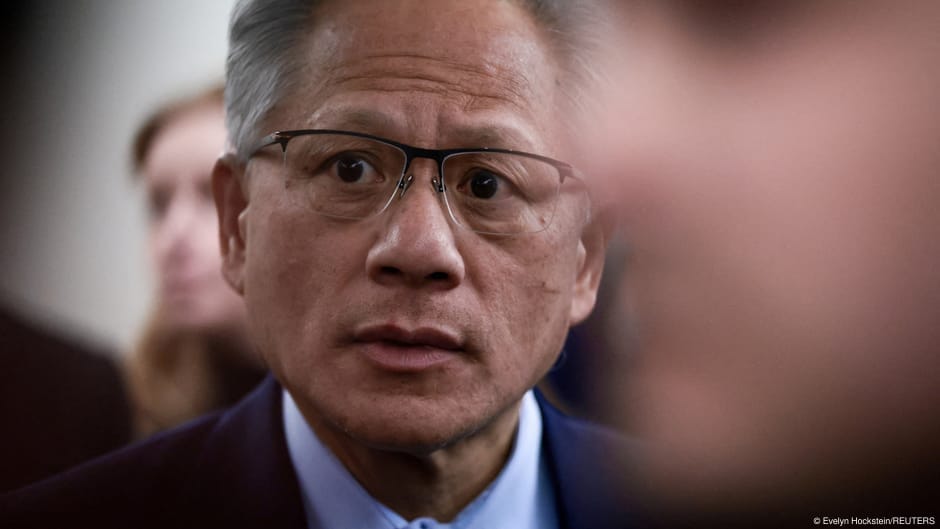
Jensen Huang is out at Nvidia, and the US Senate wants to know how the country's most strategically important chipmaker became a counterintelligence liability. Senate Banking Committee Chairman Tim Scott has called Huang and Commerce Secretary Howard Lutnick to testify in December over what Scott describes as "serious concerns about our national security and the protection of sensitive US technology." The subpoena threat is already on the table.
Extraction Map
Huang resigned after reports surfaced that a woman named Alice Huang — with whom the former CEO admitted to having an extramarital affair — is suspected by US authorities of spying for China. Beijing denies the allegation. Nvidia itself was investigating the matter as a "foreign intelligence effort" targeting its chief executive. The New York Times added a second affair, this one with an Nvidia executive who reported to Huang. Colette Kress, the company's CFO, is now interim CEO. The Lutnick thread is separate but entangled. Lawmakers have hammered the Commerce Secretary over two issues: the administration's refusal to add dozens of Chinese companies to a key US trade blacklist, and its oversight — or lack thereof — of Nvidia's exports to China. Two sources told Reuters the White House is now discussing whether to push Lutnick out entirely. He has agreed to testify on December 10. Three House committee chairs have separately demanded closed-door interviews with Huang and Nvidia General Counsel Tim Teter on December 1 and 2, with subpoenas as the backstop. The congressional dragnet is bipartisan in scope if not in motive: Republicans want to demonstrate toughness on China, while the underlying questions about compromised leadership and porous export controls cut across party lines. President Trump, who publicly defended Huang multiple times this week as an "honorable guy" and a "fine person," has pivoted to suggesting Apple's former CEO Tim Cook replace Huang at Nvidia — a recommendation that reveals more about Trump's CEO Rolodex than about semiconductor governance. House Speaker Mike Johnson offered a more measured take, saying Huang "did the right thing" by resigning. The structural picture is stark. The United States has spent three years building an export-control regime designed to deny China access to advanced AI chips. Nvidia is the single most important node in that regime. If the CEO of that company was compromised by a foreign intelligence operation — even partially, even indirectly — the entire enforcement architecture is called into question. The question is not whether Huang had affairs. The question is whether adversarial intelligence had a channel into the decision-making apparatus of America's most consequential chip company. What emerges from this episode is less a scandal than a stress test. Nvidia's $3+ trillion market cap, its monopoly position in AI accelerators, and its role as the chokepoint in US-China tech competition made its CEO an obvious intelligence target. The system's failure was not in the targeting — that was predictable — but in the absence of any institutional mechanism to detect or prevent it before it became a front-page crisis.
Worth reading?
SKIP
Score
24
/100
Extractive. A single point of failure — one CEO's personal conduct — has compromised the integrity of an entire export-control regime, extracting national security value from the public while concentrating risk in an unaccountable leadership structure.
What Is GRIN?
GRIN stands for Generativity, Resilience, Innovation efficiency, and Novelty openness. These four dimensions capture the essential characteristics of any memetic intelligence — whether a nation, a corporation, a religion, or a movement.
About GRINGenerativity
1/5
Resilience
1/5
Efficiency
1/5
Novelty
2/5
Extractive
4/5
Inverted
Does this create new capability or just redistribute existing value?
Pure destruction. No new capability created. AI chip leadership, export-control credibility, and corporate governance all degraded simultaneously with nothing built in return.
Verified Facts (11)
Senate Banking Committee Chairman Tim Scott asked Jensen Huang to testify on December 3 and Howard Lutnick on December 10
Lutnick has agreed to testify, per NBC News quoting a Commerce Department spokesman
Scott said he would consider a subpoena if Huang does not appear voluntarily
Colette Kress, Nvidia's EVP and CFO, named as interim CEO
Huang admitted in an email to Nvidia staff: 'I was unfaithful to my wife'
The New York Times reported Huang also had an affair with an Nvidia executive who worked for him
US authorities suspect Alice Huang of spying for China; China denies she is a spy
Two people told Reuters the White House was discussing whether to push Lutnick out
Three House committee chairs told Huang and Nvidia General Counsel Tim Teter to appear for closed-door interviews on December 1 and 2, or face subpoenas
Trump called Huang an 'honorable guy' and a 'fine person' and called for Tim Cook to replace Huang
Speaker Mike Johnson said Huang 'did the right thing' by resigning
More latest news
Read all