PEOPLE NEED AID
33.7M
UN PLAN FUNDED
47%
SHELTER NEEDS MET
10%
DRONE DEATHS · H1 2026
1,120
Sudan's humanitarian crisis has crossed a threshold that numbers alone struggle to convey: 33.7 million people need aid, 15.4 million need emergency shelter, and organizations can reach only 10% of them. The gap is not logistical ambiguity — it is a $1.5 billion funding hole in the UN's own response plan, now only 47% funded. The IOM and UNHCR are warning that even the most basic supplies — tarpaulins, cooking pots, blankets — are running out.
Extraction Map
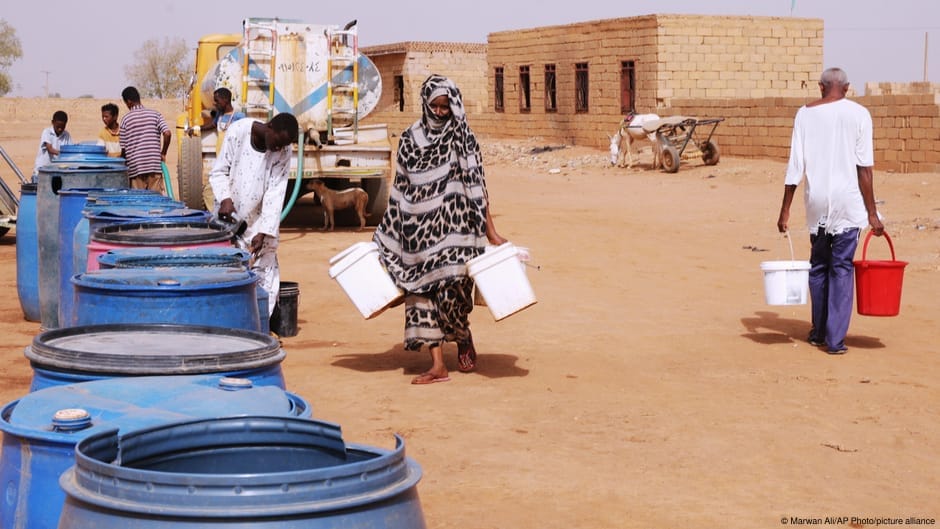
The war between the Sudanese Armed Forces under General Abdel Fattah Al-Burhan and the Rapid Support Forces has ground on for over three and a half years. It has displaced 8.6 million internally, pushed 4.6 million into neighboring countries, and killed somewhere between 40,000 and 250,000 people — a death toll so uncertain it spans a sixfold range because the information infrastructure itself has been destroyed. Satellite internet is curtailed, observers have fled, and bodies go uncounted. The structural absurdity at the heart of this crisis is the October 23 joint statement. The UK and 31 international partners, including Germany, called on the warring parties to allow humanitarian access and demanded increased international aid funding. As Sudan expert Marina Peter pointed out to DW, most of the signatories have themselves systematically cut funding for humanitarian aid and development cooperation. The appeal to the international donor community is directed at the states that hollowed it out. The US has slashed contributions. Germany and the EU are providing significantly less than four or five years ago. The demand letter is addressed to its own authors. Meanwhile, the Khartoum government's response is flatly delusional. On October 26, the SAF-led government claimed the food situation is "reassuring" and that government reserves and agricultural production are sufficient to meet demand, dismissing Western warnings as politicization. Peter called the statement "truly cynical and almost perfidious," noting that the government's claim of unrestricted humanitarian access does not reflect reality. In large parts of the country, people have been cut off from aid since the war began. Some have survived by eating roots. Drone warfare is compounding the disaster. The Peace for Sudan Platform reported at least 306 civilian deaths in the first three weeks of October alone. The UN Human Rights Office documented at least 1,120 civilian drone deaths in the first half of 2026. Strikes hit markets, hospitals, and water and electricity infrastructure — the connective tissue of survival. Caritas International's Ivo Körner confirmed the strikes cause widespread anxiety and endanger humanitarian workers, making international access nearly impossible. The remaining operational capacity increasingly depends on local partner organizations — groups embedded in communities that international agencies cannot reach. Caritas International's 2026 Sudan projects are financed exclusively through donations, with no institutional funding. Körner hopes for German Foreign Office support but expects significantly more limited funding than in previous years. The aid architecture is being replaced by an improvised patchwork with no guaranteed future. The 5.2 million people who have returned to destroyed home regions despite ongoing war illustrate the depth of the trap. They are not returning because conditions improved — they are returning because refugee camp food rations have been drastically cut. People are being pushed from one form of deprivation into another, with no exit. The crisis is not worsening because of new shocks. It is worsening because the system designed to respond has been defunded by the governments that built it.
Worth reading?
SKIP
Score
8
/100
Extractive. Value flows away from 33.7 million vulnerable people through three mechanisms: donor governments redirecting funds away from commitments, warring parties obstructing access for strategic advantage, and the Khartoum regime denying reality to avoid accountability.
What Is GRIN?
GRIN stands for Generativity, Resilience, Innovation efficiency, and Novelty openness. These four dimensions capture the essential characteristics of any memetic intelligence — whether a nation, a corporation, a religion, or a movement.
About GRINGenerativity
0/5
Resilience
0/5
Efficiency
1/5
Novelty
1/5
Extractive
5/5
Inverted
Does this create new capability or just redistribute existing value?
Zero new capability created. Aid capacity is shrinking, not expanding. Local organizations improvise survival but with no institutional backing or scale pathway.
Verified Facts (14)
$2.9 billion is needed for the United Nation's Humanitarian Needs and Response Plan
Only 47% of the required funds have been raised
33.7 million people in the war- and famine-stricken country are dependent on humanitarian aid
15.4 million alone require emergency shelter and basic household items
Aid organizations have been able to assist only 10%
About 8.6 million people fled within the country
More than 4.6 million fled to neighboring countries
Another 5.2 million have returned to their regions of origin despite the ongoing war
Between 40,000 and 250,000 people have been killed
19.5 million people — about 41% of the population — are suffering from acute food insecurity
In the first three weeks of October alone, at least 306 people were killed in attacks
Drones claimed the lives of at least 1,120 civilians in the first half of 2026
On October 23, the United Kingdom and 31 other international partners, including Germany, issued a joint statement
Caritas International's projects in 2026 have been financed exclusively through donations
More latest news
Read all