OFFICERS NAMED
4
TROOPS TO JAKARTA
20K
WIRETAP PERIOD
2025-26
YEARS SINCE REFORM
27+
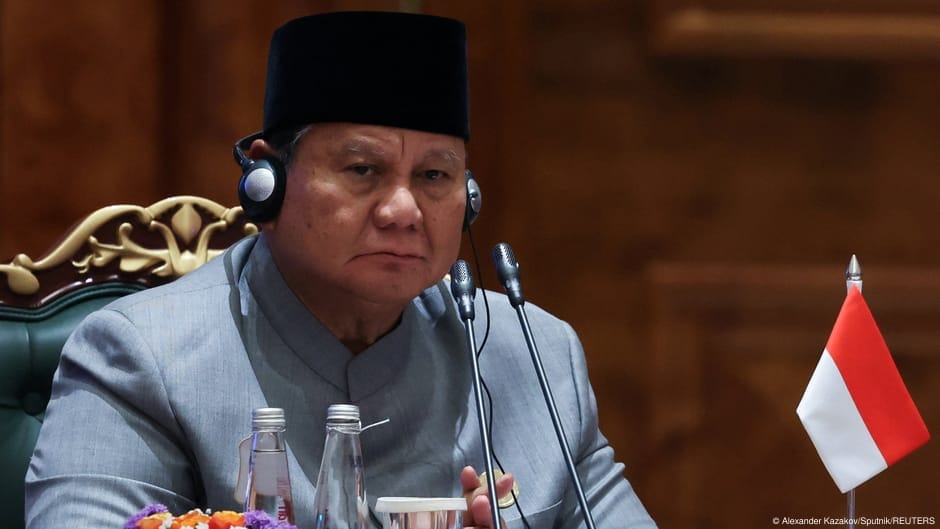
Indonesia's police have named four senior officers, including former national police chief Listyo Sigit Prabowo, as suspects in an illegal surveillance operation that allegedly targeted President Prabowo Subianto, cabinet officials, lawmakers, governors, anti-corruption investigators, activists, and students. The intercepted communications spanned 2025 and 2026, with investigators claiming officers attempted to destroy records afterward. The sheer breadth of targets — from the presidential palace to student groups — suggests an operation designed not for law enforcement but for political intelligence gathering.
Extraction Map
The scandal lands at the fracture point between Indonesia's current president and his predecessor. Listyo was appointed police chief by former President Jokowi in 2021 and was widely regarded as a Jokowi loyalist. When Prabowo took office in October 2024, he initially made Listyo his chief of staff before replacing him as police chief weeks later. The timing raises an obvious question: was the surveillance apparatus built under Jokowi's decade in power being turned against the man who succeeded him? Prabowo's path to the presidency ran directly through Jokowi's political machinery. Jokowi backed Prabowo's 2024 campaign and installed his own son, Gibran Rakabuming Raka, as vice president. That alliance delivered the election but left Prabowo governing atop networks he did not build and does not fully control. Gibran resigned this week over a separate controversy — Indonesia's Constitutional Court and Supreme Court found his overseas high school qualifications fell short of legal requirements for vice presidential candidates. The structural problem predates both administrations. Indonesia's Electronic Information and Transactions Law prohibits unauthorized interception, but enforcement is essentially nonexistent. Academic and policy analysts told DW that police and intelligence agencies operate "essentially unconstrained" on surveillance. The pattern extends back through the Suharto era's intelligence-driven repression, through the 1999 leaked recording of President Habibie, through the 2024 revelation that the elite counterterrorism unit Densus 88 was surveilling a deputy attorney general overseeing corruption cases. The government's response has been revealing. Prabowo deployed an additional 20,000 troops to Jakarta as a precaution — despite no evidence the wiretapping was part of a coup attempt. A police reform commission established in November 2024 produced no meaningful changes under Listyo's leadership. The new police chief, Suyudi Ario Seto, disclosed the full target list to parliament, but the investigation remains within the police's own institutional orbit. Amnesty International has called for investigations into whether surveillance was used to intimidate government critics. Nicky Fahrizal of the Center for Strategic and International Studies in Jakarta identified a structural deficiency: the National Police answers directly to the president, creating inherent incentives for political responsiveness over legal compliance. Without a unified legal framework governing interception powers across agencies, surveillance capabilities remain available as instruments of factional competition. The risk now is that Prabowo emerges politically stronger by dismantling rival networks within the police — only to replace Jokowi-era loyalists with his own. That would resolve nothing about the underlying architecture. As one researcher put it, divided political loyalties risk becoming a "dangerous virus" spreading through security institutions. The question is whether Indonesia's democratic institutions can impose genuine constraints on a security apparatus that has operated without them for decades.
Worth reading?
SKIP
Score
12
/100
Extractive. Surveillance capabilities built with public resources are being weaponized for factional political intelligence, concentrating information power among security elites while imposing costs on democratic governance and civil liberties.
What Is GRIN?
GRIN stands for Generativity, Resilience, Innovation efficiency, and Novelty openness. These four dimensions capture the essential characteristics of any memetic intelligence — whether a nation, a corporation, a religion, or a movement.
About GRINGenerativity
0/5
Resilience
1/5
Efficiency
1/5
Novelty
1/5
Extractive
5/5
Inverted
Does this create new capability or just redistribute existing value?
Zero new capability created. Surveillance infrastructure serves factional intelligence, not public safety or institutional development. The operation destroyed trust without producing anything.
Verified Facts (9)
Indonesian police named four senior officers as suspects in an alleged illegal surveillance operation targeting President Prabowo Subianto and other prominent figures
Former national police chief Listyo Sigit Prabowo was among the senior officers arrested
Investigators claim officers intercepted communications without proper authorization in 2025 and 2026 and then tried to delete records
The government ordered an additional 20,000 troops to Jakarta as a precaution
In 2024, the elite counterterrorism unit Densus 88 was caught surveilling Deputy Attorney General Febrie Adriansyah
Indonesia's Constitutional Court and Supreme Court found that Gibran's overseas high school qualifications fell short of legal requirements for vice presidential candidates
In November last year, Prabowo established a police reform commission
Yohanes Sulaiman stated 'the police and intelligence are essentially unconstrained'
Nicky Fahrizal called the surveillance 'a calculated and systematic abuse of power'
More latest news
Read all