TOTAL SPEND
€561B
TOTAL BORROWING
€210B+
DEFENSE BUDGET
€110B
DEBT-TO-GDP
63.5%
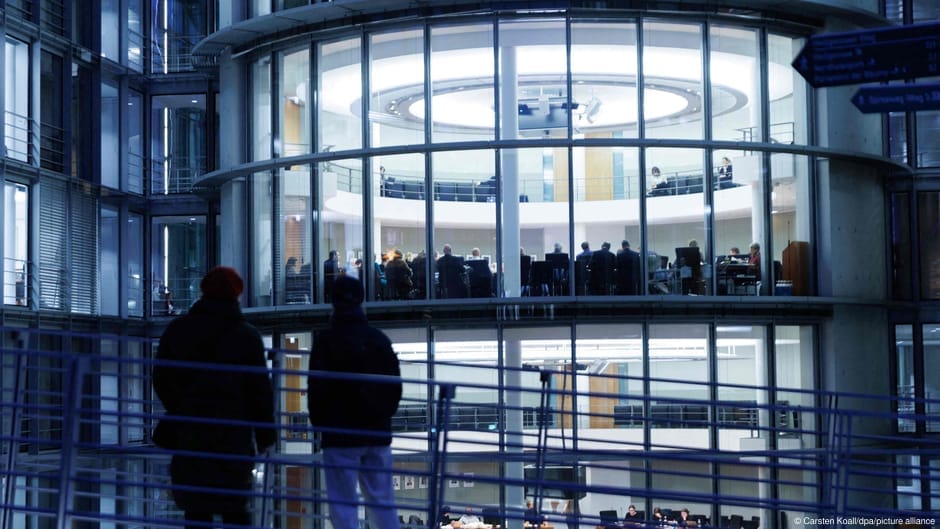
Germany's coalition government has passed a 2027 draft budget of approximately €561 billion through the Bundestag's Budget Committee after a 16-hour overnight session. The CDU/CSU and SPD voted in favor; the Greens, Left Party, and AfD voted against. The final Bundestag vote is scheduled for November 27. The document runs nearly 1,000 pages and contains a structural revenue shortfall of €123 billion, requiring massive borrowing to close the gap.
Extraction Map
Total new borrowing — including special funds for defense and infrastructure renovation — reaches over €210 billion, the second-highest in the Federal Republic's history, trailing only the €215.4 billion borrowed during the COVID-19 pandemic in 2021. Opposition parties have called it a "gigantic mountain of debt" and "irresponsible" policy imposed on future generations. The numbers are stark: Germany, once synonymous with balanced budgets, ran six consecutive years of zero new debt from 2014 to 2019. That era is definitively over. The spending drivers are structural, not discretionary. Defense is set to grow to just under €110 billion, up approximately €27 billion from the prior year, as Russia's war in Ukraine enters its sixth year and NATO commitments expand. The federal government estimates its total Ukraine support at roughly €100 billion through mid-2025 and has committed to indefinite continuation. More than half of all new borrowing is directed at security and defense. The largest single budget item, however, is the Ministry of Labor and Social Affairs at over €200 billion. Germany's 1960s baby boom cohort — exceeding 1 million births per year — is now entering retirement, while birth rates nearly halved in the early 1970s and continued declining. The pension system cannot be financed by contributions from a shrinking workforce alone; pension contribution rates are expected to rise to just under 20% of gross salary. The Federal Employment Agency requires an additional €8 billion in federal subsidies for 2027. Germany's debt-to-GDP ratio stood at 63.5% at end-2025 — still favorable compared to France (over 110%), Italy (135-140%), and the US (above 100%). But the German Council of Economic Experts warns the ratio could reach 100% by 2040 if current trajectories hold. Germany remains the only G7 nation with a triple-A credit rating, which keeps borrowing costs lower. Interest payments alone are projected at approximately €42 billion for 2027. The budget also carries unresolved internal tensions. Chancellor Friedrich Merz is pushing for a reduction in the electricity tax to the European minimum starting next year, a measure not yet locked into the budget. He stated at the Dublin European leaders summit that the issue would be discussed again in the coalition committee. The electricity tax question sits at the intersection of energy transition costs, industrial competitiveness, and the limits of how much fiscal room remains once defense and pensions have claimed their share. What the numbers reveal is a country being reshaped by forces largely outside the government's control — demographic decline, geopolitical confrontation, infrastructure decay accumulated over decades of underinvestment, and the compound costs of energy transition. The budget is less a policy statement than an acknowledgment of accumulated obligations. The question is not whether Germany can afford this spending — it clearly intends to borrow its way through — but whether the spending generates enough productive capacity to service the debt before the demographic window closes further.
Worth reading?
SKIP
Score
32
/100
Extractive — the budget transfers costs forward to a shrinking future workforce through massive borrowing while the largest spending categories (pensions, debt service) are consumption, not investment. Defense spending may build resilience but does not generate economic returns.
What Is GRIN?
GRIN stands for Generativity, Resilience, Innovation efficiency, and Novelty openness. These four dimensions capture the essential characteristics of any memetic intelligence — whether a nation, a corporation, a religion, or a movement.
About GRINGenerativity
2/5
Resilience
2/5
Efficiency
2/5
Novelty
1/5
Extractive
4/5
Inverted
Does this create new capability or just redistribute existing value?
Mostly consumption, not creation. Over €200B goes to pensions and €42B to debt service — transfers, not investments. Infrastructure and energy transition spend is generative but dwarfed by demographic costs.
Verified Facts (17)
Federal government plans to spend around €561 billion ($620 billion) in 2027
Revenue shortfall of €123 billion requiring borrowing
Total borrowing amounts to over €210 billion including special funds
Highest borrowing was during COVID-19 in 2021 at €215.4 billion
Defense budget set to grow to just under €110 billion, increase of around €27 billion
Federal government estimated Ukraine support at approximately €100 billion as of end of June
Ministry of Labor and Social Affairs budget set to grow to over €200 billion
Pension contributions expected to rise to just under 20% of gross salary
Federal Employment Agency to receive more than €8 billion in subsidies
Germany had zero new debt for six consecutive years between 2014 and 2019
Germany's debt-to-GDP ratio stood at 63.5% at end of 2025
France debt-to-GDP over 110%, Italy about 135-140%, US well above 100%
Debt-to-GDP ratio could climb to 100% by 2040 per Council of Economic Experts
Germany is the only G7 country with a triple-A (AAA) credit rating
Interest payments of approximately €42 billion expected in 2027
Budget Committee session concluded at 5:55 a.m. on Friday after nearly 16 hours
CDU/CSU and SPD voted in favor; Greens, Left Party and AfD voted against
More latest news
Read all