WOMEN HELPED / DAY
130
HOSPITAL ABORTIONS / YR
851
PUBLIC SUPPORT FOR REFORM
61%
PILL COST
€75
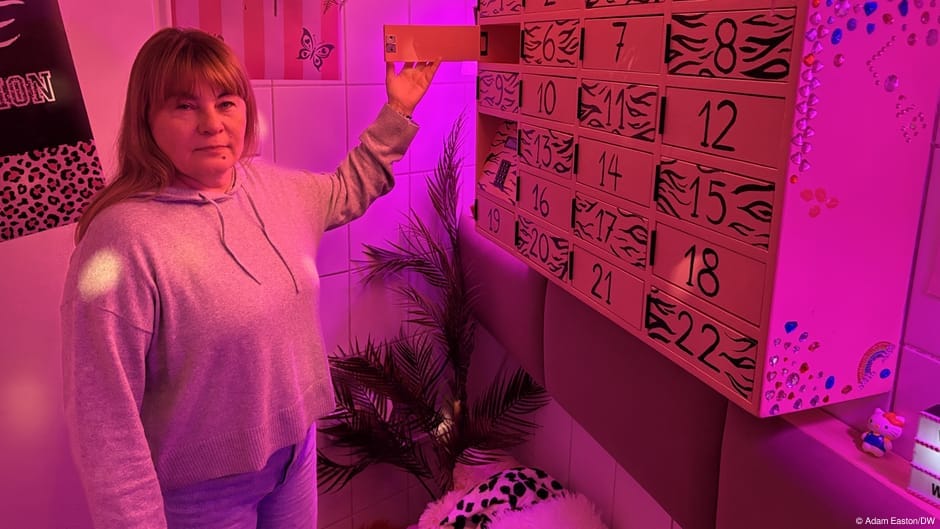
Women's rights activists in Poland have opened the "Abortomat," a set of 22 pink lockers dispensing abortion pills, in a building directly across from the Polish parliament. The location is deliberate: a physical monument to the gap between Prime Minister Donald Tusk's 2023 campaign promise of abortion on demand through week 12 and the zero legislative progress his coalition has delivered. Poland remains one of only two EU member states — alongside Malta — where abortion on request is illegal.
Extraction Map
The mechanism is straightforward. A woman completes a medical questionnaire through the organization Women Help Women. A doctor reviews it. She receives a PIN code. She opens a locker containing mifepristone and misoprostol, typically used up to the 14th week of pregnancy. Mifepristone is not registered in Poland but is registered in the EU, and Polish women as EU citizens can legally order it. The pills cost about €75. Abortion Dream Team activist Justyna Wydrzynska — who in 2023 became the first person convicted in Poland of helping a woman obtain an abortion, a conviction later overturned — believes the locker may exploit a legal ambiguity: a machine, not a person, delivers the pills. The legal ambiguity is real but contested. Reproductive rights lawyer Dr. Sabrina Mana-Walasek notes that a woman ordering and paying for pills herself commits no crime. But the ultra-Catholic legal group Ordo Iuris has reported the activists to prosecutors, arguing that humans operate the machine — sending codes, procuring pills, restocking lockers. Director Katarzyna Gesiak frames this as aiding an abortion, which carries up to three years in prison. Anti-abortion demonstrators regularly target the Abotak center with loudspeakers aimed at pressuring the landlord to evict them. The scale of unmet demand is stark. Abortion Dream Team helps roughly 130 women daily in Poland — about 125 using pills, the remainder traveling abroad. Polish hospitals performed just 851 legal abortions in all of last year. The gap between 851 and the approximately 47,000 women assisted annually by one organization alone reveals the true scale of demand that the legal framework refuses to acknowledge. Two bills recently passed the Sejm: one reinstating severe irreversible fetal defects as legal grounds for termination (struck down by the Constitutional Court in 2020 under the previous Law and Justice government), and another partially decriminalizing assistance with abortion. A poll by SW Research for Onet.pl found almost 61% of respondents want President Karol Nawrocki to sign the fetal-defect bill. Both activists and political observers expect Nawrocki, backed by PiS, to veto both. The political failure is bipartisan in character. Tusk's coalition includes left-wing and conservative partners who could not agree on a common position. Separate bills failed in 2024. Tusk himself conceded abortion on request would not happen during this parliamentary term. Activist Natalia Broniarczyk's fury is directed squarely at the liberals: "For three years, they did nothing to protect us. They lost three years and now, when we're close to an election, they are fighting for our voices and respect. People are more progressive than politicians." The Abortomat is infrastructure built in the absence of governance. It exists because the political system — liberal coalition, conservative president, Catholic legal establishment — has created a vacuum where roughly 130 women a day need help that the state refuses to provide. The 2020 Constitutional Court ruling that triggered the largest street protests since 1989 produced no legislative correction in five years. Activists are not waiting for permission; they are engineering around obstruction, one pink locker at a time.
Worth reading?
SKIP
Score
24
/100
Extractive. The political and legal establishment — across coalition lines — extracts compliance from Polish women by maintaining one of Europe's most restrictive abortion regimes while offering symbolic promises. Activists absorb legal risk and operational costs to fill a vacuum the state deliberately preserves.
What Is GRIN?
GRIN stands for Generativity, Resilience, Innovation efficiency, and Novelty openness. These four dimensions capture the essential characteristics of any memetic intelligence — whether a nation, a corporation, a religion, or a movement.
About GRINGenerativity
2/5
Resilience
1/5
Efficiency
1/5
Novelty
1/5
Extractive
4/5
Inverted
Does this create new capability or just redistribute existing value?
Activists generate real healthcare access for ~130 women/day, but as workaround infrastructure, not systemic capacity. 851 hospital abortions vs. ~47,000 assisted annually reveals the generative gap the state refuses to fill.
Verified Facts (8)
Only two EU member states, Poland and Malta, do not allow abortion on request.
In Poland, abortion is only allowed when the pregnancy is the result of a crime — rape or incest — or when it endangers the health or life of the woman.
The Abortomat opened in late September and has 22 pink lockers.
In 2023, Wydrzynska was the first activist to be convicted in Poland of helping a woman to have an abortion by sending her pills. The conviction was later overturned.
Abortion Dream Team helps about 130 women daily in Poland. About 125 use pills costing about €75.
851 abortions were performed in Polish hospitals last year.
Almost 61% of respondents said they want President Nawrocki to sign into law the bill on the fetal defect justification, according to SW Research for Onet.pl.
The 2020 Constitutional Court ruling led to tens of thousands of people taking part in street protests, some of the largest since communism fell in 1989.
More latest news
Read all