REGISTERED VOTERS
103M
2023 TURNOUT
27%
ELECTION YEAR
2027
MAJOR CANDIDATES
3
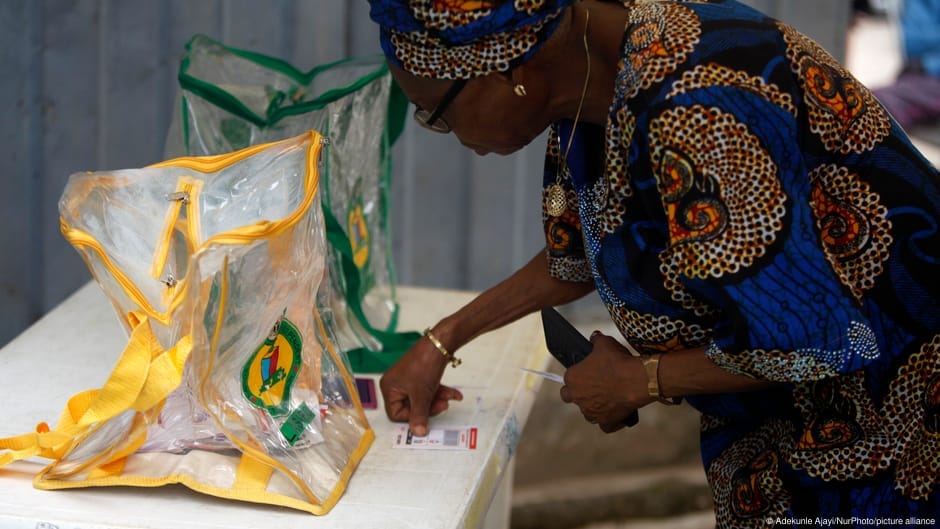
Nigeria's Independent National Electoral Commission faces a credibility crisis two months before the 2027 general election. Its preliminary voter register reportedly contains images with telltale signs of AI generation — exaggerated facial features, duplicated names, and identities of deceased individuals. INEC Chairman Joash Amupitan has announced an investigation and a new dedicated unit to monitor AI-related threats and detect deepfakes.
Extraction Map
The problem is not new in kind, only in scale. Before AI proliferation, the 2023 election cycle was already saturated with deepfakes falsely linking candidates to terror-related activities. What AI changes is the production cost: synthetic content that once required skilled operators can now be generated at commodity prices. Political parties are already using inflated crowd images to manufacture the appearance of mass support, according to DUBAWA's Lois Ugbede. The more corrosive dynamic is what Akintunde Babatunde of the Centre for Journalism Innovation and Development calls the liar's dividend. Rather than just tricking people into believing false content, the mere existence of convincing AI fakes gives politicians a blanket excuse to dismiss genuine evidence. Babatunde cites a lawmaker who made inflammatory remarks at a campaign rally, then claimed the clips were AI-manipulated. When every piece of evidence can be waved away as synthetic, accountability collapses. Nigeria's relationship with election technology has been troubled throughout. Electronic voter accreditation was introduced in 2011 with Direct Data Capture Machines. The Bimodal Voter Accreditation System (BVAS) replaced it in 2021, combining fingerprint and facial recognition. During the 2023 elections, BVAS suffered systemic failures caused by poor cell signal, delaying voter accreditation across the country. The institutional context makes this worse. Election consultant Chibuike Mgbeahuruike of CDD-West Africa argues that AI itself is not the threat — the absence of effective accountability for its deployment is. INEC is asking 103 million registered voters to trust a system that cannot even guarantee its own register is free of synthetic data. Without transparent, independently scrutinized technology governance, each new tool becomes another vector for manipulation rather than an upgrade. Voter apathy completes the feedback loop. The 2023 elections recorded the lowest turnout since Nigeria's return to democratic rule in 1999, with only 27% of registered voters casting ballots. When the electoral infrastructure is visibly compromised — whether by deepfakes, system failures, or institutional weakness — the rational response for many citizens is to disengage. That disengagement further concentrates power among those who benefit from low participation. President Bola Tinubu faces former Vice President Atiku Abubakar and Peter Obi in the coming contest. The question is not whether AI disinformation will appear — it already has. The question is whether Nigeria's institutions can establish accountability mechanisms fast enough to prevent the complete erosion of electoral legitimacy in a country of 220 million people.
Worth reading?
SKIP
Score
20
/100
Extractive — AI-generated disinformation and institutional failure concentrate political power among incumbents and well-resourced actors while imposing trust costs on 103 million voters and deepening democratic disengagement.
What Is GRIN?
GRIN stands for Generativity, Resilience, Innovation efficiency, and Novelty openness. These four dimensions capture the essential characteristics of any memetic intelligence — whether a nation, a corporation, a religion, or a movement.
About GRINGenerativity
1/5
Resilience
1/5
Efficiency
1/5
Novelty
1/5
Extractive
4/5
Inverted
Does this create new capability or just redistribute existing value?
Zero new capability created. AI is used to fabricate voter identities and manufacture crowd support — pure value destruction. INEC's new monitoring unit is reactive, not generative.
Verified Facts (13)
INEC released preliminary voter's register reportedly riddled with AI-generated images
Joash Amupitan is chairman of INEC and announced establishment of dedicated AI monitoring unit
2023 elections featured deepfakes falsely linking candidates to terror-related activities
Direct Data Capture Machines first deployed in 2011
Bimodal Voter Accreditation System (BVAS) introduced as new standard combining fingerprints with facial recognition
BVAS suffered system failures during 2023 general elections due to poor cell signal
INEC tallied more than 103 million Nigerians registered to participate
2023 elections recorded lowest voter turnout since return to democratic rule in 1999 with 27% of registered voters going to the polls
President Bola Tinubu faces former Vice President Atiku Abubakar and Peter Obi
Lois Ugbede is assistant editor at factchecking platform DUBAWA
Akintunde Babatunde is Executive Director of the Centre for Journalism Innovation and Development (CJID)
Chibuike Mgbeahuruike is election consultant at Centre for Democracy and Development (CDD-West Africa)
Mallam Jibrin Baba Ndace is Director-General of Voice of Nigeria (VON)
More latest news
Read all