TEENS USING AI
91%
AI FOR HOMEWORK
74%
GERMAN PISA
25yr LOW
PISA COUNTRIES
90+
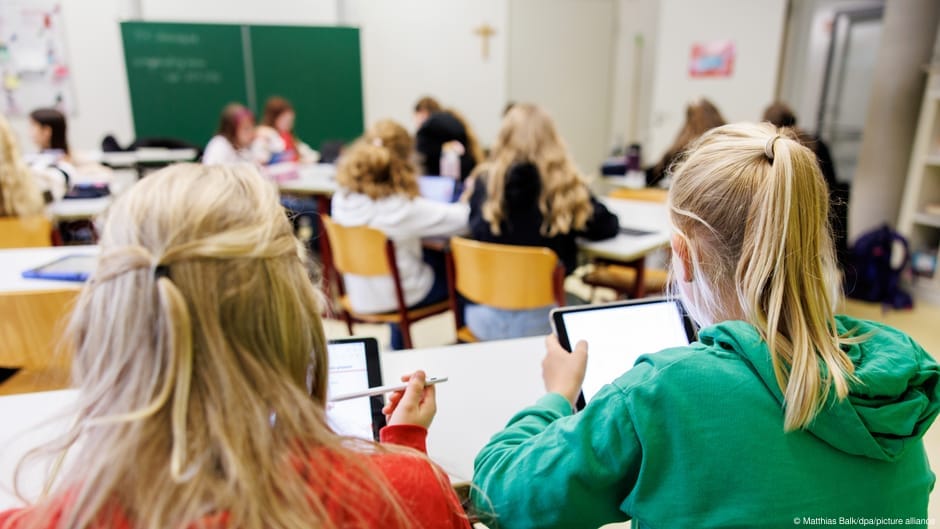
The numbers are stark and the mechanism is simple. Ninety-one percent of German teenagers aged 12 to 19 use at least one AI application. Seventy-four percent use AI for homework and learning. Germany's 15-year-olds just posted their lowest PISA scores in the study's 25-year history. The OECD's own analysis draws the line directly: students who report using AI chatbots score lower in science than those who don't.
Extraction Map
The concept has a clinical name — cognitive outsourcing — but the classroom reality is blunter. Students type questions into tablets mid-lesson and read AI-generated answers aloud when called upon. A German teacher with decades of experience told DW her students 'can't even think for themselves anymore.' Text comprehension is declining because students let AI summarize everything. The Brookings Institution concluded the risks of AI in education outweigh the benefits, citing erosion of critical thinking, memory, perseverance, and independent judgment. The OECD's Andreas Schleicher offered the clearest framing: 'Just as we don't get fit by watching sports but by doing sports ourselves, learning doesn't come from consuming content, but from the mind's productive cognitive engagement with new material.' An LLM differs from a calculator or notepad because it can handle the entire problem-solving process, not just a step or two. The cognitive workout vanishes entirely. The inequality amplifier is the sharpest edge. The Brookings study found that students with solid foundational skills can use AI to deepen learning and progress faster. But students with knowledge gaps tend to adopt AI's errors, outsource their thinking, and fall further behind. AI widens the gap. The PISA study confirms that children from more affluent backgrounds already have a better starting position, and AI accelerates that advantage — the Matthew effect in digital form. Policy responses range from blunt to toothless. New York's mayor banned AI in public schools through eighth grade for the 2026-2027 school years. Germany's Standing Conference of Education Ministers has issued statements since 2024 calling for students to engage with AI in a 'critical, reflective and responsible manner' — language that commits to nothing. Individual German states hold education authority, fragmenting any coordinated response. The actual adaptation is happening teacher by teacher. Julian Hinn integrates AI from the 10th grade onward, teaching students to critically evaluate AI output quality. Franziska Müller bans AI for certain exercises while permitting it in others. Both stress personal autonomy and the reality check of exams, where no AI is allowed. One of Müller's students recently confessed he felt he 'simply couldn't think for himself anymore because of AI.' That confession, from inside the system, may be the most important data point in the story. The structural problem is speed mismatch. AI adoption among students is essentially universal and accelerating. Institutional response is fragmented, slow, and largely advisory. Teachers are improvising individual solutions with no systemic support. The 15-year-old interviewed for this piece has been using AI tools for two and a half years — longer than most education ministries have been discussing the issue.
Worth reading?
SKIP
Score
24
/100
Extractive — AI tool providers capture engagement and data while the cognitive costs are borne entirely by students whose foundational skills atrophy, with inequality widening as a compounding side effect.
What Is GRIN?
GRIN stands for Generativity, Resilience, Innovation efficiency, and Novelty openness. These four dimensions capture the essential characteristics of any memetic intelligence — whether a nation, a corporation, a religion, or a movement.
About GRINGenerativity
1/5
Resilience
1/5
Efficiency
1/5
Novelty
2/5
Extractive
4/5
Inverted
Does this create new capability or just redistribute existing value?
Net destructive for human capital. AI handles the entire cognitive process, eliminating the productive struggle that builds understanding. Students with weak foundations fall further behind; the gap compounds.
Verified Facts (8)
91% of young people surveyed in Germany, between the ages of 12 and 19, stated that they use at least one AI application
74% use AI for homework and learning
German 15-year-olds posted their lowest PISA scores in the 25-year history of the study
Students who report using AI chatbots get lower scores in science, on average, than those who don't use AI — Andreas Schleicher, OECD
PISA participants from more than 90 countries
New York Mayor Zohran Mamdani has banned the use of AI in public schools up to the eighth grade for the 2026 and 2027 school years
The last JIM study dates back to 2024
The Standing Conference of the Ministers of Education and Cultural Affairs (KMK) has been issuing statements on the use of AI since 2024
More latest news
Read all