SHIP CATCH EVER
1st
ORBITAL FLIGHT
22+hrs
STARLINK DEPLOYED
26
TEST FLIGHT
15th
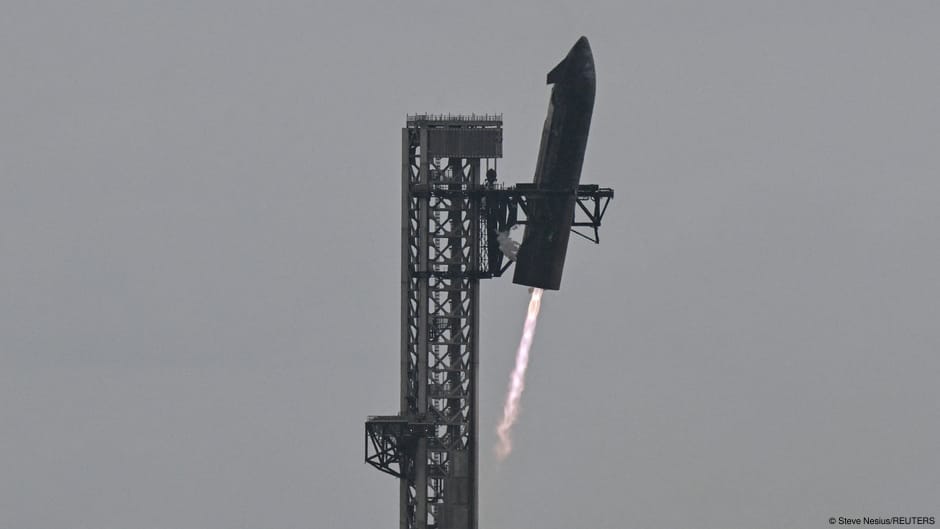
SpaceX landed the headline it wanted: Starship, the upper stage of the world's largest rocket system, descended from orbit and slipped between the mechanical "chopstick arms" at Launch Pad 2 in Texas on Saturday. It was the first successful capture of the spacecraft itself — the centerpiece vessel that Elon Musk's company needs to make fully reusable if it wants to collapse the cost of spaceflight by orders of magnitude. The ship had orbited Earth 14 times over 22-plus hours, deploying 26 Starlink satellites along the way.
Extraction Map
The booster story is less tidy. The Super Heavy first stage — the bottom half of the rocket — was also supposed to be caught, a trick SpaceX had already pulled off on three earlier test flights. This time it failed. Engines cut off too early, the guidance system detected the vehicle was out of position, and the flight termination system did its job: the booster detonated over the Gulf of Mexico shortly after Friday's launch. SpaceX engineer Kate Tice confirmed the anomaly; an investigation is underway. This is the 15th test flight of the full Starship stack, and the split outcome is instructive. Catching the spacecraft is the harder, higher-value achievement — it returns from orbital velocity, endures reentry heating, and must hit a precise corridor with zero margin. The booster catch, by contrast, is a suborbital return that SpaceX had already demonstrated. Losing it here is a regression, not a frontier problem, and that makes the failure more puzzling than the spacecraft catch is impressive. NASA has billions of dollars riding on Starship. The agency is paying SpaceX to develop a Starship-derived lunar lander for the Artemis program, with crewed Moon landings targeted later this decade and a permanent lunar base as the longer arc. Administrator Jared Isaacman called the spacecraft capture "almost magic" on X. That enthusiasm is understandable — NASA needs Starship to work — but the booster failure is a reminder that "fully reusable" requires both halves to come home intact, every time. The economic logic is straightforward: expendable rockets throw away hardware worth tens of millions of dollars per flight. Full reusability turns rockets into something closer to airliners — expensive to build, cheap to operate per mission. SpaceX already reuses Falcon 9 boosters routinely, but Starship is a different scale. The spacecraft catch proves the harder half of that equation is solvable. The booster explosion proves it isn't solved yet. Musk's stated ambition runs from Starlink constellation buildout through lunar infrastructure to Mars colonization. All of it depends on Starship achieving rapid, reliable reusability at costs no other launch system can match. Saturday's catch moves the program forward on the spacecraft side. But the booster anomaly — particularly the fact that this is a capability SpaceX had previously demonstrated — introduces a new question about consistency rather than capability. The net position: SpaceX proved something genuinely new (spacecraft catch from orbit) while regressing on something it had already shown it could do (booster catch). That asymmetry defines the current moment. The generative potential is enormous if both halves converge on reliability. The risk is that each test flight is still a coin flip on which half cooperates.
Worth reading?
RECOMMENDED
Score
72
/100
Generative. A first-ever spacecraft orbital catch creates real new capability in reusable launch infrastructure, even though the booster failure reveals inconsistency in a previously demonstrated capability.
What Is GRIN?
GRIN stands for Generativity, Resilience, Innovation efficiency, and Novelty openness. These four dimensions capture the essential characteristics of any memetic intelligence — whether a nation, a corporation, a religion, or a movement.
About GRINGenerativity
4/5
Resilience
3/5
Efficiency
3/5
Novelty
4/5
Extractive
1/5
Inverted
Does this create new capability or just redistribute existing value?
High generative potential. First orbital spacecraft catch is a genuine new capability. 26 Starlink satellites deployed in the same flight — dual-use productivity from a test mission.
Verified Facts (8)
SpaceX's Starship spacecraft returned from orbit on Saturday to the tower it was launched from on Friday
The spaceship descended and smoothly slipped between the mechanical 'chopstick arms' above Launch Pad 2 in Texas
It was the 15th test flight of the world's biggest and most powerful rocket system
The Starship spacecraft orbited Earth 14 times for over 22 hours, deploying 26 Starlink satellites
NASA Administrator Jared Isaacman wrote on X: 'It was almost magic'
The Super Heavy booster exploded over the Gulf of Mexico shortly after launch on Friday
SpaceX's Kate Tice said its engines stopped firing too soon
SpaceX caught the Super Heavy Booster on three earlier test flights
More latest news
Read all