PEACE PLAN · NO RESULT
4 yrs
SUMMIT BAN START
Oct 2021
SCS CODE · DONE
80%
ASEAN MEMBERS
10
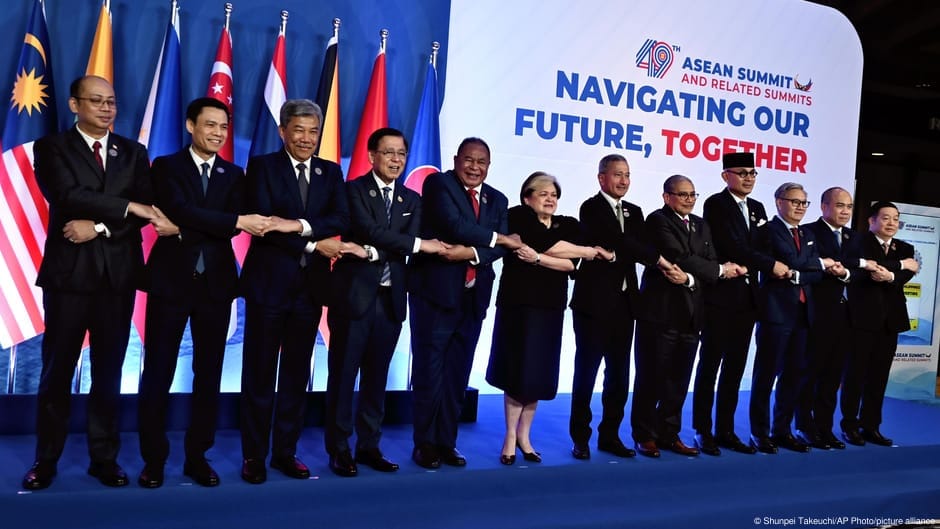
ASEAN has spent four years trying to manage Myanmar's military coup without the tools — or the will — to reverse it. The bloc's new "calibrated engagement" framework, announced at the Manila summit, formalizes what has been obvious: Myanmar's junta is not going away, and ASEAN needs a mechanism that looks like leverage without requiring any.
Extraction Map
The five-point consensus peace plan, agreed in April 2021, has produced nothing measurable. Fighting between the Tatmadaw, pro-democracy resistance forces, and ethnic armed organizations continues across multiple fronts. Min Aung Hlaing staged elections widely dismissed as illegitimate and installed himself as civilian president. ASEAN's response — barring Myanmar's political leaders from summits since October 2021 — was the strongest censure the bloc has ever imposed on a member. It changed nothing on the ground. The new "phased and progress-based approach" creates a diplomatic escalator: Myanmar can regain summit access incrementally if it demonstrates "sustained and concrete progress" on the peace plan. Thailand, which shares Myanmar's longest border and absorbs the bulk of its refugee flows, has pushed hardest for re-engagement since Min Aung Hlaing's transition to nominal civilian rule. Philippine President Marcos Jr. framed the question as "what more can we do?" — a signal that ASEAN's patience for isolation as strategy is thinning. The structural problem is unchanged. ASEAN's non-interference doctrine means no member will condition trade, investment, or border access on political reform. The phased approach creates the appearance of conditionality while the actual conditions — cessation of hostilities, humanitarian access, inclusive dialogue — remain entirely within the junta's discretion. Thailand's advocacy for closer engagement is partly humanitarian, partly a hedge: Bangkok wants a stable interlocutor on its western border regardless of how that interlocutor came to power. Meanwhile, the Manila summit is stacking other significant business. Australia and the Philippines signed a defense pact. Canada and the Philippines concluded free trade negotiations. South China Sea code-of-conduct talks with Beijing are reportedly 80% complete but unlikely to close in Manila, with Chinese Premier Li Qiang representing Beijing. Donald Trump arrives Tuesday to meet Quad partners (India, Japan, Australia) before heading to Shenzhen for talks with Xi Jinping and Vladimir Putin — a sequence that positions Manila as a waypoint to the main event. The Myanmar track and the broader geopolitical maneuvering reflect the same underlying tension: ASEAN wants to matter as an institution without exercising the coercive power that would make it consequential. The phased engagement framework is a sophisticated piece of institutional self-preservation — it gives every member something to point to while requiring nothing of the one member that needs to change. If this pattern continues, Myanmar's junta gets a slow, predictable path back to the table, the civil war grinds on without external pressure, and ASEAN's peace plan becomes a permanent process rather than a deliverable. The bloc preserves consensus. The people of Myanmar bear the cost.
Worth reading?
SKIP
Score
20
/100
Extractive. The framework re-legitimizes the junta's position incrementally while imposing no binding costs on the entity responsible for the crisis, extracting diplomatic cover from ASEAN's institutional credibility at the expense of Myanmar's civilian population.
What Is GRIN?
GRIN stands for Generativity, Resilience, Innovation efficiency, and Novelty openness. These four dimensions capture the essential characteristics of any memetic intelligence — whether a nation, a corporation, a religion, or a movement.
About GRINGenerativity
1/5
Resilience
1/5
Efficiency
1/5
Novelty
1/5
Extractive
4/5
Inverted
Does this create new capability or just redistribute existing value?
No new capability created. The phased approach recycles the same failed peace plan with a new governance wrapper. Zero new leverage, zero new incentives for the junta to change behavior.
Verified Facts (11)
Myanmar's political leaders have been barred from summits and foreign ministers' meetings since October 2021
The military seized power that year, overthrowing the elected government led by Nobel Peace Prize laureate Aung San Suu Kyi
ASEAN's five-point peace plan was agreed in 2021 and has yielded little
Thailand has pushed for closer engagement since coup leader Min Aung Hlaing took office as civilian president following elections that monitors dismissed as a sham
Australia and the Philippines signed a defense agreement on Sunday
Canada and the Philippines concluded free trade negotiations on Saturday
Philippine Foreign Secretary Theresa Lazaro said South China Sea code-of-conduct negotiations between ASEAN and China were 80% complete
Chinese Premier Li Qiang is representing Beijing at the summit
US President Donald Trump is expected to arrive on Tuesday and meet the leaders of India, Japan and Australia (the Quad)
Trump-Xi and Trump-Putin talks expected in Shenzhen on Thursday
The Philippines hands the rotating ASEAN chair to Singapore next year, with Thailand due to take over in 2028
More latest news
Read all