DISTANCE · 1 LIGHT-DAY
26B km
KM/H SPEED
61,000
MISSION DURATION
49 yrs
SIGNAL ROUND-TRIP
2 days
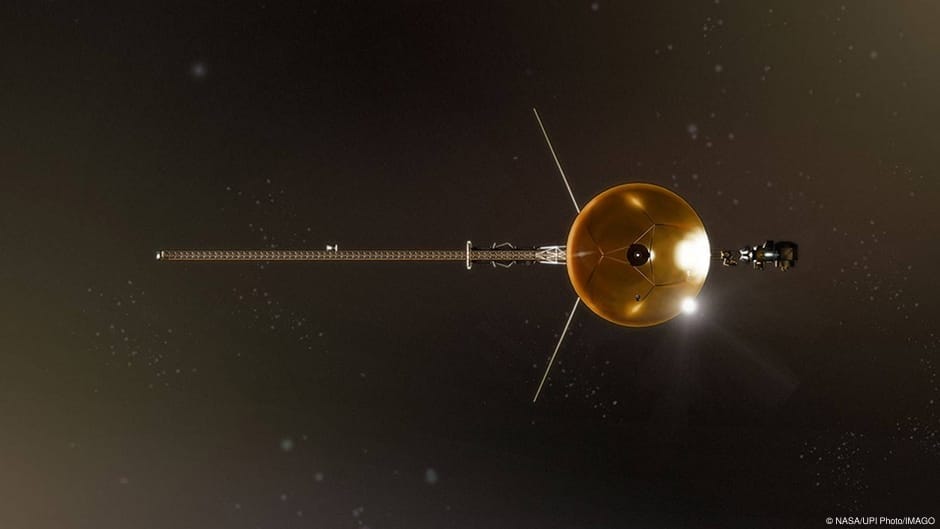
On November 18, 2025, at 11:16 a.m. Central European Time, NASA's Voyager 1 crossed a symbolic but physically real threshold: one light-day from Earth. That's roughly 26 billion kilometers — the distance light covers in 24 hours, accomplished by a 1977-era spacecraft in 49 years, two months, and 11 days. A round-trip radio signal now takes two full days.
Extraction Map
The distance is a consequence of physics, not fuel. Voyager 1 exploited a planetary alignment of Jupiter, Saturn, Uranus, and Neptune that occurs once every 176 years. By performing gravitational slingshots around Jupiter and Saturn, the spacecraft accelerated to 61,000 km/h without burning additional propellant. In the vacuum of interstellar space, nothing slows it down. The speed is permanent. Voyager 1 has been collecting firsts for decades. On Valentine's Day 1990, it captured the only portrait of the solar system ever taken from the outside — the famous Pale Blue Dot image, shot from beyond Neptune. In 2012, it became the first human-made object to enter interstellar space. Now it holds the record for the most distant functioning piece of human technology, still transmitting scientific data from a region no other craft has explored. The spacecraft remains operational, powered by a plutonium-238 radioisotope thermoelectric generator that is slowly decaying. Project manager Suzanne Dodd at NASA's Jet Propulsion Laboratory notes the two-day communication lag is now a practical reality of mission operations. Mission manager Kareem Badaruddin confirms the instruments are still returning usable science. The mission was designed for a few years; it has lasted nearly five decades. Voyager 1 carries the Golden Record — a phonographic disc containing sounds, music, and greetings in dozens of languages, intended as an artifact for any extraterrestrial intelligence that might encounter it. The first voice on the record belongs to Kurt Waldheim, then UN Secretary-General, whose concealed wartime past as a German army officer in the Balkans — including allegations of participation in Nazi crimes — surfaced a decade after launch. The choice, intended to represent Earthly unity, became an uncomfortable footnote. The trajectory ahead is staggering. In roughly 18,000 years, Voyager 1 will reach the one light-year milestone. In about 40,000 years, long after its power supply is dead, it will pass the star Gliese 445, more than 17 light-years from Earth. NASA describes its ultimate fate plainly: Voyager 1 is destined to wander the Milky Way "perhaps eternally." What makes this story structurally interesting is not the distance itself but what it represents about generativity. A $865 million program (in 2025 dollars for both Voyagers) launched with 1970s technology is still producing novel scientific data 49 years later. No subscription fee, no recurring extraction, no planned obsolescence. The mission's value compounds over time rather than depreciating — a rare example of public investment that generates returns across generations.
Worth reading?
ESSENTIAL
Score
88
/100
Generative. A sub-billion-dollar public investment from 1977 is still producing first-of-kind scientific data with zero recurring extraction — the textbook case of compounding generative value from patient public spending.
What Is GRIN?
GRIN stands for Generativity, Resilience, Innovation efficiency, and Novelty openness. These four dimensions capture the essential characteristics of any memetic intelligence — whether a nation, a corporation, a religion, or a movement.
About GRINGenerativity
5/5
Resilience
2/5
Efficiency
5/5
Novelty
5/5
Extractive
0/5
Inverted
Does this create new capability or just redistribute existing value?
Peak generativity. A single 1977 investment still produces novel interstellar data 49 years later. No other instrument probes this region of space. Value compounds without additional cost.
Verified Facts (9)
Voyager 1 reached one light-day from Earth on November 18, 2025, at 11:16 a.m. Central European Time
A light-day is about 26 billion kilometers (around 16 billion miles)
Voyager 1 is traveling at 61,000 km/h (38,000 mph)
The planetary alignment of Jupiter, Saturn, Uranus, and Neptune happens only once every 176 years
On Valentine's Day 1990, Voyager 1 took the only portrait of the solar system from the outside ever made by a spacecraft
In 2012, it became the first human-made object to reach interstellar space
In about 40,000 years it will pass by the star Gliese 445, more than 17 light-years away
It will take Voyager 1 about 18,000 years to reach the one light-year milestone
The Golden Record's first voice is that of Kurt Waldheim, former UN Secretary-General (1972-81) and Austrian President (1986-92), whose concealed wartime past as a German army officer in the Balkans surfaced a decade after launch
More latest news
Read all