US LEADERS AT COP31
120+
US GDP · PARIS-ALIGNED STATES
~60%
PROJECTED CO₂ CUT BY 2035
46%
FEDERAL DELEGATES
0
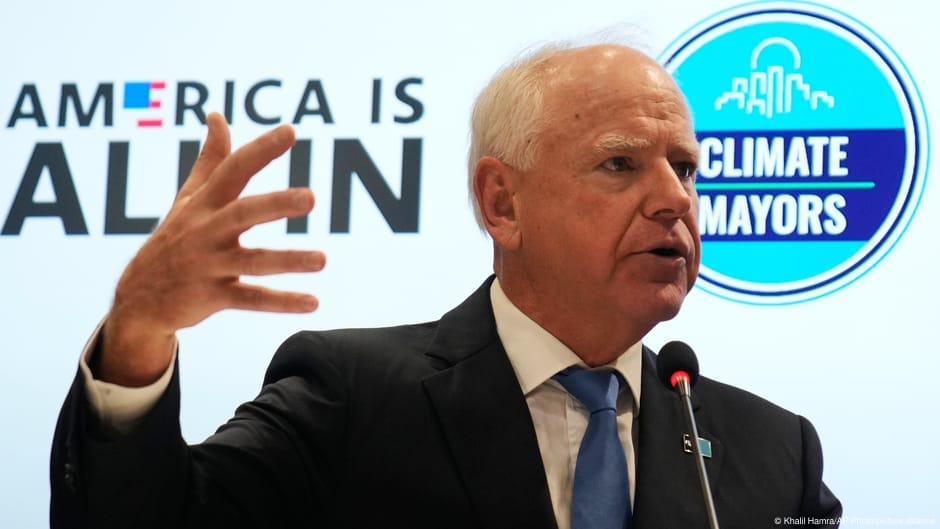
The United States has no official seat at COP31 in Antalya. For the second consecutive year under President Trump, Washington sent no federal delegation to the UN climate summit. The vacuum, however, is not empty. More than 120 state and local leaders — governors, mayors, former Cabinet officials — descended on Turkey under the banner of the "America Is All In" coalition, staging a parallel presence that is part diplomacy, part domestic signaling.
Extraction Map
The roster is heavy with Democratic firepower: former Secretary of State John Kerry, former Vice President Al Gore, California Governor Gavin Newsom, Minnesota Governor Tim Walz, New Mexico Governor Michelle Lujan Grisham. They cannot negotiate on behalf of the United States. They hold no federal mandate. What they hold is control over economies and energy grids that, taken together, represent roughly 60% of US GDP. Nearly half of US states have committed to emissions reductions aligned with the Paris Agreement. The numbers behind that commitment are not trivial. A joint report from America Is All In and the University of Maryland's Center for Global Sustainability found that current state policies, combined with market trends and falling technology costs, could cut US carbon emissions by up to 46% below 2005 levels by 2035. Minnesota claims it will reach a 100% carbon-free grid by 2037. New Mexico — the nation's second-largest oil and gas producer — touts the largest wind farm in North America and aggressive methane regulations. California aims for 100% renewable energy by 2045. The subnational push is real, but its limits are structural. States cannot set national fuel-efficiency standards, negotiate international agreements, or redirect federal research budgets. Trump has actively promoted fossil fuel expansion, cut clean energy funding, and rolled back power plant emission rules. The federal machinery runs in the opposite direction, and states lack the jurisdictional reach to substitute for it on trade policy, international climate finance, or cross-border carbon pricing. The timing carries domestic political weight. The US midterm elections delivered a significant defeat for Trump's Republicans, and Democrats in Antalya were visibly eager to signal that federal re-engagement is two years away at most. Jorge Gastelumendi of the Atlantic Council's Climate Resilience Center noted that US credibility on climate — and foreign policy broadly — has been "badly damaged" under Trump. Mike Williams of the Center for American Progress was blunter: nobody should expect the US to be "welcomed back with open arms." Newsom framed the stakes in competitiveness terms, warning that China is outpacing the US in solar power and electric vehicles. "There is no substitute for national leadership," he told reporters — an implicit acknowledgment that the subnational strategy is a holding action, not a replacement. The coalition's presence at COP31 is designed to preserve relationships and credibility until a federal pivot becomes possible. The deeper structural question is whether a 46% emissions cut driven by state-level action and market forces is sufficient without federal coordination, or whether the ceiling on decarbonization without national policy is lower than the optimistic projections suggest. The states are doing real work. Whether it adds up to enough — and whether international partners will trust a country that exits climate agreements every time the White House changes hands — remains the unresolved problem.
Worth reading?
OPTIONAL
Score
52
/100
Mildly generative at the subnational level — real renewable capacity is being built — but the federal vacuum creates systemic fragility and credibility extraction that limits the overall generative potential.
What Is GRIN?
GRIN stands for Generativity, Resilience, Innovation efficiency, and Novelty openness. These four dimensions capture the essential characteristics of any memetic intelligence — whether a nation, a corporation, a religion, or a movement.
About GRINGenerativity
3/5
Resilience
2/5
Efficiency
2/5
Novelty
3/5
Extractive
2/5
Inverted
Does this create new capability or just redistribute existing value?
Real capacity being built: wind farms, grid decarbonization, methane rules. But capped by federal opposition — states can't set trade policy or international frameworks. Net positive, structurally limited.
Verified Facts (8)
More than 120 state and local leaders from across the country are attending as part of the 'America Is All In' coalition.
Nearly half of US states, representing about 60% of the US economy, are committed to reducing emissions in line with the Paris Agreement.
Current state policies, combined with market trends and falling technology costs, could slash US carbon emissions by up to 46% below 2005 levels by 2035.
Minnesota was on track to have a '100% carbon free' grid by 2037, earlier than their target of 2040.
New Mexico is the second-largest oil and gas producer in the US.
The largest wind farm in North America is in New Mexico.
California plans to get 100% of its energy from renewables by 2045.
Trump's Republicans suffered a significant defeat in the US midterm elections.
More latest news
Read all