PRISON SENTENCE
18 yrs
ECHR COMPENSATION
€32,500
ECHR RULINGS DEFIED
3
MANDATE REVOKED
2024
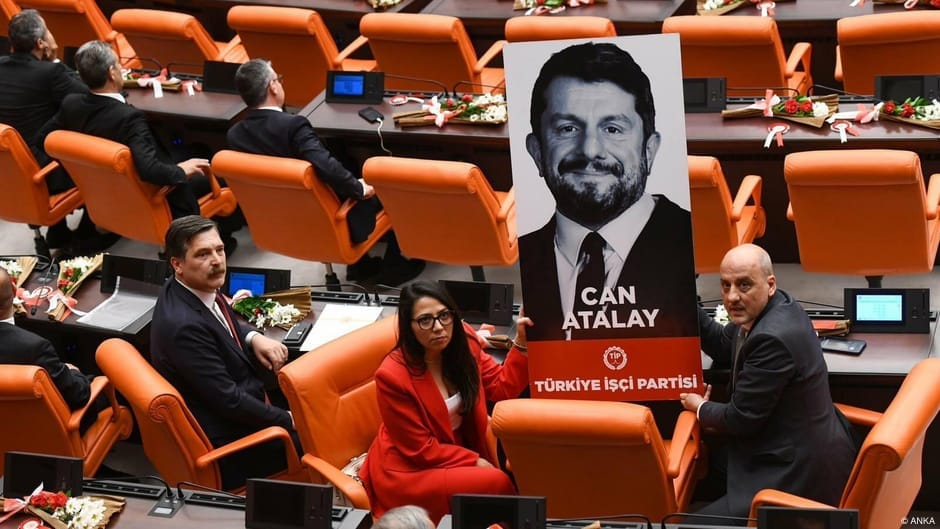
The European Court of Human Rights ruled Tuesday that Turkey must release Can Atalay, a human rights lawyer and elected member of parliament who has been imprisoned since his involvement in the 2013 Gezi Park protests. The court found his continued detention was designed to silence political opposition and undermine pluralism. It ordered €32,500 in compensation.
Extraction Map
Atalay's case is a textbook example of how Turkey's ruling apparatus converts judicial process into a tool of political control. As a lawyer, Atalay represented victims in social, political, and press freedom cases. He was among the leading voices in the 2013 Gezi protests, which the Erdogan government reframed as an attempted coup. In April 2022, Atalay and seven others were sentenced to 18 years in prison for "aiding and abetting an attempted coup" — a charge widely viewed as politically motivated. From Silivri prison, Atalay ran as a candidate for the Workers' Party of Turkey (TIP) in the 2023 parliamentary elections, winning a seat representing the earthquake-devastated province of Hatay. Despite multiple rulings by Turkey's own Constitutional Court ordering his release, the government refused to comply. His parliamentary status was revoked in 2024, a decision the Constitutional Court later overturned — but Erdogan's AKP blocked the opposition from formally reading that decision in parliament. The ECHR judges explicitly framed Atalay's case not as an isolated incident but as part of a broader pattern of detaining political opponents, human rights activists, and journalists. This context matters because Turkey has already refused to comply with ECHR rulings in the cases of rights activist Osman Kavala and Kurdish politician Selahattin Demirtas, both of whom remained imprisoned long after Strasbourg ordered their release. Turkey was among the original signatories of the European Convention on Human Rights, making its systematic defiance of the court's rulings a structural problem for the Convention system itself. Each ignored ruling degrades the court's authority not just over Turkey but as a credible enforcement mechanism for all 46 member states. The question is no longer whether the ECHR can issue correct rulings — it's whether its rulings mean anything when a signatory state treats them as advisory. After the ruling was published, TIP leader Erkan Bas called on social media for Atalay's release and the restoration of his parliamentary mandate. The practical likelihood of compliance remains low. Turkey's governing coalition has demonstrated repeatedly that domestic political calculus overrides international legal obligations, and no enforcement mechanism exists to compel compliance beyond reputational cost and potential suspension from the Council of Europe. The 20-year trajectory here is grim. If Turkey continues to imprison elected lawmakers and defy its own courts and the ECHR alike, the European rights architecture loses its credibility as anything more than a declaration of principles. For Turkish civil society, the message is that legal avenues for political participation are functionally closed — which historically accelerates either emigration or radicalization.
Worth reading?
SKIP
Score
8
/100
Extractive. The ruling party captures political control by neutralizing elected opponents, independent courts, and international oversight — extracting legitimacy from democratic institutions to consolidate executive power.
What Is GRIN?
GRIN stands for Generativity, Resilience, Innovation efficiency, and Novelty openness. These four dimensions capture the essential characteristics of any memetic intelligence — whether a nation, a corporation, a religion, or a movement.
About GRINGenerativity
0/5
Resilience
1/5
Efficiency
1/5
Novelty
0/5
Extractive
5/5
Inverted
Does this create new capability or just redistribute existing value?
Pure destruction. An elected lawmaker is jailed, a parliamentary seat sits empty, legal advocacy is criminalized. No new capability is created — only political competition is eliminated.
Verified Facts (8)
ECHR ruled Tuesday that Turkey must release Can Atalay and allow him to take up his parliamentary seat
Court ordered Turkey to pay €32,500 (about $35,700) in compensation
Atalay sentenced to 18 years in prison in April 2022 for 'aiding and abetting an attempted coup'
Atalay ran as a candidate for the Workers' Party of Turkey (TIP) in the 2023 parliamentary elections
His parliamentary status was revoked in 2024, a decision the Constitutional Court later overturned
President Recep Tayyip Erdogan's party stopped the opposition from formally reading the decision in parliament
Turkey was among the original signatories of the European Convention on Human Rights
Turkey has previously refused to comply with ECHR decisions in the cases of Osman Kavala and Selahattin Demirtas
More latest news
Read all