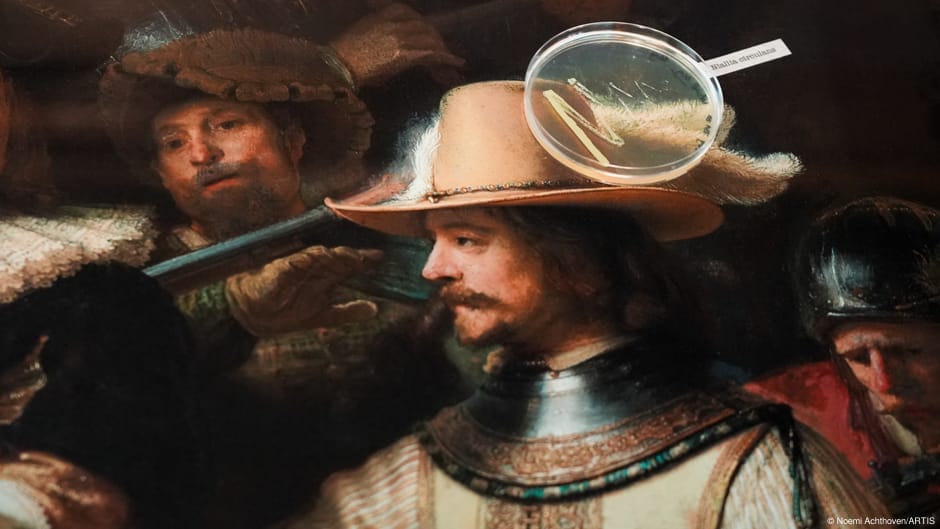
"The Night Watch Lives" is a six-month study in which microbiologist Eline van Bloois presses sterile discs against Rembrandt's 1642 masterpiece once a month, cultures what grows, and displays the Petri dishes in an exhibition at ARTIS-Micropia in Amsterdam. The project is a collaboration between that museum — dedicated to microorganisms — and the Rijksmuseum, where the painting hangs. It sits within the broader "Operation Night Watch," described as the most extensive study and restoration of the painting ever undertaken, running since 2019. The format is the thing. Van Bloois isn't presenting finished findings — she's exhibiting the study as it unfolds. At the November 11 opening, only two of six sampling sessions were complete. Visitors watch the science happen in something closer to durational performance than traditional museum display. "We really take them through that journey with us," she says. The Petri dishes sit alongside a life-size reproduction showing sampling locations and identified organisms. The microbiology itself delivers a mix of the expected and the genuinely puzzling. Many organisms found are common human skin bacteria — logical, given the painting lives in a room full of people. But Microbacterium saccharophilum, first identified at a sugar refinery in Japan in 2013, turned up in the samples. How and when it reached a 17th-century Dutch painting is unknown. "You cannot ask the microbes where they originate from," van Bloois notes. Soil bacteria associated with plant roots also appeared, though van Bloois explains they exist as inactive spores on the canvas and would need nutrients, temperature, and humidity conditions the museum doesn't provide in order to grow. The conservation implications are real but prospective. Studying what lives on a painting's surface may eventually inform understanding of how paintings age, how environmental conditions affect cultural heritage, and how museums can better preserve works. Whether any organisms date to Rembrandt's time is "highly unlikely," van Bloois acknowledges — microbes don't carry timestamps. What makes this project land is the honesty about its own limits. This isn't a team announcing conclusions — it's a team showing its process, admitting uncertainty, and making the gaps in knowledge part of the visitor experience. The microbial colonies themselves resemble abstract art: colorful clusters and intricate patterns created by living organisms. The project's home institution, ARTIS-Micropia, sits under the umbrella name Natura Artis Magistra — "nature is the teacher of art and science" — and the exhibition takes that motto literally. The exhibition runs at ARTIS-Micropia in Amsterdam until the end of May 2027.
Worth reading?
RECOMMENDED
Score
60
/100
Anyone visiting Amsterdam before May 2027 who enjoys science museums, conservation, or Rembrandt — especially if you're the person who lingers at the 'how we restored this' plaques.
Cultural Placement
Like Marina Abramović's durational performance art crossed with the open-lab ethos of citizen science exhibits, but grounded in conservation microbiology. The closest precedent is the Rijksmuseum's own Operation Night Watch livestream, which turned restoration into spectacle — this extends that logic to microbiology. There's a lineage from the Exploratorium's science-as-exhibition philosophy and the recent trend of museums making process visible (the Louvre's public restoration of the Winged Victory, the British Museum's conservation studios). The difference is the temporal uncertainty: the exhibition literally doesn't know its own ending.
Honest assessment
A well-designed hybrid of science and exhibition that benefits enormously from its setting and its subject. The microbiology is genuinely interesting but preliminary; the real achievement is the format — exhibiting uncertainty itself. Best experienced in person, where the Petri dishes and the reproduction make the sampling tangible.
What Is NOVEL?
60
/ 100
BedrockNews applies a structured analytical framework called NOVEL to cultural works — games, books, film, music, and more.
How NOVEL worksNerve
3/5
Originality
3/5
Voice
3/5
Endurance
2/5
Lineage
4/5
What did the artist risk? What could have failed?
Moderate institutional risk. Exhibiting unfinished science publicly — before conclusions exist — stakes the Rijksmuseum's credibility on a process with no guaranteed payoff. Not career-ending, but genuinely uncertain.
Lineage tree
Operation Night Watch
direct ancestor — same painting, same open-process ethos, extended into microbiology
Exploratorium (SF)
extends the form of — science-as-live-exhibition philosophy
Marina Abramović durational work
tonal influence — exhibiting an unfinished process as the artwork itself
Louvre public restorations
institutional precedent — making conservation visible to visitors
Verified Facts (8)
Rembrandt's 'The Night Watch' dates to 1642
Operation Night Watch started in 2019
Exhibition opened November 11 at ARTIS-Micropia
Microbacterium saccharophilum first identified at a sugar refinery in Japan in 2013
Eline van Bloois is taking samples once a month over six months
Exhibition runs at ARTIS-Micropia in Amsterdam until the end of May 2027
Natura Artis Magistra translates to 'nature is the teacher of art and science'
Two of six sampling sessions were complete at opening
More latest news
Read all