CECOT CAPACITY
40,000
GOVTS REPLICATING
12+
CUSTODY DEATHS · SV
500+
MAX SENTENCE
1,000yr
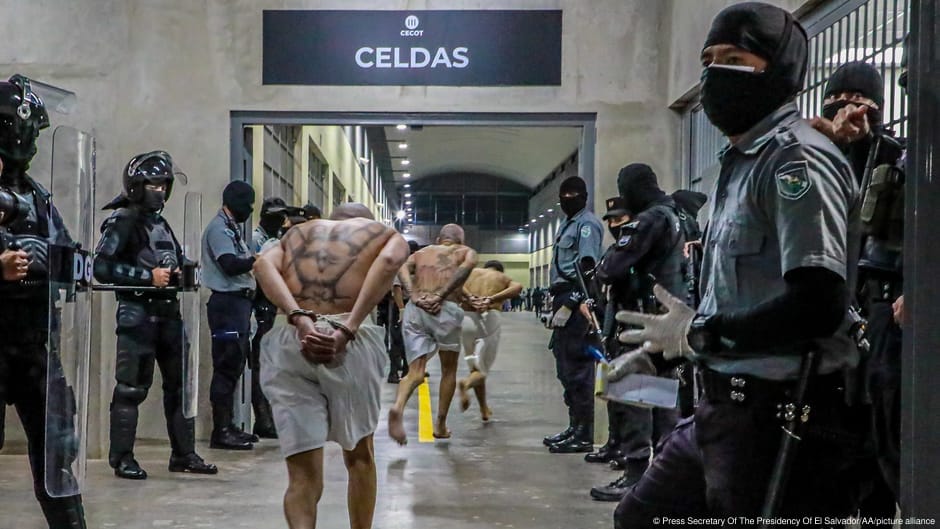
El Salvador's Terrorism Confinement Center — CECOT — holds around 15,000 inmates with capacity for 40,000, hands down sentences of up to 1,000 years, and stages submission imagery of shaved-head detainees surrounded by armed guards. It is the centerpiece of President Nayib Bukele's security brand, and more than a dozen Latin American governments have announced plans to build something like it.
Extraction Map
The problem is that mega-prisons are not new. Latin America has run de facto mega-prisons for decades — overcrowded, violent, and ungovernable. Peru's Lurigancho Prison was designed for 3,000 inmates and has held nearly 11,000 for years. What CECOT changed was the marketing: rebranding mass incarceration in maximum-security packaging and broadcasting it as strength. Criminologist Jose Luis Perez Guadalupe calls it "pure propaganda" and argues the staged images from CECOT violate human dignity. The cost problem is structural. Maximum-security facilities demand heavy investment in infrastructure, technology, specialized personnel, anti-corruption protocols, and reintegration programs. Placing the entire prison population — regardless of risk profile — in maximum-security conditions amounts to what University of Chile academic Olga Espinoza calls "over-intervention": expensive, indiscriminate, and counterproductive. Renato Rivera of the Global Initiative Against Transnational Organized Crime says there is "insufficient evidence" that mega-prisons are more cost-effective than alternatives. The criminogenic feedback loop is well documented. International evidence shows that mixing inmate risk profiles in overcrowded conditions accelerates the spread of criminal behavior. Several of Latin America's most dangerous transnational gangs — Venezuela's Tren de Aragua, Ecuador's Los Choneros, Brazil's PCC and Comando Vermelho — were born inside overcrowded prisons. Ecuador's 2021 prison massacres, among the worst on record, occurred in its largest facilities. Experts acknowledge that mass incarceration under Bukele's state of emergency coincided with a dramatic drop in Salvadoran violence and a surge in perceived public safety. But they warn this political and symbolic impact does not guarantee sustainable results. El Salvador now has one of the highest incarceration rates in the world, with over 500 deaths in state custody reported alongside allegations of arbitrary arrest and abuse. No government replicating the model has demonstrated commitment to external oversight, human rights protections, or reintegration. Alternatives exist and have been tested. Brazil's APAC model operates facilities without guards, weapons, or violence. Argentina uses Conflict Prevention and Resolution Committees. Mexico's state of Sonora runs an Alternative Criminal Justice Center. The UN's Nelson Mandela Rules, updated in 2015, recommend medium-sized prisons of 1,000-2,000 inmates with dignity, rehabilitation, and social reintegration at the center. Maximum-security capacity is needed for specific profiles, experts say — but at smaller scale with precise classification. The deepest structural problem remains untouched. Prisons — mega or otherwise — address the consequences of organized crime, not its root causes. Poverty, social exclusion, and lack of opportunity require investment in employment, education, and integration. Without that, Latin America's most unequal societies will continue generating the conditions that fill these prisons, mega or not.
Worth reading?
SKIP
Score
20
/100
Extractive — concentrates massive public spending on punitive infrastructure that breeds criminal networks, while starving upstream prevention of funding and attention.
What Is GRIN?
GRIN stands for Generativity, Resilience, Innovation efficiency, and Novelty openness. These four dimensions capture the essential characteristics of any memetic intelligence — whether a nation, a corporation, a religion, or a movement.
About GRINGenerativity
1/5
Resilience
1/5
Efficiency
1/5
Novelty
1/5
Extractive
4/5
Inverted
Does this create new capability or just redistribute existing value?
Zero new capability created. Mega-prisons warehouse existing populations without rehabilitation, producing no skill formation, economic value, or reduced recidivism. The only output is political imagery.
Verified Facts (10)
CECOT holds around 15,000 inmates with capacity of up to 40,000
Prison sentences of up to 1,000 years
More than a dozen governments in the region have proposed building similar mega-prisons
Lurigancho Prison in Lima, designed to hold 3,000 inmates, has housed nearly 11,000 for decades
CECOT was launched in 2023
Reports of more than 500 deaths in state custody in El Salvador
UN Standard Minimum Rules for the Treatment of Prisoners adopted in 1955 recommend medium-sized prisons housing between 1,000 and 2,000 inmates
Criminal groups with roots in overcrowded prisons: Tren de Aragua (Venezuela), Los Lobos, Los Choneros, Los Tiguerones (Ecuador), PCC and Comando Vermelho (Brazil)
Ecuador prison massacres in 2021 occurred in largest and most populated facilities
UN Nelson Mandela Rules updated in 2015
More latest news
Read all