DOCS LEAKED
15M
PAST PENALTIES
€20B+
2025 RUSSIA PROFITS
€61M
SHARE DROP · TUES
-6%
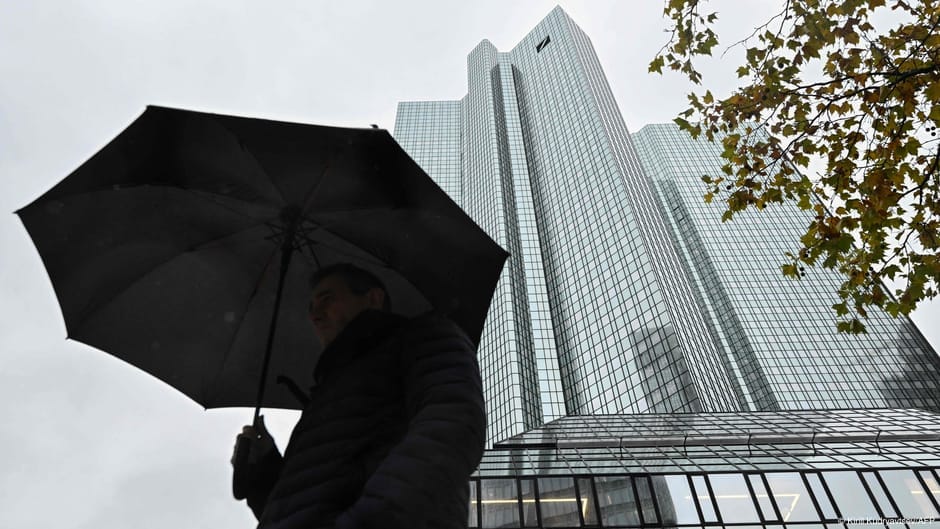
An international consortium of more than 200 investigative journalists has published findings from nearly 15 million leaked Deutsche Bank internal documents, covering two decades of business dealings that repeatedly placed revenue generation ahead of sanctions compliance and anti-money laundering rules. The leak, branded "Inside Deutsche Bank," appeared simultaneously in Der Spiegel, the Financial Times, Le Monde, and The New York Times.
Extraction Map
The documents trace the bank's aggressive pursuit of Russian business right up until the 2022 full-scale invasion of Ukraine — despite repeated internal risk warnings from managers. CEO Christian Sewing himself participated in the bank's Russia strategy working group. The bank still employs more than 160 people in Russia and generated €61 million in pre-tax profits there in 2025 through a local subsidiary. The institution's client list also included convicted sex offender Jeffrey Epstein and now-US President Donald Trump. Beyond the marquee names, the documents surface a broader pattern: tax-optimization schemes for wealthy clients, potential criminal networks moving illicit cash through the bank, facilitation of arms deals, support for environmentally damaging industries, and accounts held for the far-right Alternative for Germany (AfD) party. Each item alone is damaging; together, they describe an institution where compliance was structurally subordinated to deal-making. Deutsche Bank has been here before. Its role in the US subprime mortgage crisis cost it more than €20 billion in penalties and settlements. Sewing's 2018 appointment was supposed to mark a clean break — and he did return the bank to profitability, though at the cost of massive layoffs. His comments to Handelsblatt amounted to a qualified admission: "I am not without mistakes," he said, while insisting the strategic direction "has always been right and remains so." Supervisory Board Chairman Alexander Wynaendts backed him, saying he hadn't seen "a single decision from Christian Sewing that I was not comfortable with." The bank's official response was to label the revelations "legacy" matters with no lasting financial impact. Markets disagreed immediately: shares fell up to 6% on Tuesday. German Finance Minister Lars Klingbeil called for "full transparency" and said authorities must investigate and "take necessary action" — language that leaves room for regulatory escalation but commits to nothing specific. The structural question is not whether Deutsche Bank made mistakes in the past — that is established fact. The question is whether the institution's compliance architecture has been genuinely rebuilt or whether profitability was restored by cutting costs rather than by addressing the culture that treated risk warnings as obstacles to revenue. The continued Russian operations, generating profits three years into the Ukraine war, suggest the reform narrative is incomplete at best. If the pattern holds, Deutsche Bank will pay fines, issue statements, cycle executives, and resume operations. The extraction mechanism — in which the bank captures upside from sanctioned, criminal, or ethically compromised clients while socializing cleanup costs through penalties, bailout risk, and regulatory overhead paid by the broader financial system and taxpayers — remains structurally intact until regulators impose consequences that exceed the profits generated.
Worth reading?
SKIP
Score
16
/100
Extractive. Deutsche Bank captured decades of fees from sanctioned entities, oligarchs, and high-risk clients while offloading compliance failures, fines, and systemic risk onto shareholders, regulators, and the broader financial system.
What Is GRIN?
GRIN stands for Generativity, Resilience, Innovation efficiency, and Novelty openness. These four dimensions capture the essential characteristics of any memetic intelligence — whether a nation, a corporation, a religion, or a movement.
About GRINGenerativity
1/5
Resilience
1/5
Efficiency
1/5
Novelty
1/5
Extractive
5/5
Inverted
Does this create new capability or just redistribute existing value?
Net-negative generativity. Facilitation of oligarch wealth, arms deals, and tax-optimization schemes redistributes existing value upward rather than creating new economic capacity.
Verified Facts (11)
More than 200 investigative journalists participated in the consortium
Nearly 15 million documents were leaked to a journalist from India and another from South Africa
Published in Der Spiegel, Financial Times, Le Monde and The New York Times
Deutsche Bank CEO Christian Sewing took part in the bank's Russia strategy working group
The bank still employs more than 160 people in Russia
2025 pre-tax profits of €61 million ($67 million) generated in Russia through a local subsidiary
Deutsche Bank's involvement in the US subprime mortgage crisis cost more than €20 billion in penalties and settlements
Sewing took over as CEO in 2018
Bank shares fell by up to 6% in Tuesday trading
German Finance Minister Lars Klingbeil called for 'full transparency'
Supervisory Board Chairman Alexander Wynaendts: 'During my tenure I haven't seen a single decision from Christian Sewing that I was not comfortable with'
More latest news
Read all