COALITION NATIONS
36
DE SUPPORT · SEP 26
52%
DE OPPOSE · SEP 26
42%
FAVOR RUSSIA TIES
29%
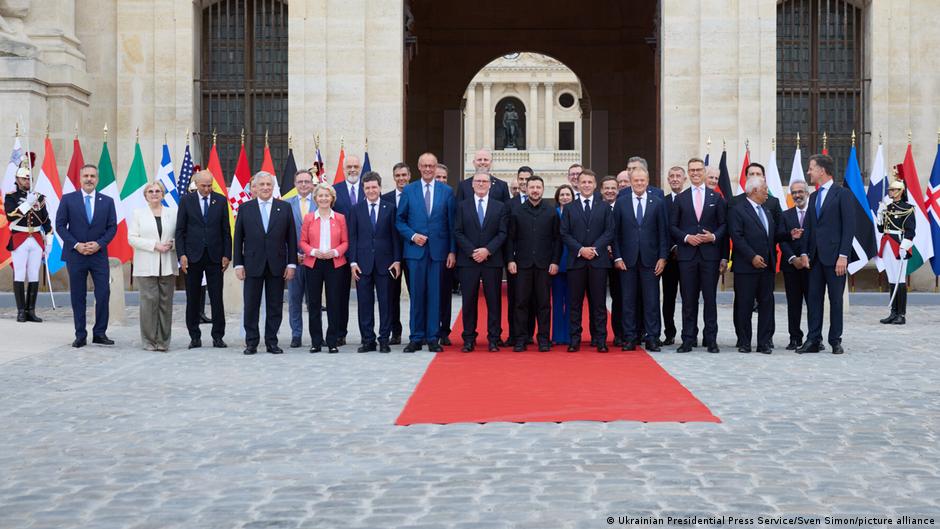
Around 20 heads of state and government are converging on Berlin on Thursday for the latest meeting of the 'Coalition of the Willing,' a 36-country grouping committed to Ukraine's defense. The coalition, led by Germany, France, and the United Kingdom, is nominally prepared to help monitor a possible ceasefire and contribute to security guarantees. US negotiators Steve Witkoff and Jared Kushner are expected to attend. Zelenskyy's presence remains unconfirmed.
Extraction Map
The problem, stated plainly: Europe has no plan. Stefan Meister of the German Council on Foreign Relations told DW there is no proposal outlining what security guarantees Europe would offer, what troops it would deploy, what measures it could provide to safeguard a ceasefire, or where it would compromise. The coalition first met in London in March 2025. Nine months later, the gap between stated willingness and operational specificity remains enormous. The question of who speaks for Europe is itself a symptom. After the EU summit in Dublin, Chancellor Friedrich Merz declared Germany has 'a seat at the table.' Berlin later clarified that representation would include the E3 — Germany, France, the UK — plus Poland and Italy, alongside European Council President António Costa. Jared Kushner, speaking in Abu Dhabi, offered an acid test: 'If Europe could identify one person to speak on their behalf, that would be a bigger achievement than getting the Russians to include them in the negotiations.' Meister reads the jockeying as driven more by domestic politics than negotiating strategy. France and Poland face elections next year. It remains unclear whether French support for Ukraine will continue in its current form afterward. The representation debate, in this reading, is a performance of relevance rather than a consolidation of leverage. The Abu Dhabi talks between Russia, Ukraine, and the US produced only a prisoner exchange — a modest step. But the fact that talks are happening at all marks a shift. Europe's window to secure influence over outcomes is real but narrow, and the coalition's credibility depends on converting rhetorical commitment into deployable capability before terms are set without European input. Meanwhile, the domestic foundation is cracking. The September 2026 ARD DeutschlandTrend survey found 52% of eligible German voters still support weapons deliveries to Ukraine, but 42% say support has gone too far — the highest opposition since the war began. A November 2026 WDR study found Ukraine support is now more polarizing in Germany than immigration, with 29% of respondents favoring rapprochement with Russia despite its ongoing war of aggression. The coalition's structural weakness is now visible from every angle: no unified negotiating position, no single spokesperson, no concrete security guarantee framework, and an electorate that is drifting. German government spokesperson Sebastian Hille urged 'stamina, perseverance, and painstaking work.' That is not a strategy. It is an admission that one does not yet exist.
Worth reading?
SKIP
Score
28
/100
Extractive — the coalition's current form extracts credibility from the promise of collective action without delivering the institutional architecture to back it, while domestic political actors extract positioning value from the representation debate.
What Is GRIN?
GRIN stands for Generativity, Resilience, Innovation efficiency, and Novelty openness. These four dimensions capture the essential characteristics of any memetic intelligence — whether a nation, a corporation, a religion, or a movement.
About GRINGenerativity
1/5
Resilience
1/5
Efficiency
1/5
Novelty
2/5
Extractive
3/5
Inverted
Does this create new capability or just redistribute existing value?
No new capability created yet. The coalition promises security guarantees and ceasefire monitoring but has produced no plan, no troop commitments, no framework — nine months after its first meeting.
Verified Facts (10)
Around 20 heads of state and government are set to gather in Berlin on Thursday (November 19)
The 'Coalition of the Willing' is a group of 36 countries
Led by Germany, France, and the United Kingdom
The effort dates back to March 2025, when the countries involved first met in London
52% of eligible voters still support weapons deliveries to Ukraine, while 42% believe such support has gone too far — ARD DeutschlandTrend, September 2026
54% of respondents favor continued support for Ukraine, while just under 29% would prefer a rapprochement with Russia — WDR study, November 2026
Jared Kushner said: 'If Europe could identify one person to speak on their behalf, that would be a bigger achievement than getting the Russians to include them in the negotiations'
Friedrich Merz said: 'For the first time, concrete peace talks are expected to take place in the coming weeks with Europe represented. Germany has a seat at the table, that is absolutely clear'
Europe would be represented by the E3 countries — Germany, France, and the non-EU member United Kingdom — joined by Poland and Italy, plus European Council President António Costa
Russia, Ukraine, and the US managed to agree only on a prisoner exchange in Abu Dhabi
More latest news
Read all