Q3 REVENUE
$115B+
YOY GROWTH
2×
YRS HUANG LED
30+
PERMANENT CEO
0
Nvidia reported third-quarter revenues exceeding $115 billion, roughly doubling year-over-year, in its first earnings release since founder Jensen Huang resigned last Thursday. The results beat Wall Street expectations and arrived as a stress test for the thesis that Nvidia's dominance is structural rather than biographical.
Extraction Map
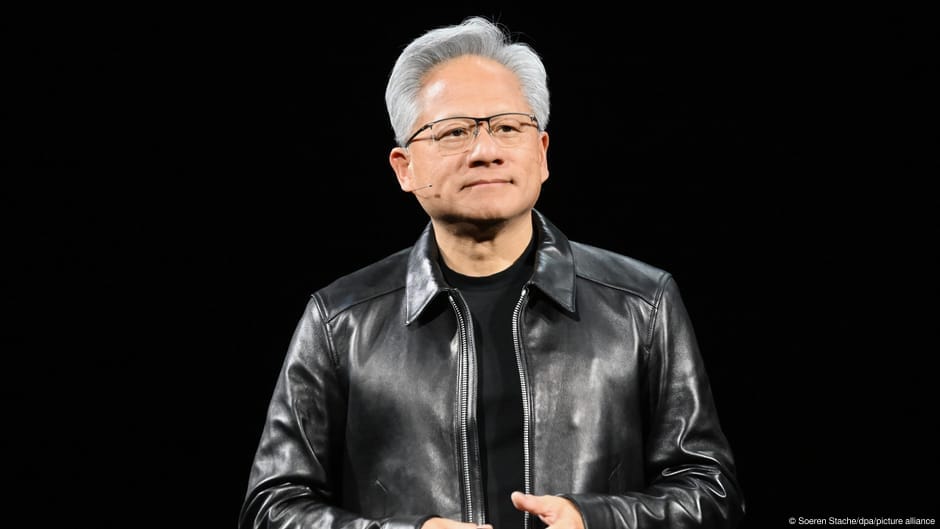
Interim CEO Colette Kress, the company's longtime CFO elevated to the top job days ago, delivered her first public remarks with a message calibrated for institutional investors: "business as usual." She pointedly declined to address the Huang scandal or the succession question, treating the leadership vacuum as a communications problem rather than a strategic one. Chairman Harvey Jones went further during the earnings call, stating the board "unanimously accepted" Huang's resignation and "does not intend to reinstate Jensen as CEO." This directly contradicts the growing lobby for Huang's return, which now includes Elon Musk and President Donald Trump under a "Bring Jensen Back" campaign. Jones is drawing a line: Nvidia's governance will not be crowdsourced from X. Huang, 63, broke his silence hours before the earnings release, posting on X that he had made "serious mistakes in his personal life" and failed to "live up to the standards expected of everyone at" the company. He also said he had received an "outpouring of calls from Nvidia's employees, investors, business partners, and customers" urging his return and signaled willingness to come back if the board agreed. The timing — just before a blowout earnings print — reads as a negotiating move, not a confession. The scandal that forced Huang out involves a string of extramarital affairs, including with a woman suspected of being a Chinese intelligence asset. For a company whose chips are classified as strategic national security assets by the US government, subject to export controls and at the center of the US-China technology war, the counterintelligence dimension is not a tabloid detail. It is the reason the board cannot simply weigh shareholder sentiment and reinstate him. The $115 billion quarter demonstrates that Nvidia's moat — its CUDA software ecosystem, data center GPU dominance, and position as the chokepoint in AI training infrastructure — survives a leadership decapitation in the short term. The harder question is whether Nvidia can execute a permanent CEO succession without losing the culture of technical aggression that Huang built over 30 years. Kress is a finance executive, not an engineer, and the company has no obvious internal successor with Huang's combination of technical depth and strategic vision. The political pressure campaign to reinstate Huang reveals how deeply Nvidia has become entangled with state power. When a sitting president lobbies publicly for a corporate CEO's reinstatement, the company has crossed from strategically important to politically captured. The board's refusal is a governance win today, but Nvidia now operates in a space where its leadership decisions are subject to geopolitical pressure from Washington, Beijing, and Silicon Valley simultaneously.
Worth reading?
OPTIONAL
Score
48
/100
Mixed: Nvidia's chips generate enormous downstream value across the AI ecosystem, but single-supplier dominance, founder dependency, and political entanglement create extraction risk and fragility that the blowout quarter obscures.
What Is GRIN?
GRIN stands for Generativity, Resilience, Innovation efficiency, and Novelty openness. These four dimensions capture the essential characteristics of any memetic intelligence — whether a nation, a corporation, a religion, or a movement.
About GRINGenerativity
4/5
Resilience
2/5
Efficiency
2/5
Novelty
2/5
Extractive
3/5
Inverted
Does this create new capability or just redistribute existing value?
Nvidia's chips underpin the entire AI training stack, generating massive downstream value. But monopoly pricing power and CUDA lock-in mean value creation increasingly flows through a single tollbooth.
Verified Facts (8)
Nvidia doubled its third-quarter revenues to more than $115 billion (about €104.59 billion)
Chairman Harvey Jones confirmed the board has no plans to bring back former CEO Jensen Huang
Huang resigned on Thursday after a string of extramarital affairs came to light, including with a woman who is suspected of being a Chinese intelligence asset
Interim CEO and CFO Colette Kress said it is 'business as usual'
Board had 'unanimously accepted' Huang's resignation and 'does not intend to reinstate Jensen as CEO'
Tech industry figures such as Elon Musk, as well as US President Donald Trump, called for Huang to be reinstated as part of a campaign called 'Bring Jensen Back'
Huang acknowledged he had made 'serious mistakes in his personal life'
Huang, 63, co-founded Nvidia, which he led for more than three decades
More latest news
Read all