TAKEDOWN WINDOW
3 hrs
HOURS · OLD→NEW
36→3
VIEWS BEFORE BLOCK
10M
NOTICES TO CREATORS
0
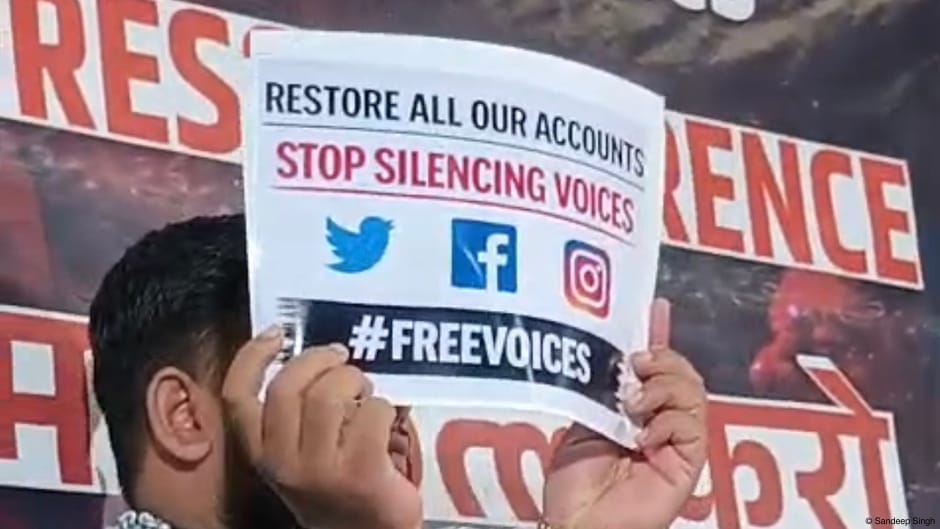
India's amended IT Rules, updated in February 2026, have created what digital rights advocates call the worst period of social media censorship the country has ever seen. The core mechanism is straightforward: Section 79 of the IT Act grants platforms liability protection only if they comply with government takedown orders within three hours — down from 36 hours under the previous framework. Miss the window, lose the shield. Platforms have responded predictably, building automated compliance systems that prioritize speed over accuracy.
Extraction Map
The pattern is consistent across cases. Content creator CitySavitri, with just 600 Instagram followers, had a video about the RSS's role in BJP's 2014 election victory restricted within an hour of posting. Independent journalist Sadhika Tiwari's video of a young girl crying about police brutality during the July 20 Cockroach Janata Party protests in New Delhi — which had garnered around 10 million views — was restricted in India. Political cartoonist Satish Acharya has had his Instagram profile blocked twice. Digital news outlet Maktoob Media's X account was withheld during the India-Pakistan conflict in May 2025 without any official notice from either the government or X. The government's Sahyog portal, which coordinates takedown requests between law enforcement, platforms, and telecom providers, operates as the pipeline's nerve center. Under the amended rules, authorized police officials can notify intermediaries about content they consider unlawful without filing a formal complaint or initiating legal proceedings. Technology law adviser Pranesh Prakash describes the result bluntly: digital news accounts blocked, cartoonists' accounts blocked, discussions of an opposition leader's memoirs blocked — none of which disclosed any 'unlawful acts.' The integrity of the system itself is questionable. The Software Freedom Law Center India (SFLC.in) tested X's verification process by submitting a takedown request against one of its own posts using a fake email address. X registered the request without verifying the identity or authority of the submitter. Only after SFLC.in flagged the vulnerability did X introduce email verification codes — a minimal fix for a channel that, as SFLC.in noted, lets anyone pose as a law enforcement official to silence lawful speech. Meta's response has been to point users to appeal processes while deploying automated tools that restrict content to comply with Indian legal requirements under the IT rules. Several content creators and journalists interviewed by DW said they received no prior notification or explanation for restrictions. Some were unsure whether their content had been blocked at the government's request or proactively by the platforms — a deliberate ambiguity that serves both parties. The Indian government denies censorship. IT Ministry communications chief Vinod Kumar told DW in August that Instagram posts by students and protesters following the July CJP protests 'are not being taken down as alleged,' adding that the government only acts against 'objectionable content.' Under the IT rules, 'unlawful content' encompasses material threatening India's sovereignty, disturbing public order, inciting violence, or constituting defamation — categories broad enough to cover virtually any critical political speech. The deeper structural concern, as journalist Tiwari articulated, is about the erasure of the evidentiary record. The Delhi Police denied allegations of excessive force during the July 20 protest before the Supreme Court. Tiwari's restricted video was evidence to the contrary. 'They want to take this stuff down so it fades from memory,' she said, 'allowing them to categorically deny it later when we have little left to show for what happened.' Human Rights Watch has warned that expanding restrictions could chill free expression and encourage self-censorship. The machinery is now in place for exactly that outcome.
Worth reading?
SKIP
Score
8
/100
Extractive. The amended IT Rules concentrate information control power in the state while distributing compliance costs and speech suppression across journalists, creators, platforms, and the public — with no transparency or accountability mechanism flowing in the reverse direction.
What Is GRIN?
GRIN stands for Generativity, Resilience, Innovation efficiency, and Novelty openness. These four dimensions capture the essential characteristics of any memetic intelligence — whether a nation, a corporation, a religion, or a movement.
About GRINGenerativity
0/5
Resilience
1/5
Efficiency
1/5
Novelty
0/5
Extractive
5/5
Inverted
Does this create new capability or just redistribute existing value?
Destroys generative capacity. Independent journalism, satire, and political commentary are suppressed without due process, eliminating the feedback loops democratic governance requires.
Verified Facts (10)
India's IT Rules, 2021, were amended in February 2026
The amended rules require removal or disabling access to specified unlawful content within three hours of receiving a valid court order or a reasoned government notice; the previous deadline was 36 hours
Content creator CitySavitri had a video about RSS's role restricted within an hour of posting; she had around 600 Instagram followers
Journalist Sadhika Tiwari's video of a young girl crying about police brutality during the July 20 CJP protest garnered around 10 million views before being restricted in India
Political cartoonist Satish Acharya had his Instagram profile blocked twice
Maktoob Media's X account was withheld in India during the India-Pakistan conflict in May 2025
SFLC.in submitted a takedown request against one of its own posts using a fake email address and X registered the request
IT Ministry communications chief Vinod Kumar said the government 'does not censor online content' and only acts against 'objectionable content'
University professor Madri Kakoti's Instagram account was restricted in India on November 16 without notice
Human Rights Watch warned expanding content restrictions could chill free expression
More latest news
Read all