PEACE ACCORD BREACHES
109
ATTACKS · 2 MONTHS
30+
2023 VOTER TURNOUT
27%
REGISTERED VOTERS
103M
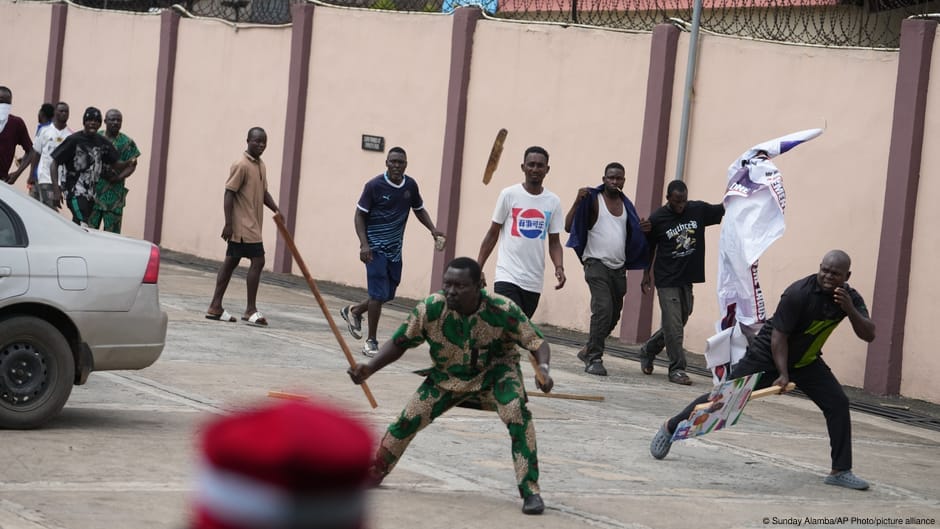
Samuel Adebanjo, a journalist with The Cable newspaper, went to cover a town hall meeting for the opposition National Democratic Congress (NDC) in the Oregun area of Lagos. Armed men arrived in buses and attacked attendees with axes, cutlasses, and wooden planks. Despite wearing a press jacket, Adebanjo was surrounded by five men who broke his middle finger, struck at his wrist with an axe — deflected only by his wristwatch — and seized his camera equipment. He sustained broken bones and internal rib injuries. The attack also destroyed vehicles and injured multiple party supporters.
Extraction Map
The incident is a data point in a surging pattern. The National Peace Committee has recorded 109 breaches of the National Peace Accord across 26 states and Abuja since the campaign officially launched on August 19, 2027. Between that date and October 27, political violence and thuggery accounted for 33 incidents, while misinformation and disinformation accounted for 29. On November 15, armed men attacked the campaign convoy of NDC vice-presidential candidate Rabiu Kwankwanso in the Bichi area of Kano. Similar attacks hit former Vice President Atiku Abubakar's campaign stops in Sokoto and Kebbi. Raheem Mutiu, a Nigerian researcher at the Armed Conflict Location & Event Data Project (ACLED), told DW that over 30 politically linked attacks with 10 fatalities have been recorded in just two months. The attacks are becoming more frequent and geographically widespread compared to prior cycles. Mutiu described supporters across the political spectrum as involved, but noted that the intensity depends on local stronghold dynamics and territorial dominance. Perpetrators typically act anonymously as proxies for the interests they serve. The structural driver is Nigeria's winner-takes-all multiparty system, where control of government translates directly into control of economic resources. This makes electoral defeat existential for political networks, incentivizing violence as a rational strategy for actors who face total exclusion from patronage if they lose. The pattern is not new — the 2011 post-election violence killed at least 800 people across northern Nigeria in days of rioting — but each cycle appears to ratchet the baseline higher. The downstream cost lands squarely on democratic participation. More than 103 million Nigerians are registered to vote in the January 16, 2027 general elections. But the 2023 elections recorded the lowest turnout since the return to democratic rule in 1999, with only 27% of nearly 94 million registered voters casting ballots. Dengiyefa Angalapu of the Abuja-based Center for Democracy and Development warned that growing violence adds direct suppressive pressure on top of already chronic disengagement: voters who fear punishment for their political preferences withdraw from politics altogether. President Bola Tinubu, running for re-election on a platform of combating insecurity, has condemned the violence and warned that intimidation would not be tolerated. Amnesty International and other civil society organizations have called on security agencies to hold perpetrators accountable. But condemnation without enforcement is the historical norm. The gap between stated intolerance and actual impunity is precisely where political thuggery thrives. Adebanjo's question from his hospital bed is the structural diagnosis: "If this could happen to me, a journalist, how much more the citizens? I am not sure, at this stage, people will even come out to vote." Each cycle of violence suppresses turnout, which concentrates electoral outcomes among mobilized factions willing to use or tolerate force — a feedback loop that makes the next election more violent, not less.
Worth reading?
SKIP
Score
4
/100
Extractive. Political violence functions as a value-extraction tool — armed proxies suppress opposition participation to concentrate state resources among incumbent networks, destroying democratic generativity in every cycle.
What Is GRIN?
GRIN stands for Generativity, Resilience, Innovation efficiency, and Novelty openness. These four dimensions capture the essential characteristics of any memetic intelligence — whether a nation, a corporation, a religion, or a movement.
About GRINGenerativity
0/5
Resilience
1/5
Efficiency
0/5
Novelty
0/5
Extractive
5/5
Inverted
Does this create new capability or just redistribute existing value?
Actively destroys generativity. Each attack suppresses civic participation, journalism, and opposition organizing — shrinking the political marketplace to factions that can deploy force.
Verified Facts (9)
Samuel Adebanjo, journalist with The Cable, was attacked at an NDC town hall meeting in Oregun, Lagos, sustaining a broken middle finger and internal rib injuries
109 breaches of the National Peace Accord recorded across 26 states and Abuja per the National Peace Committee
Between August 19 and October 27, political violence/thuggery accounted for 33 incidents, misinformation/disinformation for 29
November 15: armed men attacked campaign convoy of NDC VP candidate Rabiu Kwankwanso in Bichi, Kano
ACLED researcher Raheem Mutiu: over 30 politically linked attacks with 10 fatalities recorded in two months
2011 post-election violence killed at least 800 people across northern Nigeria
103 million Nigerians registered to vote in January 16, 2027 general elections
2023 elections: 27% turnout of nearly 94 million registered voters — lowest since 1999 return to democracy
Dengiyefa Angalapu, researcher at Center for Democracy and Development, Abuja, warned violence could further suppress turnout
More latest news
Read all