IRAN CRUDE → CHINA
80%+
OIL REV SCENARIO
0
POWERS OVER TEHRAN
3
ZERO-OIL BUDGET
2027-28
Iran's economic survival now depends on two powers that view it instrumentally. China absorbs more than 80% of Iran's seaborne crude exports, mostly through independent refiners buying at steep sanctions-driven discounts. Russia offers Caspian Sea access, northern trade routes, and military cooperation. Together they form a lifeline — but neither has committed to keeping it open if Washington raises the price of doing so.
Extraction Map
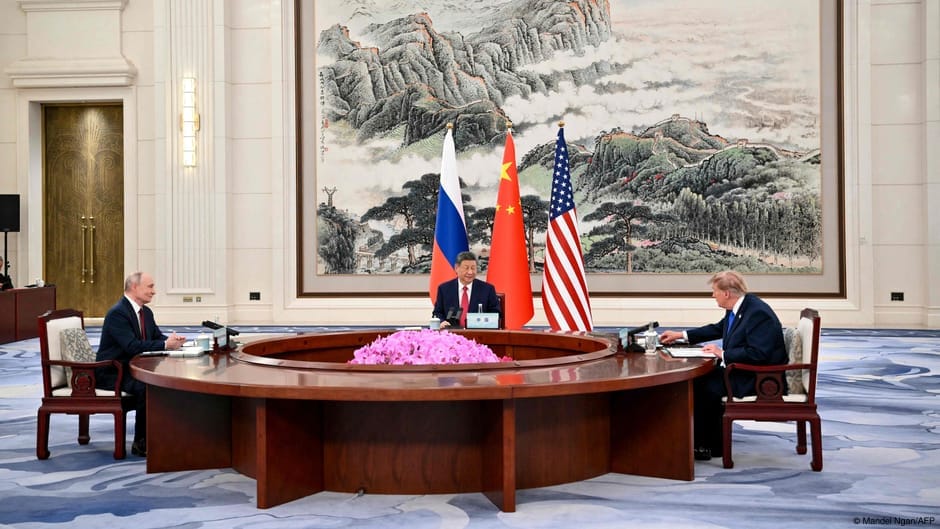
The structural asymmetry is stark. Iran needs China and Russia far more than either needs Iran. Beijing wants cheap oil and regional stability; a prolonged conflict around the Strait of Hormuz threatens both. Chinese Foreign Minister Wang Yi has explicitly called for safe passage through Hormuz and negotiations — diplomatic code for 'don't drag us into your fight.' Moscow, meanwhile, is consumed by Ukraine and would trade Iranian leverage for concessions from Washington without hesitation. Washington's Task Force Iron Gate, announced in November, targets sanctioned goods, military equipment, and revenue flows through Iran's land borders and the Caspian Sea. The initiative adds friction to every remaining trade corridor. But as analyst Mohsen Solhdoost argues, disrupting trade is far easier than dictating another government's political choices. The US can shrink Iran's economy without China's full cooperation; it cannot force Tehran to accept specific nuclear or regional policies through economic pressure alone. The clearest signal of Tehran's anxiety: a senior official at Iran's Plan and Budget Organization confirmed the government is preparing its 2027-2028 budget under multiple scenarios, including one where oil revenue falls to zero. That's not a forecast — it's a stress test. The fact that it's being discussed publicly reveals how seriously Iranian planners view the blockade risk. China's leverage operates on a different plane. Even if maritime crude shipments collapse, Chinese machinery, electronics, spare parts, and industrial components can still reach Iran by rail and road. This overland trade cannot replace seaborne commerce at comparable scale or cost, but it can keep selected factories and critical infrastructure running. Iran's economy doesn't die — it shrinks and becomes more dependent on Beijing's choices. Russia's role is real but bounded. The 'strategic partnership' provides for security cooperation and counter-sanctions coordination, but Solhdoost is blunt: it does not require Russia to enter a war on Iran's behalf. Moscow could simultaneously support Tehran and use the relationship as a chip in Ukraine negotiations with Trump. The Shenzhen summit among Trump, Xi, and Putin is best understood as three powers calculating how much of Iran's interests they're willing to trade for their own. The 20-year trajectory is dependency deepening into clientelism. Iran becomes a junior partner whose economic survival is determined by decisions made in Beijing and Moscow, while Washington retains the ability to tighten the vice at will. No party in this arrangement is building Iranian self-sufficiency — each is extracting what they can from Tehran's isolation.
Worth reading?
SKIP
Score
20
/100
Extractive — Iran's isolation concentrates leverage in the hands of three external powers, none of whom bear the costs of economic deterioration that Iranian citizens absorb.
What Is GRIN?
GRIN stands for Generativity, Resilience, Innovation efficiency, and Novelty openness. These four dimensions capture the essential characteristics of any memetic intelligence — whether a nation, a corporation, a religion, or a movement.
About GRINGenerativity
1/5
Resilience
1/5
Efficiency
1/5
Novelty
1/5
Extractive
4/5
Inverted
Does this create new capability or just redistribute existing value?
Zero new capability created. Iran's trade corridors are degraded versions of existing ones, and every 'lifeline' deepens dependency rather than building productive capacity.
Verified Facts (6)
Chinese buyers took more than 80% of Iran's seaborne crude exports in 2025
Washington announced Task Force Iron Gate in November, aimed at disrupting sanctioned goods through Iran's land borders and Caspian Sea
A senior official at Iran's Plan and Budget Organization said the government was preparing its 2027-2028 budget under scenarios including one in which oil revenue falls to zero
Chinese Foreign Minister Wang Yi called for negotiations, safe passage through the Strait of Hormuz and stable energy supplies
Mohsen Solhdoost is an assistant professor of international relations at Xi'an Jiaotong-Liverpool University
Ahmad Vakhshiteh is director of the Moscow-based Center for Strategic Research on Developing Relations with the Middle East
More latest news
Read all