MILITIA CONTROL
12 yrs
DISPLACED RESIDENTS
89K
OIL SMUGGLED (SINCE 2021)
$100M+
DISARMAMENT DEADLINE
Jun 2026
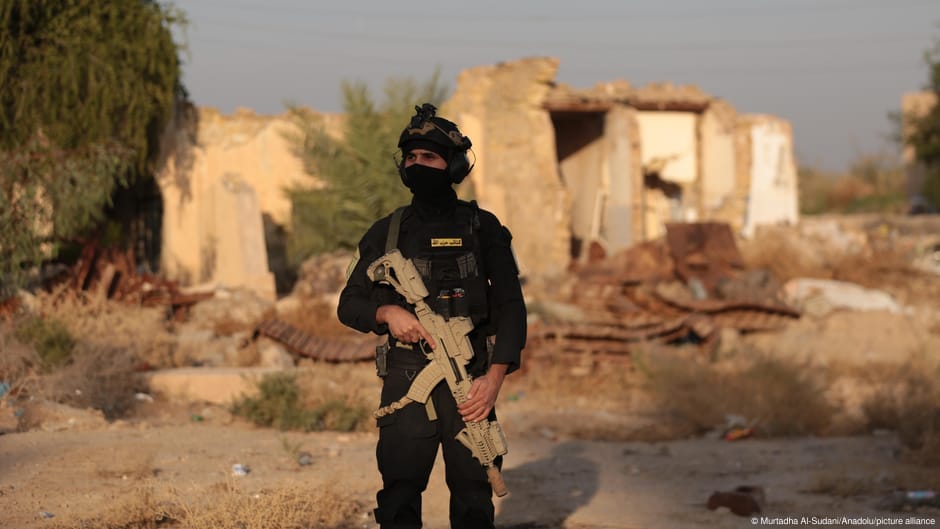
For twelve years, a 50-kilometer stretch south of Baghdad called Jurf al-Sakhar has functioned as a state within a state. Kataib Hezbollah — an Iranian-allied militia that entered the area fighting IS in 2014 — has barred Iraqi government forces, displaced tens of thousands of mostly Sunni residents, and even renamed the town. No journalists, no oversight, no accountability. The area's rumor profile reads like a war economy checklist: secret prisons, mass graves, drone manufacturing, oil smuggling.
Extraction Map
The oil smuggling is no longer just rumor. A November 2025 government report alleges Kataib Hezbollah has siphoned hundreds of millions of dollars' worth of state-owned crude from pipelines running through the area since 2021. Prime Minister Ali al-Zaidi, who took office with backing from the very parliamentary bloc that includes Kataib Hezbollah's political wing, issued a Friday, November 20 deadline for the militia to withdraw. Kataib Hezbollah's response was unambiguous: "not even over our dead bodies." Al-Zaidi then ordered state security forces to surround the area; Kataib Hezbollah brought in reinforcements. By late Thursday, Reuters reported a compromise had been reached allowing government forces to enter. But the details matter enormously. If one PMF faction simply replaces another while retaining autonomous networks, the standoff is theater — armed influence reshuffled, not resolved. The confrontation sits at the intersection of two external pressures. The Trump administration has warned Iraq it could be designated a state sponsor of terrorism if it fails to disarm Iranian-backed militias by next June. Meanwhile, Iran's allies inside Iraq hold real military capability and deep institutional penetration — Kataib Hezbollah doesn't need to defeat the Iraqi army conventionally; it can impose costs through asymmetric attacks, political pressure, and networks embedded inside the state itself. The structural problem is older than this standoff. Iraq's Popular Mobilization Forces — the umbrella grouping of militias that fought IS — were never fully integrated into state command structures. Some remained loyal to Baghdad; others, like Kataib Hezbollah, remained loyal to Tehran. The PMF's political wings sit in parliament. Their fighters control territory. Their commanders run economic operations. The line between state and militia was never drawn clearly, and that ambiguity has been profitable for everyone except displaced civilians and the Iraqi treasury. What makes this confrontation consequential is not whether al-Zaidi wins the immediate standoff — a compromise was always the likely outcome — but whether it establishes a precedent. Every other militia in Iraq is watching. If Kataib Hezbollah's territorial monopoly is genuinely broken, with oil infrastructure placed under state control and displaced residents allowed to return, it signals that the state can claw back sovereignty. If the compromise merely swaps one armed faction for another under the same opaque arrangements, it signals that the state cannot. Al-Zaidi's June 2026 deadline to bring all weapons under state control looms over everything. The Jurf al-Sakhar standoff is the test case. Its outcome will determine whether that deadline is a real policy objective or a talking point designed to satisfy Washington while changing nothing on the ground.
Worth reading?
SKIP
Score
16
/100
Extractive. Kataib Hezbollah has captured territory, displaced civilians, and siphoned state oil revenues for years. The compromise risks redistributing armed influence rather than restoring generative state capacity.
What Is GRIN?
GRIN stands for Generativity, Resilience, Innovation efficiency, and Novelty openness. These four dimensions capture the essential characteristics of any memetic intelligence — whether a nation, a corporation, a religion, or a movement.
About GRINGenerativity
1/5
Resilience
1/5
Efficiency
1/5
Novelty
1/5
Extractive
5/5
Inverted
Does this create new capability or just redistribute existing value?
Near-zero generativity. Twelve years of militia control produced weapons caches and oil theft, not economic development. 89,000 displaced residents remain locked out of their homes and livelihoods.
Verified Facts (10)
Jurf al-Sakhar is around 50 kilometers south of Baghdad
Kataib Hezbollah has controlled the area for around 12 years
The area previously had an estimated 89,000 residents
An early November report says the group has smuggled hundreds of millions of dollars' worth of state-owned oil since 2021
Iraq's PM Ali al-Zaidi demanded Kataib Hezbollah leave by Friday, Nov. 20
Kataib Hezbollah spokesperson said the group would not withdraw 'not even over our dead bodies'
Al-Zaidi has set a deadline of next June to bring all weapons under the state's control
Reuters reported that according to three anonymous officials, all parties had come to an agreement allowing government forces to enter on Friday
Kataib Hezbollah was first founded around 2007
The area's name was changed from Jurf al-Sakhar ('rocky bank') to Jurf al-Nasr ('bank of victory')
More latest news
Read all