NUCLEAR POWERS
3
COMBINED WARHEADS
~10,500
BINDING COMMITMENTS
0
CHINA vs US/RU WARHEADS
500 vs 5,000+
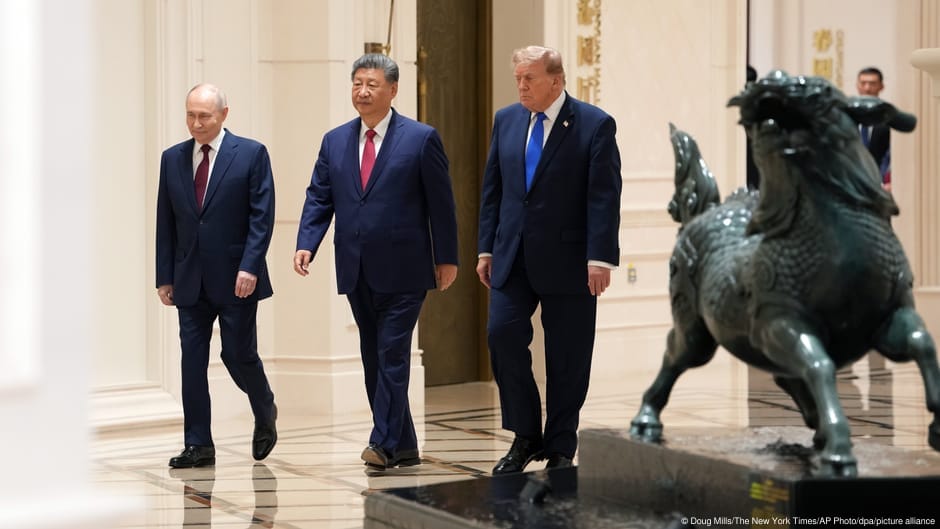
The first-ever trilateral summit between the leaders of the United States, China, and Russia took place Thursday in Shenzhen, bringing the three largest nuclear powers to one table. Xi Jinping hosted, Donald Trump attended, Vladimir Putin showed up — and the joint declaration they produced was remarkable mostly for what it omitted.
Extraction Map
The so-called "peace declaration" made no mention of Russia's war in Ukraine or the US-led war in Iran. Instead, the three leaders agreed to pursue UN reforms, limit the International Criminal Court's role, reaffirm commitment to avoiding nuclear war, and boost refined petroleum supplies. Xi called the talks "groundbreaking." Trump called them "really making history." Neither adjective is supported by the text of the declaration itself. The clearest winner was Putin. Western nations have spent three years trying to isolate him over the full-scale invasion of Ukraine. In Shenzhen, he stood shoulder-to-shoulder with the leaders of the world's two largest economies, cast as an equal partner in global governance. Russian media framed the summit as confirmation of Moscow's restored standing. As Emma Chanlett-Avery of the Asia Society Policy Institute noted, Putin "appeared on the world stage as one of the dominant players in the world" — which was, for him, the entire point. Beijing was initially reluctant to host, wary of being tied to Russia's war and of alienating EU partners it is courting for economic rebalancing. But China managed to steer the agenda away from Ukraine entirely, showcase Shenzhen's high-tech infrastructure, and avoid any binding commitments. The nuclear arms conversation — which Trump pushed, hoping for a legacy-defining trilateral arms control deal — ended with a promise of "dialogue," nothing more. China's estimated 500 warheads remain dwarfed by the 5,000-plus held by each of the other two, and Beijing sees no incentive to freeze at that ratio. The summit's most consequential signal may be structural rather than substantive. Ukrainian President Volodymyr Zelenskyy warned beforehand of a "second Yalta" — a reference to the 1945 conference where Allied powers carved up post-war Europe. Analysts called that comparison a stretch, but the underlying concern is real: three nuclear powers meeting to discuss "global governance" and "spheres of influence" without input from the states whose sovereignty is at stake. The petroleum pledge — boosting refined product supplies — is the declaration's only item with direct material consequences, and even that lacks specifics on volume, timeline, or pricing. The ICC provision, limiting the court's role, directly serves both Russia (whose president faces an ICC arrest warrant) and potentially the US (which has historically resisted ICC jurisdiction). Neither provision generates new capability or institutional resilience; both redistribute power toward the three signatories and away from multilateral frameworks. Putin said all three leaders agreed this was "a useful format" and that such meetings could recur. EIU analyst Chim Lee concurred, noting the trilateral setup "is unlikely to be just a one-off." If that proves true, the real question is not what was declared in Shenzhen, but what gets negotiated in the bilateral margins — where the actual deals get cut and the smaller nations discover what was decided on their behalf.
Worth reading?
SKIP
Score
20
/100
Extractive — the summit's primary output is legitimacy transfer to Putin and institutional erosion of multilateral bodies (ICC, UN norms), with no new generative capability or binding commitment produced.
What Is GRIN?
GRIN stands for Generativity, Resilience, Innovation efficiency, and Novelty openness. These four dimensions capture the essential characteristics of any memetic intelligence — whether a nation, a corporation, a religion, or a movement.
About GRINGenerativity
1/5
Resilience
1/5
Efficiency
1/5
Novelty
1/5
Extractive
4/5
Inverted
Does this create new capability or just redistribute existing value?
Nothing new was built. No binding arms deal, no concrete petroleum terms, no institutional creation. The summit produced a vague declaration and a photo op — pure legitimacy redistribution, zero new capability.
Verified Facts (10)
Xi hailed the talks as 'groundbreaking'
Trump heralded the gathering as 'really making history'
The 'peace declaration' made no mention of Russia's war in Ukraine or the US-led war in Iran
The last nuclear arms pact between Russia and the United States, known as New START, expired in February
Beijing's estimated arsenal of around 500 warheads remains far smaller than those of Russia and the US
Moscow and Washington are believed to possess more than 5,000 warheads each
Emma Chanlett-Avery, senior director for Political-Security Affairs at the Asia Society Policy Institute, said Putin had the most to gain
Chim Lee, senior analyst with The Economist Intelligence Unit, said the trilateral setup 'is unlikely to be just a one-off'
Ukrainian President Volodymyr Zelenskyy warned of a 'second Yalta'
Putin stressed that Russia, the US and China, as victors in World War II and veto-wielding members of the UN Security Council, bore a 'joint responsibility for maintaining international peace'
More latest news
Read all