PRIOR TRADE CURBS
$13B
AUS IRON ORE RANK
#1
XI-ALBANESE MEETING
4th
CENTRAL BUYER BODY
1
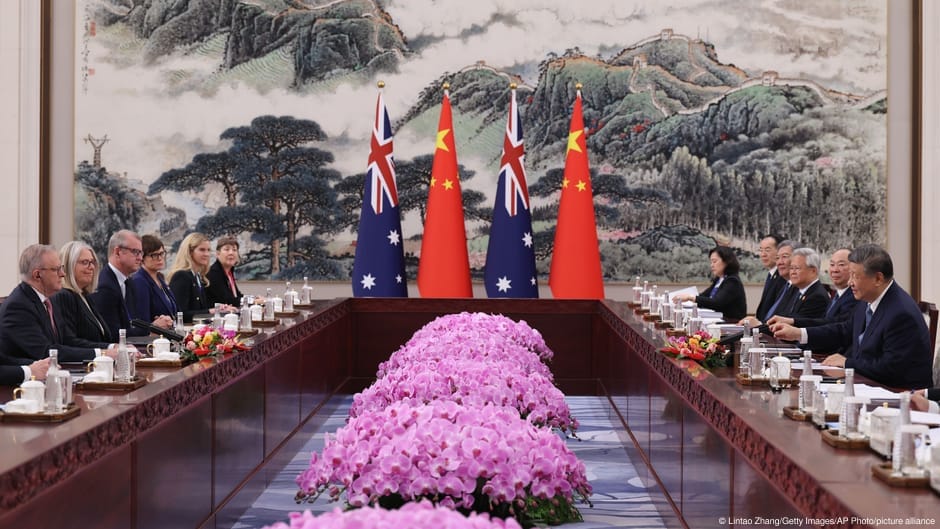
Chinese President Xi Jinping and Australian Prime Minister Anthony Albanese met on the sidelines of the APEC summit in Shenzhen on Friday, with Xi declaring a "comprehensive turnaround" in bilateral relations — their fourth meeting since Albanese took office in 2022. The diplomatic choreography was careful and deliberate: both leaders spoke the language of constructive engagement while leaving the structural tensions largely unnamed.
Extraction Map
The backdrop matters more than the stage dressing. China imposed $13 billion in import curbs on Australian timber, coal, barley, lobsters, and wine after the previous Australian government called for an independent inquiry into the origins of COVID-19. Since Labor came to power, Beijing has lifted most of those blocks — a thaw that is real but reversible. The trade relationship remains asymmetric: China is Australia's top trading partner, and that dependency shapes every interaction. The most consequential tension surfaced just days before the meeting. On Monday, Australia publicly called out China's "manipulation" of iron ore trade after Beijing formed a central buying body to purchase ore on behalf of its steelmakers. Australia is the world's biggest iron ore producer. A single buyer facing multiple sellers is a textbook monopsony — it concentrates bargaining power on the demand side and compresses margins for producers. This is not a tariff or a sanction; it is a structural market intervention designed to shift pricing power permanently. Xi called for deeper cooperation in agriculture, energy, the green economy, and artificial intelligence — sectors where China wants access to Australian resources and technology. Albanese responded with the formula that has defined his China approach: engage constructively, manage differences, refuse to be defined by them. It is a posture designed to keep trade flowing while avoiding the provocations that triggered Beijing's earlier retaliation. Albanese was expected to travel to Beijing later Friday to meet Premier Li Qiang, with a business roundtable featuring executives from Rio Tinto, BHP, and Chinese companies. The guest list tells the story: this is fundamentally about who captures the margin on the commodity flows that underpin both economies. The miners want price competition; Beijing wants monopsony leverage. Friction points remain visible beyond iron ore. China conducted a missile test in the South Pacific; Australia tightened foreign investment screening in critical minerals. These are not random irritants — they reflect a structural competition over influence in the Pacific and control of strategic supply chains. The diplomatic warmth is real but thin; the underlying contest is over who sets the terms of exchange in a deeply interdependent relationship. The twenty-year question is whether Australia diversifies its trade exposure or accepts structural dependency on a single buyer who is actively organizing to pay less. The diplomatic thaw buys time but does not resolve the fundamental power asymmetry.
Worth reading?
SKIP
Score
28
/100
Extractive. China's centralized buying body is a monopsony play designed to shift pricing power permanently away from Australian producers, while the diplomatic framing masks a deepening structural dependency.
What Is GRIN?
GRIN stands for Generativity, Resilience, Innovation efficiency, and Novelty openness. These four dimensions capture the essential characteristics of any memetic intelligence — whether a nation, a corporation, a religion, or a movement.
About GRINGenerativity
1/5
Resilience
2/5
Efficiency
2/5
Novelty
1/5
Extractive
4/5
Inverted
Does this create new capability or just redistribute existing value?
No new capability created. This is a redistribution fight over existing iron ore margins disguised as diplomatic normalization. The cooperation areas Xi named remain aspirational, not operational.
Verified Facts (8)
Xi pointed out that they had met four times since Albanese became Prime Minister in 2022
China imposed import curbs worth $13 billion (€12.2 billion) on Australian timber, coal, barley, lobsters and wine
Australia is the world's biggest producer of iron ore
Beijing formed a central buying body to purchase ore on behalf of its steelmakers
Albanese and Li will attend a business roundtable comprising senior executives from Rio Tinto and BHP and Chinese company executives
China conducted a missile test in the South Pacific
Australia tightened foreign investment screening in the critical minerals sector
Xi called for enhancing cooperation in agriculture, energy, the green economy and artificial intelligence
More latest news
Read all