ANNUAL BOOST
£3.8B
EXPORTS SHIELDED
£6.5B
YOUTH VISAS / SIDE
100K
BREGRET · PEAK
60%
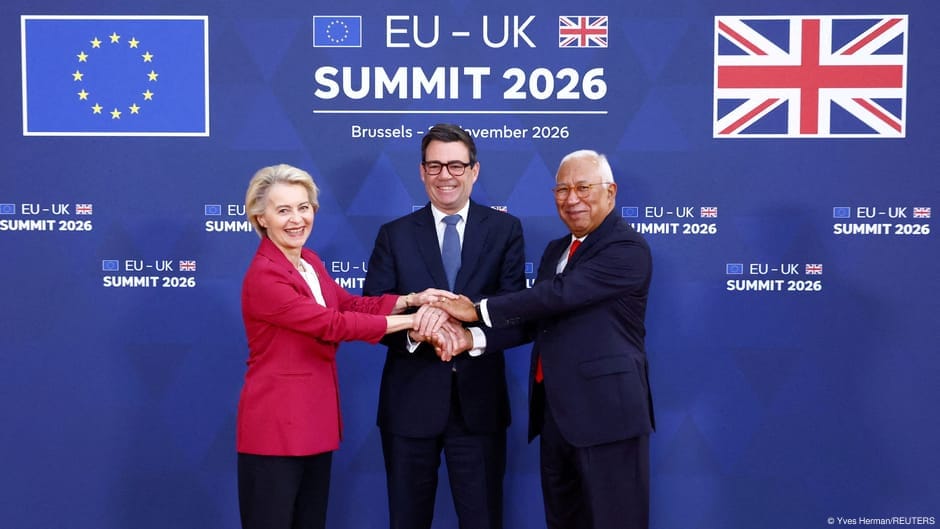
Nine years after the referendum that severed Britain from its largest trading partner, Prime Minister Andy Burnham flew to Brussels and signed what amounts to a partial reconnection agreement. Three deals — on food trade, emissions trading, and youth mobility — represent the most significant UK-EU rapprochement since 2016. Burnham himself called it "the limit of what we can achieve in this Parliament," a revealing admission that the political ceiling for EU re-engagement remains low even as public regret climbs to record highs.
Extraction Map
The food deal is the most structurally significant. Britain agrees to align more closely with EU food safety and animal health rules in exchange for the elimination of certificates and border checks on food and animal products. This is the core bargain of the entire package: regulatory alignment traded for friction reduction. It reverses one of the most visible and costly Brexit outcomes — the red tape that crushed small food exporters and raised consumer prices — but it does so by accepting rule-taking from Brussels on food standards, precisely the kind of sovereignty concession that Leave campaigners promised would never happen. The emissions-trading linkage is a quieter but potentially larger economic play. By connecting the UK and EU carbon markets, both sides recognize each other's carbon allowances and exempt traded goods from carbon border taxes. London estimates this spares £6.5 billion worth of steel, aluminum, and industrial exports from additional taxation. This is not trivial — the EU's Carbon Border Adjustment Mechanism was set to become a de facto tariff wall against non-aligned trading partners, and Britain just bought its way inside. The youth experience scheme — 100,000 people under 30 from each side, up to three years for work, study, or travel — is the deal's emotional centerpiece. Burnham leaned into the generational framing: "Brexit took opportunities from young people." The scheme is not freedom of movement; it is a managed visa program with caps and age limits. But it creates a pathway that did not exist yesterday, and Britain's agreement to rejoin Erasmus+ adds institutional depth. The unresolved tuition fee dispute — the EU wants parity for its students at UK universities — remains a genuine obstacle, with Von der Leyen expressing confidence that a solution will come "in the next month." The political context is as important as the policy content. YouGov's regular tracker shows "Bregret" at 60% — the highest ever recorded — and a sustained majority since mid-2022 saying Brexit was wrong. Burnham is operating in a window where re-engagement is popular but re-accession remains politically radioactive. The structured dialogue on migration, with its careful language about "engagement with third countries" and "returns," signals that the UK is trading cooperation on the EU's priority (migration management) for access on its own (trade friction reduction). The £3.8 billion annual boost London claims is modest against the scale of Brexit's economic damage, which the OBR and multiple academic studies have estimated at 4% of GDP over the long term. This deal does not close that gap. It trims the most visible friction costs while leaving the fundamental trade barriers — customs union exclusion, services market access, financial passporting — untouched. What it does is establish a political and institutional framework for further deals, with formal talks on economic security and export controls now launched. Burnham's hint that he could campaign for EU re-accession at the next election is the most forward-looking signal. The current deal is a floor, not a ceiling. Its real significance is directional: Britain is moving back toward alignment, and the political cost of doing so is lower than at any point since 2016.
Worth reading?
RECOMMENDED
Score
68
/100
Modestly generative. The deal recovers destroyed value rather than creating genuinely new capability, but the emissions linkage and youth scheme open pathways that didn't exist before. Net direction is positive, scale is limited.
What Is GRIN?
GRIN stands for Generativity, Resilience, Innovation efficiency, and Novelty openness. These four dimensions capture the essential characteristics of any memetic intelligence — whether a nation, a corporation, a religion, or a movement.
About GRINGenerativity
3/5
Resilience
3/5
Efficiency
4/5
Novelty
3/5
Extractive
1/5
Inverted
Does this create new capability or just redistribute existing value?
Recovers lost ground more than it creates new capability. The £3.8B annual boost and carbon market linkage are real but partial — the fundamental Brexit trade barriers remain untouched.
Verified Facts (8)
London estimates the deal could boost the British economy by 3.8 billion pounds annually
6.5 billion pounds worth of steel, aluminum and other industrial exports spared from additional taxation
Youth experience scheme would allow 100,000 people under 30 from each side to reside for up to three years
In September, the 'Bregret' camp rose to 60% — the highest ever
Since mid-2022, a majority of people surveyed said Britain was wrong to leave
Britain will rejoin the Erasmus+ program
No deal was reached on tuition fees for EU students studying in Britain
Burnham said the agreements represent the most the UK could achieve at the moment
More latest news
Read all